De Dragino LPS8 is een open source meerkanaals LoRaWAN gateway. Hiermee kan een LoRa-radionetwerk worden verbonden met een IP-netwerk via WiFi of Ethernet. Met het LoRa-radionetwerk kunnen gegevens over extreem grote afstanden met lage datasnelheden worden verzonden.De LPS8 maakt gebruik van Semtech Packet Forwarder en is volledig compatibel met het LoRaWAN protocol. Het omvat een SX1308 LoRa-concentrator die 10 programmeerbare parallelle demodulatiepaden biedt.LPS8 heeft voorgeconfigureerde standaard LoRaWAN-frequentiebanden voor gebruik in verschillende landen. De gebruiker kan de frequentiebanden ook aanpassen voor gebruik in zijn eigen LoRa-netwerk.Features
Linux-gebaseerd OpenWrt systeem
Beheer via intuïtieve Web GUI, SSH via LAN of WiFi
Toegang op afstand met Reverse-SSH
Emuleert 49x LoRa-demodulatoren
LoRaWAN Gateway
10 programmeerbare parallelle demodulatiepaden
Applicaties
Logistiek en toeleveringsketenbeheer
Slimme gebouwen en huisautomatisering
Slimme steden
Slimme landbouw
Slimme fabriek
Slimme meters
Specificaties
Stroomvoorziening via USB-C (5 V, 2 A)
1x USB-hostpoort
1x RJ45 (10/100 Mbit/s)
1x 2,4 GHz WiFi (802.11 b/g/n)
LoRa Specs:
1x SX1308 Lora-concentrator
2x 1257 LoRa-transceiver
Downloads
Datasheet
User Manual
Source Code on GitHub
Dragino LoRa Gateway Selection Guide
Dragino LPS8 als Helium Data-Only Hotspot
Dragino LoRaWAN Gateway Setup
Dragino Gateways/Hotspots with Helium
Tutorial
Firmware
Ready-to-use devices and self-built Arduino nodes in the 'The Things Network'
LoRaWAN has developed excellently as a communication solution in the IoT. The Things Network (TTN) has contributed to this. The Things Network was upgraded to The Things Stack Community Edition (TTS (CE)). The TTN V2 clusters were closed towards the end of 2021.
This book shows you the necessary steps to operate LoRaWAN nodes using TTS (CE) and maybe extend the network of gateways with an own gateway. Meanwhile, there are even LoRaWAN gateways suitable for mobile use with which you can connect to the TTN server via your cell phone.
The author presents several commercial LoRaWAN nodes and new, low-cost and battery-powered hardware for building autonomous LoRaWAN nodes. Registering LoRaWAN nodes and gateways in the TTS (CE), providing the collected data via MQTT and visualization via Node-RED, Cayenne, Thingspeak, and Datacake enable complex IoT projects and completely new applications at very low cost.
This book will enable you to provide and visualize data collected with battery-powered sensors (LoRaWAN nodes) wirelessly on the Internet. You will learn the basics for smart city and IoT applications that enable, for example, the measurement of air quality, water levels, snow depths, the determination of free parking spaces (smart parking), and the intelligent control of street lighting (smart lighting), among others.
Functionality, structure and handling of a power module
For readers with first steps in power management the “Abc of Power Modules” contains the basic principles necessary for the selection and use of a power module. The book describes the technical relationships and parameters related to power modules and the basis for calculation and measurement techniques.
Contents
Basics
This chapter describes the need of a DC/DC voltage converter and its basic functionality. Furthermore, various possibilities for realizing a voltage regulator are presented and the essential advantages of a power module are mentioned.
Circuit topologies
Circuit concepts, buck and boost topologies very frequently used with power modules are explained in detail and further circuit topologies are introduced.
Technology, construction and regulation technology
The mechanical construction of a power module is presented, which has a significant influence on EMC and thermal performance. Furthermore, control methods are explained and circuit design tips are provided in this chapter.
Measuring methods
Meaningful measurement results are absolutely necessary to assess a power module. The relevant measurement points and measurement methods are described in this chapter.
Handling
The aspects of storage and handling of power modules are explained, as well as their manufacturing and soldering processes.
Selection of a power modules
Important parameters and criteria for the optimal selection of a power module are presented in this section.
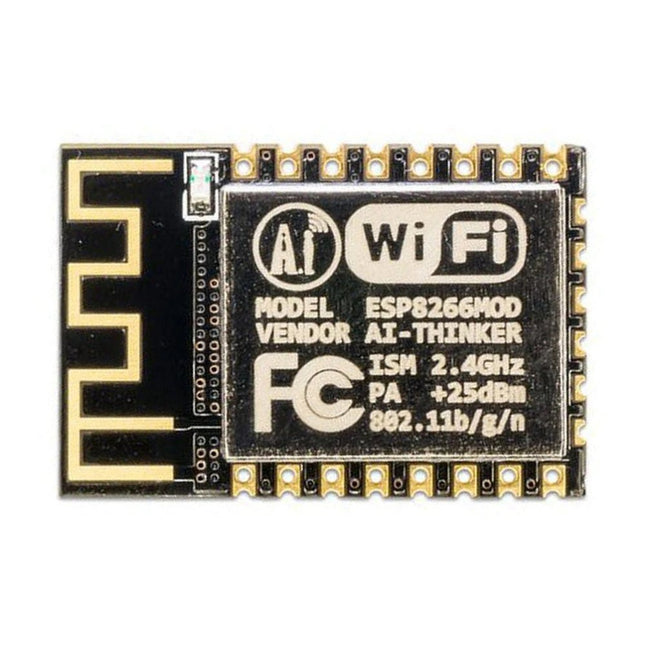
Deze Wi-Fi module is gebaseerd op de populaire ESP8266 chip. De module is FCC en CE gecertificeerd en voldoet aan RoHS. Volledig compatibel met de ESP-12E. 13 GPIO-pinnen, 1 analoge ingang, 4 MB flash-geheugen.
Deze Crowtail serie 4G module is een krachtige LTE Cat1 draadloze module. Hij maakt gebruik van de SIM A7670E communicatiemodule van Simcom, en communiceert via een UART-interface die 4G datatransmissie en spraakcommunicatie mogelijk maakt. De unit ondersteunt meerdere LTE-banden, waaronder B1 / B3 / B5 / B7 / B8 / B20, evenals WCDMA- en GSM-netwerken. Daarnaast ondersteunt hij verschillende protocollen zoals TCP/IP, FTP, HTTP en meerdere satelliet navigatiesystemen zoals GPS, GLONASS en BDS.
De module wordt geleverd met een interface voor het opladen, en kan worden gevoed met een 3,7 V lithium accu of via een 5 V USB-C interface. Hij heeft ook een 3,5 mm koptelefoonaansluiting zodat hij, door een hoofdtelefoon met een microfoon aan te sluiten, kan worden gebruikt voor het maken en ontvangen van telefoongesprekken. Het compacte formaat maakt het eenvoudig om hem te integreren in verschillende IoT-apparaten, en te voldoen aan de eisen van diverse toepassingen. Ook het lage stroomverbruik en de betrouwbare werking behoren tot de redenen waarom hij veel wordt gebruikt bij IoT, smart home, automotive en industriële besturing.
Kenmerken
Bevat de A7670E communicatiemodule, waardoor 4G-gegevensoverdracht en spraakcommunicatie mogelijk zijn met laag stroomverbruik en hoge betrouwbaarheid
Ondersteunt meerdere LTE-banden, waaronder B1 / B3 / B5 / B7 / B8 / B20, evenals WCDMA- en GSM-netwerken
Ondersteunt verschillende protocollen zoals TCP/IP, FTP, HTTP en meerdere satelliet navigatiesystemen zoals GPS, GLONASS en BDS
Wordt geleverd met een interface voor het opladen, en een hoofdtelefoonaansluiting die kan worden gebruikt voor het maken en ontvangen van telefoongesprekken door een hoofdtelefoon met microfoon aan te sluiten
Klein maar krachtig, zíjn compacte formaat maakt het gemakkelijk hem te integreren in verschillende IoT-apparaten.
Specificaties
Hoofd processor: SIM A7670E
LTE-FDD: B1 / B3 / B5 / B7 / B8 / B20
GSM: 900/1800 MHz
GSM/GPRS vermogensklasse
EGSM900: 4 (33 dBm ±2 dB)
DCS1800: 1 (30 dBm ±2 dB)
EDGE vermogensklasse:
EGSM900: E2 (27 dBm ±3 dB)
DCS1800 : E1 (26 dBm +3 dB / -4 dB)
LTE vermogensklasse: 3 (23 dBm ±7 dB)
Voedingsspanning: 4 V ~ 4,2 V
Werkspanning: 3,8 V
LTE (Mbps): 10 (DL) / 5 (UL)
GPRS/EDGE (Kbps): 236.8 (DL) / 236.8 (UL)
Protocol: TCP/IP / IPV4 / IPV6 / Multi-PDP / FTP / FTPS / HTTP / HTTPS / DNS
Communicatie interface: USB / UART
Firmware upgrade: USB / FOTA
Ondersteunde telefoonboek types: SM / FD / ON / AP / SDN
Interfaces: 1x aan/uit-knop, 1x BAT, 1x UART, 1x USB-C, 1x SIM-kaart slot
Afmetingen: 35 x 50 mm
Inbegrepen
1x Crowtail-4G SIM-A7670E
1x 4G GSM NB-IoT antenne
1x GPS keramische antenne
Downloads
Wiki
A7670 AT Command Manual
A7670 Datasheet
Source Code
De LoRa-E5 Development Kit is een gemakkelijk te gebruiken compacte ontwikkel-toolset waarmee je de krachtige eigenschappen van de LoRa-E5 STM32WLE5JC kunt ontdekken. Het bestaat uit een LoRa-E5 Dev Board, een antenne (EU868), een USB type C kabel, en een 2-AA 3 V batterijhouder.Het LoRa-E5 Dev Board is uitgerust met de LoRa-E5 STM32WLE5JC module, die de eerste combinatie is van LoRa RF en MCU chip in een kleine enkelvoudige chip, en is FCC en CE gecertificeerd. Hij is voorzien van een ARM Cortex-M4 kern en Semtech SX126X LoRa chip, ondersteunt zowel LoRaWAN als LoRa protocol op de wereldwijde frequentie en (G)FSK, BPSK, (G)MSK, en LoRa modulaties.
Het LoRa-E5 ontwikkelingsboard heeft een zeer groot zendbereik, een extreem laag stroomverbruik en gebruiksvriendelijke interfaces.
Het LoRa-E5 Dev Board heeft een long range zendbereik van LoRa-E5 tot 10 km in een open gebied. Het stroomverbruik van de on-board LoRa-E5 modules in sleep mode is slechts 2.1 µA (WOR mode). Hij is ontworpen volgens industriële normen met een brede werktemperatuur van -40? ~ 85?, hoge gevoeligheid tussen -116.5 dBm ~ -136 dBm, en uitgangsvermogen tot +20.8 dBm bij 3.3 V.
Het LoRa-E5 Dev board heeft ook veel interfaces. Om de volledige functionaliteit van de LoRa-E5 module te kunnen gebruiken heeft het LoRa-E5 Dev Board alle 28 pinnen van LoRa-E5 bedraad en voorziet het van vele interfaces waaronder Grove connectoren, RS-485 terminal, male/female pin headers waarmee je sensoren en modules met verschillende connectoren en gegevensprotocollen kunt aansluiten, zodat je tijd bespaart bij het solderen van draden. Je kunt het board ook gemakkelijk van stroom voorzien door de batterijhouder aan te sluiten met 2-AA batterijen, zodat je het tijdelijk kunt gebruiken zonder externe stroombron. Het is een gebruiksvriendelijke printplaat om gemakkelijk te testen en snel prototypes te maken.
Specificaties
Afmetingen
LoRa-E5 Dev Board: 85.6 x 54 mm
Voedingsspanning
3-5 V (Battery) / 5 V (USB-C)
Uitgangsstroom
EN 3V3 / 5 V
Uitgangsvermogen
Tot +20.8 dBm bij 3.3 V
Frequentie
EU868
Protocol
LoRaWAN
Gevoeligheid
-116.5 dBm ~ -136 dBm
Interfaces
USB Type C / JST2.0 / 3x Grove (2x I²C/1x UART) / RS485 / SMA-K / IPEX
Modulatie
LoRa, (G)FSK, (G)MSK, BPSK
Werktemperatuur
-40? ~ 85?
Stroomverbruik
LoRa-E5 module sleep current slechts 2.1 uA (WOR mode)
Inbegrepen
1x LoRa-E5 Dev Board
1x Antenne (EU868)
1x USB Type C kabel (20 cm)
1x 2-AA 3 V Batterijhouder
Eerste stappen met een ESP32-C3 en het IoTWiFi-knop en -relais
IoT Cloud à la Arduino
Arduino-shield met dubbele Geiger-Müller buisuiterst gevoelige en zeer zuinige stralingssensor
CO2-wachterluchtkwaliteit bewaken – doe het zelf!
MonkMakes Air Quality Kit voor de Raspberry Pimeet temperatuur en eCO2
Alle begin......verwelkomt de diode
Tips & trucs voor het testen van componentenzonder kostbare apparatuur
Reduceer het stroomverbruik van uw mollenverjagerATtiny13 in plaats van 555
Lichtschakelaar DeLuxuiterst nauwkeurig lichtgestuurd schakelen
Uitdagingen bij het op de markt brengen van IoT-oplossingenzorgen over veiligheid, schaalbaarheid en de concurrentie
Elektor Infographics
Toch beter bedraadTips voor het ontwikkelen van een 1 Gbit/s interface in de industriële omgeving
Edge Impulse FOMOreal-time objectdetectie voor MCU’s
Lopende-golfbuisVreemde onderdelen, de serie
Smalband-Internet of Thingsstandaarden, dekking, overeenkomsten en modules
Dragino LPS8 indoor-gatewayLoRaWAN-gateway snel geïnstalleerd
Ontdek ATtiny-microcontrollers met behulp van C en assemblervoorbeeldhoofdstuk: ATtiny I/O-poorten
Project 2.0correcties, updates en brieven van lezers
LoRa GPS-tracker updateontvang en toon de locatie met een Raspberry Pi
Schakelingen simuleren met TINA Design Suite & TINACloudvoorbeeldhoofdstuk: sinusoscillatoren
Uit het leven gegrepenlopendebandwerk
Het WinUI grafische framework voor Windows-appseen kleine demo-applicatie
GUI's maken met Python's Werelds slechtste GUI
Off-grid PV-systeemelektrische energie onafhankelijk van het net
De 10-jaar-smartphonestel uw verwachtingen bij
Hexadoku
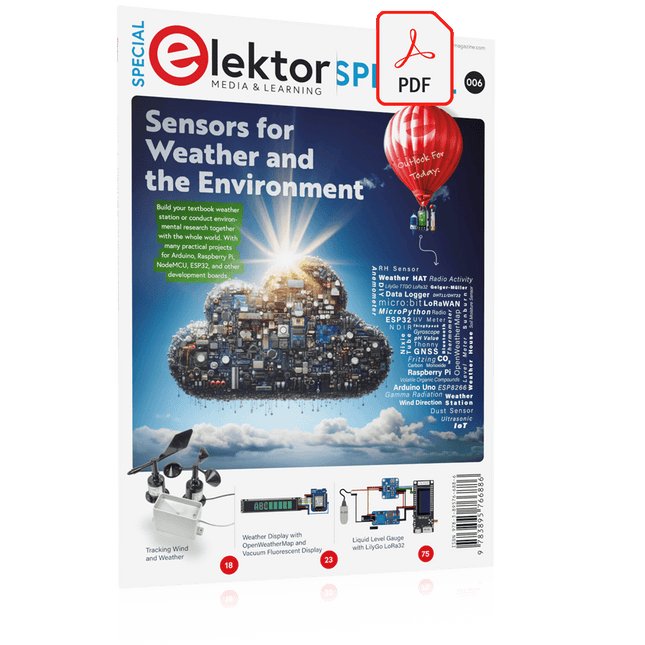
Build your textbook weather station or conduct environmental research together with the whole world. With many practical projects for Arduino, Raspberry Pi, NodeMCU, ESP32, and other development boards.
Weather stations have enjoyed great popularity for decades. Every current and even every long discontinued electronics magazine has regularly featured articles on building your own weather station. Over the years, they have become increasingly sophisticated and can now be fully integrated into an automated home — although this often requires loyalty to an (expensive) brand manufacturer across all components.
With your own weather and environmental data, you can keep up and measure things that no commercial station can. It’s also fun: expand your knowledge of electronics, current microcontroller development boards and programming languages in a fun and meaningful way. For less than 10 euros you can get started and record your first environmental data — with time and growing interest, you will continue to expand your system.
In this Edition
Which Microcontroller Fits My Project?
The Right Development Environment
Tracking Wind and Weather
Weather Display with OpenWeatherMap and Vacuum Fluorescent Display
Volatile Organic Compounds in the Air We Breathe
Working with MQ Sensors: Measuring Carbon Monoxide — Odorless but Toxic
CO2 Traffic Light with ThingSpeak IoT Connection
An Automatic Plant Watering System
Good Indoor Climate: Temperature and Humidity are Important criteria
Classy Thermometer with Vintage Tube Technology
Nostalgic Weather House for the Whole Family
Measuring Air Pressure and Temperature Accurately
Sunburn Warning Device
DIY Sensor for Sunshine Duration
Simple Smartphone Says: Fog or Clear View?
Identifying Earthquakes
Liquid Level Measurement for Vessels and Reservoirs
Water pH Value Measurement
Detecting Radioactive Radiation
GPS: Sensor Location Service Across the Globe
Saving and Timestamping Log Files on SD Cards
LoRaWAN, The Things Network, and ThingSpeak
Operating a LoRaWAN Gateway for TTN
Defying "Wind and Weather"
Mega Display with Weather Forecasz
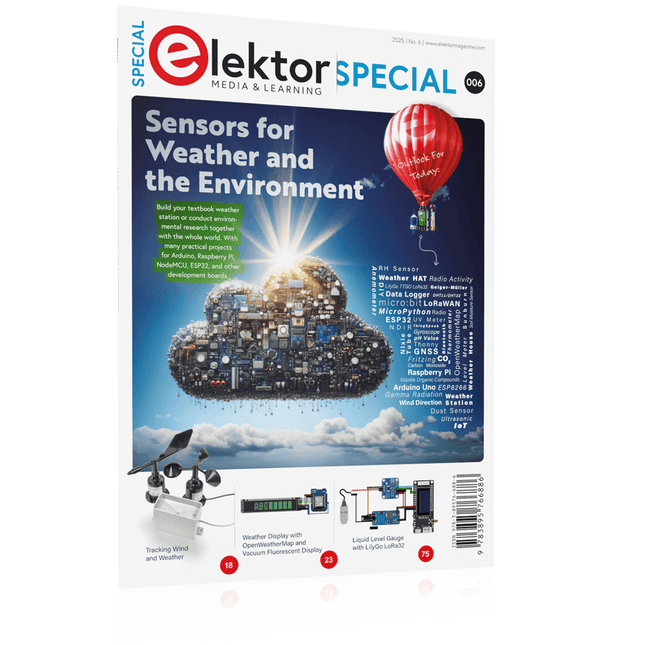
Build your textbook weather station or conduct environmental research together with the whole world. With many practical projects for Arduino, Raspberry Pi, NodeMCU, ESP32, and other development boards.
Weather stations have enjoyed great popularity for decades. Every current and even every long discontinued electronics magazine has regularly featured articles on building your own weather station. Over the years, they have become increasingly sophisticated and can now be fully integrated into an automated home — although this often requires loyalty to an (expensive) brand manufacturer across all components.
With your own weather and environmental data, you can keep up and measure things that no commercial station can. It’s also fun: expand your knowledge of electronics, current microcontroller development boards and programming languages in a fun and meaningful way. For less than 10 euros you can get started and record your first environmental data — with time and growing interest, you will continue to expand your system.
In this Edition
Which Microcontroller Fits My Project?
The Right Development Environment
Tracking Wind and Weather
Weather Display with OpenWeatherMap and Vacuum Fluorescent Display
Volatile Organic Compounds in the Air We Breathe
Working with MQ Sensors: Measuring Carbon Monoxide — Odorless but Toxic
CO2 Traffic Light with ThingSpeak IoT Connection
An Automatic Plant Watering System
Good Indoor Climate: Temperature and Humidity are Important criteria
Classy Thermometer with Vintage Tube Technology
Nostalgic Weather House for the Whole Family
Measuring Air Pressure and Temperature Accurately
Sunburn Warning Device
DIY Sensor for Sunshine Duration
Simple Smartphone Says: Fog or Clear View?
Identifying Earthquakes
Liquid Level Measurement for Vessels and Reservoirs
Water pH Value Measurement
Detecting Radioactive Radiation
GPS: Sensor Location Service Across the Globe
Saving and Timestamping Log Files on SD Cards
LoRaWAN, The Things Network, and ThingSpeak
Operating a LoRaWAN Gateway for TTN
Defying "Wind and Weather"
Mega Display with Weather Forecasz
electronica fast forward Start- & Scale-Up Awards les préparatifs vont de plus en plus vite !
Bluetooth Low Energy avec ESP32-C3 et ESP32 il n'est pas toujours nécessaire que ce soit le WiFi !
Renifleur Bluetooth LE pirater un dongle USB Makerdiary nRF52840 MDK
Cube LED RVB magique concevoir du matériel autour d'un RP2040
Marche/arrêt automatique pour le compresseur de pâte à souder
Productions vidéo Elektor livestreams, webinaires et cours pour ingénieurs et pro-makers
Électrifiez votre vélo avec un kit de conversion vélo électrique
Tous les débuts... ...multiplie les tensions
Tiré de la vie activités annexes
Teensy 4.0 – pourquoi cette planche est-elle si rapide ? la vitesse n'est pas de la sorcellerie !
Simulation d'un amplificateur de puissance audio avec TINA essayez d'abord, puis construisez
Développez et gérez vos propres nœuds LoRaWAN IoT exemple de chapitre : modules Dragino LHT65, LDS01 et LDS02 LoRaWAN
Projet 2.0 corrections, mises à jour et lettres des lecteurs
5G – juste pour moi contrôle total sur les déploiements 5G avec son propre réseau cellulaire
Infographie Elektor
Conseils pour développer une interface WiFi équiper les applications avec des interfaces WiFi
Horloge de tour du Rhin Mk 2
Analyseur de spectre audio avec dékatrons nouvelle vie pour les tubes vintage
Envoyer des données à Telegram avec un ESP32 et quelques pièces
Un filtre coupe-bande Fliege pour les mesures audio mesure mieux avec un filtre coupe-bande
Changer les communications industrielles Ethernet à paire unique – bien plus qu'un simple nouveau connecteur
PUT-ter mâle électronique voici comment fonctionne le transistor unijonction programmable
Écran tactile rond pour Raspberry Pi HyperPixel 2.1 rond de Pimoroni
Télédétection avec détection de perte de connexion avec modules nRF24L01+
Récepteur FM numérique avec Arduino et TEA5767 régler avec un Arduino Nano
Convertir l'interface OLED de SPI en I²C
Meilleur laboratoire Est-Ouest un passe-temps ne prend pas sa retraite...
Dix ans d'éthique en électronique Tessel Renzenbrink à propos de la société numérique et bien plus encore
Hexadoku Le Sudok électorisé original