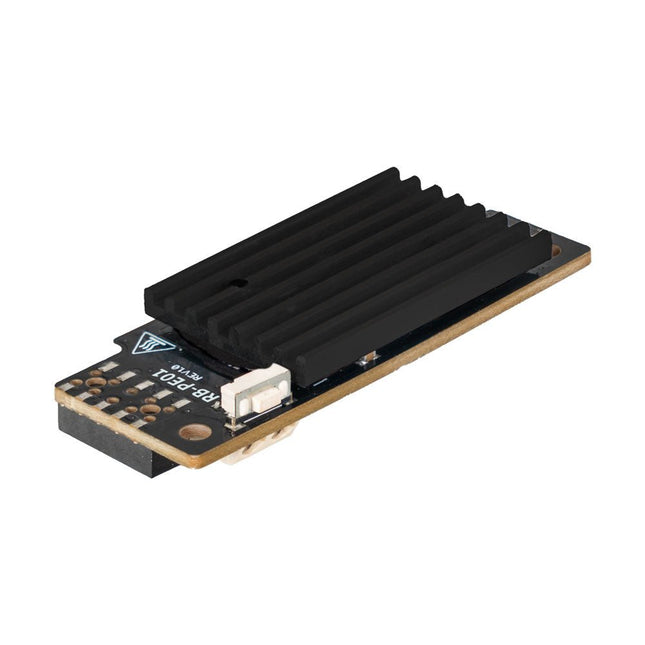
Wide Range Power Supply for Raspberry Pi
With the PiEnergy Mini, you can operate your Raspberry Pi with a voltage of 6 to 36 V DC. You can use the button integrated on the board to both power up and power down your Raspberry Pi.
Communication with the Raspberry Pi is via GPIO4, but this connection can also be cut by removing a resistor to use the pin freely. Thanks to the ultra-flat design, it can also be used in many housings. The pin header is included and not soldered on to keep the design even flatter.
Specifications
Input voltage
6 to 36 V DC
Output voltage
5.1 V
Output current
Up to 3 A (active ventilation recommended for additionally connected loads)
Cable cross-section at the power input
0.2-0.75 mm²
Interface to the Raspberry Pi
GPIO4
Microcontroller
ATtiny5
Further connections
5 V fan connector (2-pin/2.54 mm)Solder pads for external on/off switch
Compatible with
Raspberry Pi 3, 4, 5
Dimensions
23 x 56 x 11 mm
Included
Board with mounted heat sink
Pin header (2x5)
Spacer, screw, nut
Downloads
Datasheet
Manual
De fingerprintsensor module R301T kan dankzij deze geïntegreerde chip beelden verzamelen en algoritmes berekenen. Een andere opmerkelijke functie van de sensor is, dat hij de vingerafdruk kan herkennen in verschillende omstandigheden, bijvoorbeeld vochtigheid, lichttextuur of veranderingen van de huid. Dit biedt een zeer breed scala aan mogelijke toepassingen om onder andere sloten en deuren te beveiligen. De chip kan gegevens versturen via UART, seriele TTLl en USB naar de aangesloten controller. Specificaties Model JP2000 sensor Chip 32 Bit ARM Cortex-M3 Chip opslag 96 kB RAM, 1 MB Flash Voeding 4.2 - 6.0 V Stroomverbruik Typical: 40 mAPiek: 50 mA Logica 3,3 / 5 V TTL Logica Fingerprint opslag capaciteit 3000 Herkenningsmode 1:N Identificatie1:1 Verificatie Instelbaar veiligheidsniveau 1 - 5 niveaus(standaard veiligheidsniveau: 3) Fout acceptatie percentage < 0.001%(op veiligheidsniveau 3) Fout acceptatie percentage < 0.1%(op veiligheidsniveau 3) Reactie tijd Voorbehandeling: < 0.45 sHerkenning: < 1.5 s Baudrate 9600 - 921600 UART communicatie No parity, Stop Bit: 1 Afmetingen 42 x 19 x 8 mm Inbegrepen 1x Fingerprint sensor COM-FP-R301T 1x Kabel Downloads Datasheet Gebruiksaanwijzing
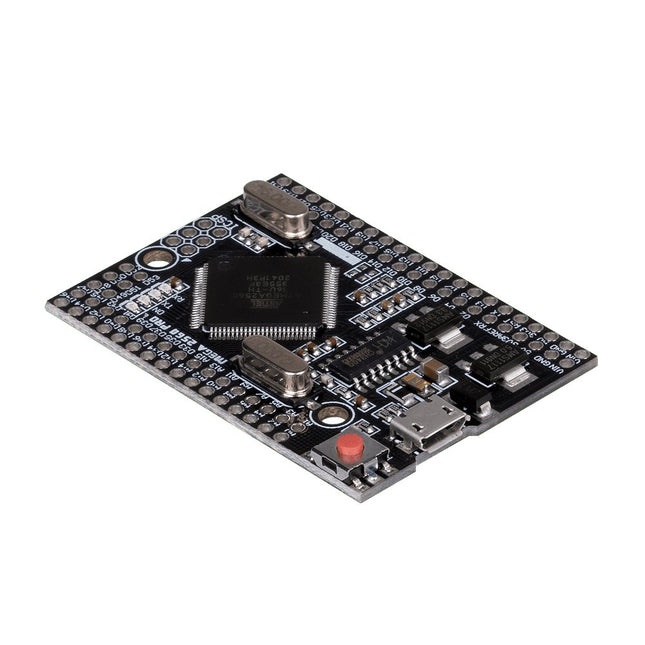
Dit JOY-iT microcontroller bord opent de wereld van het programmeren voor u en biedt u dezelfde rekenkracht als de Mega 2560, maar met een kleinere foot-print. Het heeft ook veel meer connectoren dan vergelijkbare boards (Arduino Uno). Het wordt gevoed door de Arduino IDE en de stroom kan worden geleverd via de USB-poort of de VIN-pennen. Hierdoor kun je het veilig gebruiken met veel andere apparaten, bijv. een desktop PC. Daarom is de Mega 2560 Pro zeer integreerbaar. Features Microcontroller ATmega2560 - 16AU Opslag Flash 256 KB, SRAM 8 KB, EEPRom 4 KB Aantal pinnen:Digitale I/OPWM UitgangAnaloge ingang
541516 Compatibel met Compatibel met Arduino, desktop-pc's, enz. Speciale eigenschappen USB-poort of voedingspinnen voor stroomvoorziening Interface-omzetter Micro USB naar USB UART Afmeting 55 x 38 mm Geleverde artikelen JOY-iT Mega 2560 Pro met pinnen Volgende specificaties Input Voltage 7 - 9 Volt op Vin, 5 Volt op mUSB Logisch niveau 5 Volt Uitgangsstroom 800 mA Voltage regelaar LDO (voor maximaal 12 V piek) Frequentie 16 MHz (12 MHz is mogelijk voor data-uitwisseling) Download Handleiding
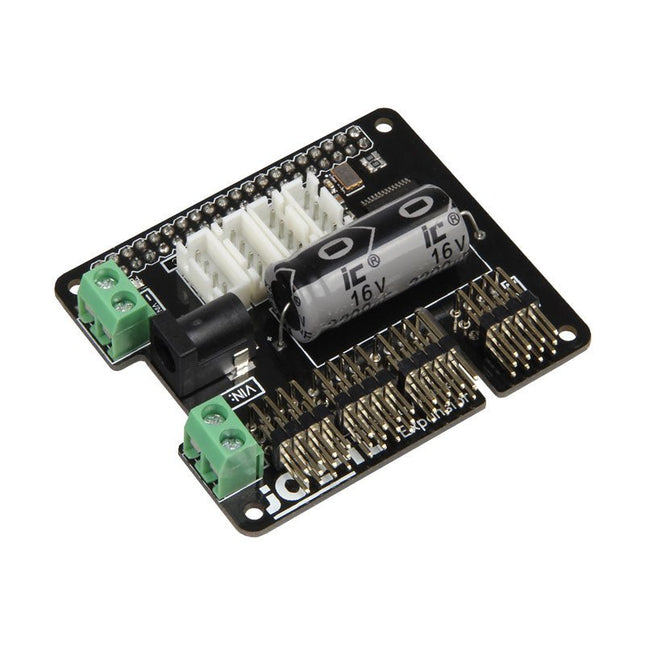
Het Motorino bord is een uitbreidingsbord om tot 16 PWM-gestuurde 5V-Servo-motoren aan te sturen en te gebruiken. De bijgeleverde klokgenerator zorgt voor een zeer nauwkeurig PWM-signaal en een zeer nauwkeurige positionering. Het bord heeft 2 ingangen voor een spanning van 4,8 V tot 6 V die gebruikt kan worden voor maximaal 11 A. Met deze ingang is een perfecte stroomvoorziening altijd gegarandeerd en zijn zelfs grotere projecten geen probleem. De voeding loopt direct over de Motorino die zorgt voor een aansluiting voor spanning, massa en aansturing. Met de ingebouwde condensator wordt de spanning gebufferd wat een plotselinge spanningsval bij een hoge belasting voorkomt. Maar er is ook de mogelijkheid om een andere condensator aan te sluiten. De besturing en het programmeren kan, zoals gebruikelijk, met de Arduino. Handleidingen en code voorbeelden maken een snelle introductie voor beginners mogelijk. Speciale kenmerken 16 Kanalen, eigen klok generator Input 1 Coaxiale voedingsconnector 5,5 / 2,1 mm, 4,8-6 V / 5 A max Input 2 Schroef-terminal, 4,8-6 V / 6 A max Communicatie 16 x PWM Compatibel met Arduino Uno, Mega en wellicht meer microcontroller met Arduino-compatibele pinout Afmetingen 69 x 24 x 56 mm Werkingssfeer Bord, Handleiding, Winkelverpakking
The MotoPi is an extension-board to control and use up to 16 PWM-controlled 5 V servo motors. The board can be additional powered by a voltage between 4.8 V and 6 V so a perfect supply is always guaranteed and even larger projects can be powered. With the additional power supply and the integrated Analog-Digital-Converter, new possibilities can be reached. An additional power supply per motor is not required anymore because all connections (Voltage, Ground, Control) are directly connected to the board. The control and the programing can be directly done, as usual, on the Raspberry Pi. Special features 16 Channels, own clock generator, Inkl. Analog Digital Converter Input 1 Coaxial power connector 5.5 / 2.1 mm, 5 V / 6 A max Input 2 Screw terminal, 4.8-6 V / 6 A max Compatible with Raspberry Pi A+, B+, 2B, 3B Dimensions 65 x 56 x 24 mm Scope of supply Board, manual, fixing material
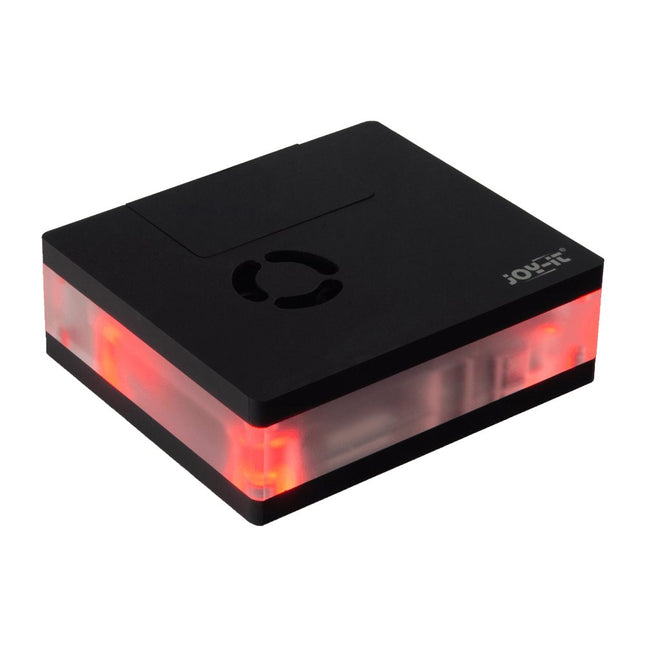
This multimedia case for all Raspberry Pi 4 models is characterized by high functionality, modern design and a sumptuous equipment:
Integrated IR receiver, controllable with almost all IR remote controls
Controllable LED lighting
Switching on/off, controlling additional functions of the Raspberry Pi
Active, quiet cooling
Toolless, magnetic assembly
All connections of the Raspberry Pi are on the backside
GPIO port is accessible via separate lid
Perfect as a multimedia platform in the living room, desktop device or for the use in digital signage.
Specifications
Material
Acryl
Color
Black
Compatible to
Raspberry Pi 4
Power supply
5 VDC (USB-C)
Microcontroller
STM32F030F4P
Infrared receiver
TSOP4838
LEDs
4x WS2812Mini
Led out connections
1x USB-C, 1x Aux, 2x microHDMIFrom Raspberry Pi: 2x USB-A 3.0, 2x USB-A 2.0, 1x RJ45
Weight
280 g
Dimensions
113 x 100 x 38 mm
Scope of delivery
Multimedia case, adapter board, control board, Aux adapter cable
Downloads
Datasheet (177.9 KB)
Manual (3.5 MB)
Expert Guide (6.5 MB)
Firmware v1.0.9-beta (11.2 KB)
Addons for LibreElec 9 (2.6 MB)
Code Examples
Addon - Multimedia Case Configuration
Addon - LED Configuration
Addon - IR Control Configuration
Prepared LibreElec Image
Prepared LibreElec Image 10.BETA
GitHub
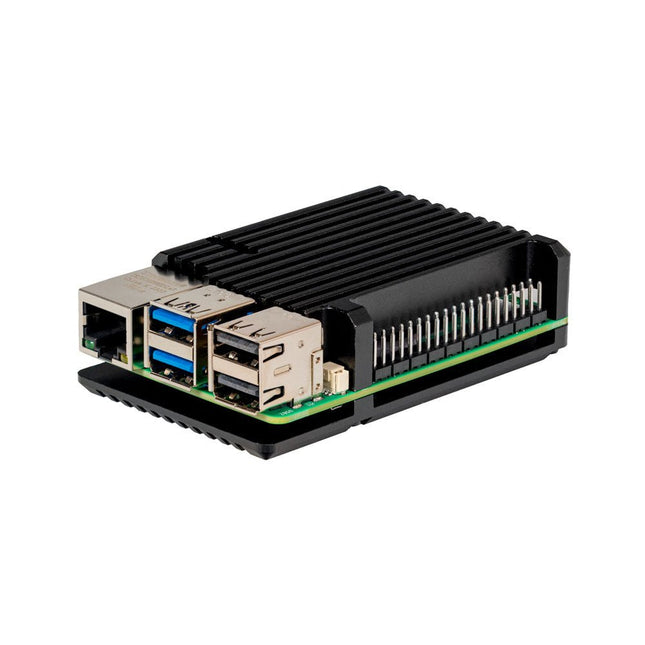
De JOY-iT Armor Case BLOCK is een robuuste aluminium behuizing speciaal ontworpen voor de Raspberry Pi 5. Het biedt uitstekende bescherming tegen hitte en fysieke schokken, waardoor het geschikt is voor uitdagende omgevingen. Het compacte ontwerp zorgt ervoor dat er geen extra ruimte nodig is, waardoor een naadloze integratie in bestaande projecten mogelijk is.
De behuizing is voorzien van een groot koellichaam om de koelefficiëntie te verbeteren. De installatie is eenvoudig, met vier schroeven (meegeleverd) waarmee de behuizing aan de Raspberry Pi wordt bevestigd.
Specificaties
Materiaal
CNC gefreesde aluminiumlegering
Koelprestaties
Inactief: ~39°CVolle belasting: ~75°C
Speciale kenmerken
Groot koellichaam, bescherming tegen schokken en hitte met hetzelfde volume als zonder behuizing
Afmetingen (bovenkant)
69 x 56 x 15,5 mm
Afmetingen (onderzijde)
87 x 56 x 7,5 mm
From Theory to Practical Applications in Wireless Energy Transfer and Harvesting
Wireless power transmission has gained significant global interest, particularly with the rise of electric vehicles and the Internet of Things (IoT). It’s a technology that allows the transfer of electricity without physical connections, offering solutions for everything from powering small devices over short distances to long-range energy transmission for more complex systems.
Wireless Power Design provides a balanced mix of theoretical knowledge and practical insights, helping you explore the potential of wireless energy transfer and harvesting technologies. The book presents a series of hands-on projects that cover various aspects of wireless power systems, each accompanied by detailed explanations and parameter listings.
The following five projects guide you through key areas of wireless power:
Project 1: Wireless Powering of Advanced IoT Devices
Project 2: Wireless Powered Devices on the Frontline – The Future and Challenges
Project 3: Wireless Powering of Devices Using Inductive Technology
Project 4: Wireless Power Transmission for IoT Devices
Project 5: Charging Robot Crawler Inside the Pipeline
These projects explore different aspects of wireless power, from inductive charging to wireless energy transmission, offering practical solutions for real-world applications. The book includes projects that use simulation tools like CST Microwave Studio and Keysight ADS for design and analysis, with a focus on practical design considerations and real-world implementation techniques.
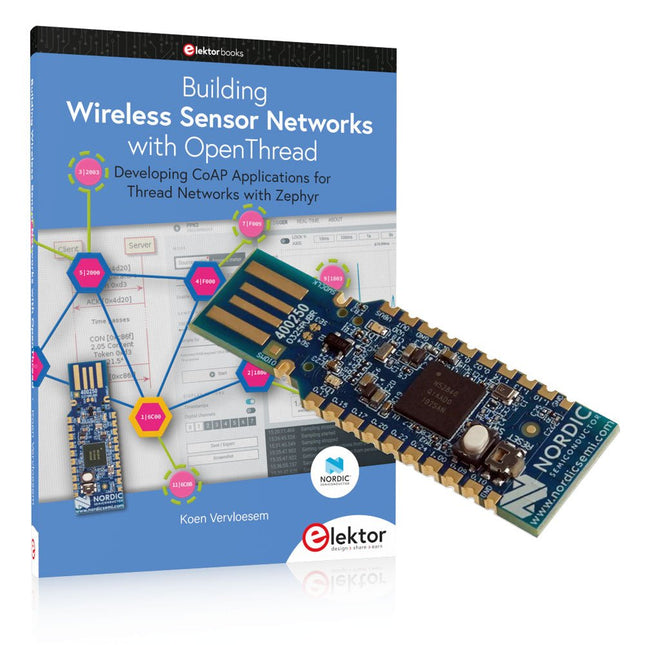
Deze bundel bevat:
Boek: Building Wireless Sensor Networks with OpenThread (normale prijs: € 40)
Nordic Semiconductor nRF52840 USB-dongle (normale prijs: € 20)
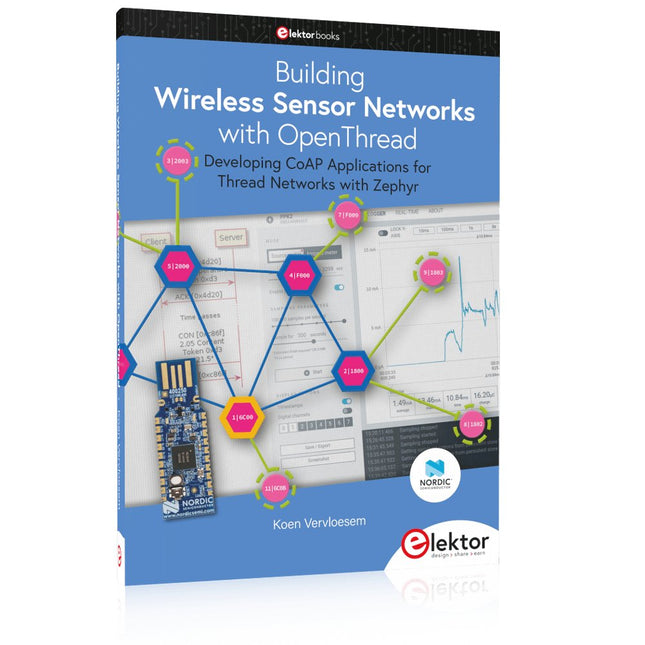
Boek: Building Wireless Sensor Networks with OpenThread
This book will guide you through the operation of Thread, the setup of a Thread network, and the creation of your own Zephyr-based OpenThread applications to use it. You’ll acquire knowledge on:
The capture of network packets on Thread networks using Wireshark and the nRF Sniffer for 802.15.4.
Network simulation with the OpenThread Network Simulator.
Connecting a Thread network to a non-Thread network using a Thread Border Router.
The basics of Thread networking, including device roles and types, as well as the diverse types of unicast and multicast IPv6 addresses used in a Thread network.
The mechanisms behind network discovery, DNS queries, NAT64, and multicast addresses.
The process of joining a Thread network using network commissioning.
CoAP servers and clients and their OpenThread API.
Service registration and discovery.
Securing CoAP messages with DTLS, using a pre-shared key or X.509 certificates.
Investigating and optimizing a Thread device’s power consumption.
Once you‘ve set up a Thread network with some devices and tried connecting and disconnecting them, you’ll have gained a good insight into the functionality of a Thread network, including its self-healing capabilities. After you’ve experimented with all code examples in this book, you’ll also have gained useful programming experience using the OpenThread API and CoAP.
Nordic Semiconductor nRF52840 USB Dongle
The nRF52840 dongle is a small, low-cost USB dongle that supports Bluetooth 5.3, Bluetooth mesh, Thread, ZigBee, 802.15.4, ANT and 2.4 GHz proprietary protocols. The dongle is the perfect target hardware for use with nRF Connect for Desktop as it is low-cost but still support all the short range wireless standards used with Nordic devices.
The dongle has been designed to be used as a wireless HW device together with nRF Connect for Desktop. For other use cases please do note that there is no debug support on the dongle, only support for programming the device and communicating through USB.
It is supported by most of the nRF Connect for Desktop apps and will automatically be programmed if needed. In addition custom applications can be compiled and downloaded to the dongle. It has a user programmable RGB LED, a green LED, a user programmable button as well as 15 GPIO accessible from castellated solder points along the edge. Example applications are available in the nRF5 SDK under the board name PCA10059.
The nRF52840 dongle is supported by nRF Connect for Desktop as well as programming through nRFUtil.
Features
Bluetooth 5.2 ready multiprotocol radio
2 Mbps
Long Range
Advertising Extensions
Channel Selection Algorithm #2 (CSA #2)
IEEE 802.15.4 radio support
Thread
ZigBee
Arm Cortex-M4 with floating point support
DSP instruction set
ARM CryptoCell CC310 cryptographic accelerator
15 GPIO available via edge castellation
USB interface direct to nRF52840 SoC
Integrated 2.4 GHz PCB antenna
1 user-programmable button
1 user-programmable RGB LED
1 user-programmable LED
1.7-5.5 V operation from USB or external
Downloads
Datasheet
Hardware Files
Developing CoAP applications for Thread networks with Zephyr
This book will guide you through the operation of Thread, the setup of a Thread network, and the creation of your own Zephyr-based OpenThread applications to use it. You’ll acquire knowledge on:
The capture of network packets on Thread networks using Wireshark and the nRF Sniffer for 802.15.4.
Network simulation with the OpenThread Network Simulator.
Connecting a Thread network to a non-Thread network using a Thread Border Router.
The basics of Thread networking, including device roles and types, as well as the diverse types of unicast and multicast IPv6 addresses used in a Thread network.
The mechanisms behind network discovery, DNS queries, NAT64, and multicast addresses.
The process of joining a Thread network using network commissioning.
CoAP servers and clients and their OpenThread API.
Service registration and discovery.
Securing CoAP messages with DTLS, using a pre-shared key or X.509 certificates.
Investigating and optimizing a Thread device’s power consumption.
Once you‘ve set up a Thread network with some devices and tried connecting and disconnecting them, you’ll have gained a good insight into the functionality of a Thread network, including its self-healing capabilities. After you’ve experimented with all code examples in this book, you’ll also have gained useful programming experience using the OpenThread API and CoAP.
From Theory to Practical Applications in Wireless Energy Transfer and Harvesting
Wireless power transmission has gained significant global interest, particularly with the rise of electric vehicles and the Internet of Things (IoT). It’s a technology that allows the transfer of electricity without physical connections, offering solutions for everything from powering small devices over short distances to long-range energy transmission for more complex systems.
Wireless Power Design provides a balanced mix of theoretical knowledge and practical insights, helping you explore the potential of wireless energy transfer and harvesting technologies. The book presents a series of hands-on projects that cover various aspects of wireless power systems, each accompanied by detailed explanations and parameter listings.
The following five projects guide you through key areas of wireless power:
Project 1: Wireless Powering of Advanced IoT Devices
Project 2: Wireless Powered Devices on the Frontline – The Future and Challenges
Project 3: Wireless Powering of Devices Using Inductive Technology
Project 4: Wireless Power Transmission for IoT Devices
Project 5: Charging Robot Crawler Inside the Pipeline
These projects explore different aspects of wireless power, from inductive charging to wireless energy transmission, offering practical solutions for real-world applications. The book includes projects that use simulation tools like CST Microwave Studio and Keysight ADS for design and analysis, with a focus on practical design considerations and real-world implementation techniques.
,
van Clemens Valens
Het testen van de Joy-it JT-PS1440-C 1,5 kW voeding
In deze tijd van e-bikes, elektrische scooters en andere voertuigen zijn krachtige programmeerbare voedingen essentieel voor het testen van motoren en het opladen van batterijen....