The State of Hollow State Audio in the Second Decade of the 21st Century
Vacuum-tube (or valve, depending upon which side of the pond you live on) technology spawned the Age of Electronics early in the 20th Century. Until the advent of solid-state electronics near mid-century, hollow-state devices were the only choice. But following the invention of the transistor (after their process fell to reasonable levels), within a couple of decades, the death of vacuum tubes was widely heralded. Yet here we are some five decades later, and hollow-state equipment is enjoying something of a comeback, especially in the music and high-end audio industries.
Many issues surround hollow-state audio:
Does it produce—as some claim—better sound? If so, is there science to back up these claims?
How do hollow-state circuits work?
How do you design hollow-state audio circuits?
If hollow-state equipment fails, how do you go about troubleshooting and repairing it?
Can we recreate some of the classic hollow-state audio devices for modern listening rooms and recording studios?
How can we intelligently modify hollow-state amplifiers to our taste?
These and other topics are covered in The State of Hollow State Audio.
Jan Didden schiep Linear Audio in 2010 en publiceerde 14 delen tussen 2010 en 2017. Elk deel van 200 bladzijden bevat gemiddeld 10 artikelen van deskundige auteurs op het gebied van audio, akoestiek, en instrumentatie. Of je nu geïnteresseerd bent in buizenversterkers, solid-state apparatuur, luidsprekerontwerp, condensator- en weerstandsvervorming of vervormingsmeting, je vindt er zeker nuttige adviezen en interessante discussies. Van beginner tot gevorderd niveau, voor de audio professional of de serieuze hobbyist, deze ExpertCollection zal je kennis vergroten en nieuwe perspectieven bieden op veel voorkomende problemen. Bonusmateriaal bij deze collectie is een 5-delige YouTube serie over negatieve feedback toegepast op audio van de bekende auteur Jan Didden, en nog negen andere baanbrekende audio artikelen en presentaties. Als je serieus geïnteresseerd bent in audio, akoestiek, en instrumentatie, mag je dit niet missen! Het gepubliceerde materiaal is geïndexeerd en volledig doorzoekbaar en zal een bijna onbeperkte bron zijn voor vele jaren. Je kunt over de auteurs van Linear Audio lezen, en de inhoudsopgave van elk deel, zie linearaudio.net.
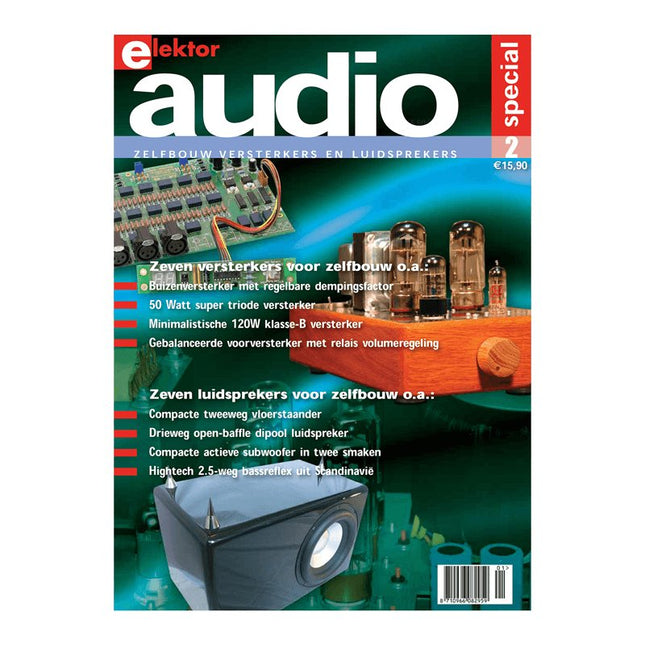
Zelfbouw versterkers en luidsprekers
Deze speciale uitgave staat vol met interessante bouwbeschrijvingen en achtergrondartikelen van internationaal gerenommeerde ontwerpers. Het gaat in alle gevallen om nieuwe, nog niet eerder gepubliceerde artikelen.
Inhoudsopgave
Buizenversterkers
30 Watt buizenversterker met variabele dempingsfactor
50 Watt super triode versterker
300 Watt buizen eindversterker
Digibias: digitaal de ruststroom instellen en bewaken
Luidsprekers
Paper Hatt - klein maar fijn
Origami M en C – compacte actieve subwoofer in twee smaken
Meerweg open baffle systemen – basistheorie, ontwerp en meetmethode
Moai – hightech uit Scandinavië
OB3W – drieweg open-baffle dipool van formaat
1685a – compacte tweeweg vloerstaander
ScanSpeak Vertigo – duizelingwekkend mooi driewegsysteem
Halfgeleiderversterkers
MinimA – minimalistische 120W klasse-B versterker
Gebalanceerde voorversterker met actief wisselfilter
RelaiXed – gebalanceerde voorversterker met relais
Programming the Finite State Machine with 8-Bit PICs in Assembly and C
Andrew Pratt provides a detailed introduction to programming PIC microcontrollers, as well as a thorough overview of the Finite State Machine (FSM) approach to programming. Most of the book uses assembly programming, but do not be deterred. The FSM gives a structure to a program, making it easy to plan, write, and modify. The last two chapters introduce programming in C, so you can make a direct comparison between the two techniques. The book references the relevant parts of the Microchip datasheet as familiarity with it is the best way to discover detailed information.
This book is aimed at Microsoft Windows and Linux users. To keep your costs to a minimum and to simplify the toolchain, specific applications are provided as a free download to enable you to use an FTDI serial lead as the programmer. The assembler used is the open-source "gpasm". All programming can be done in a text editor. There are detailed instructions on how to perform the necessary installations on Windows, Linux Debian, and derivatives such as Ubuntu and Fedora. For programming in C, Microchip's XC8 compiler is used from the command line. In addition to the programming applications, two serial read and serial write applications can be used for communicating with the PICs from a computer.
A voltmeter project including practical instructions on building a circuit board from scratch is included. All theory is covered beforehand, including how to do integer arithmetic in assembly.
Two PICs are covered: the PIC12F1822 and the PIC16F1823. Both can run at 32 MHz with an internal oscillator. You do not need to buy a factory-made development board and programmer. With relatively inexpensive parts including a serial lead, microcontroller, a few resistors, and LEDs, you can get started exploring embedded programming.
Links
Updated Programmer
Easy and Affordable Digital Signal ProcessingThe aim of this book is to teach the basic principles of Digital Signal Processing (DSP) and to introduce it from a practical point of view using the bare minimum of mathematics. Only the basic level of discrete-time systems theory is given, sufficient to implement DSP applications in real time. The practical implementations are described in real time using the highly popular ESP32 DevKitC microcontroller development board. With the low cost and extremely popular ESP32 microcontroller, you should be able to design elementary DSP projects with sampling frequencies within the audio range. All programming is done using the popular Arduino IDE in conjunction with the C language compiler.After laying a solid foundation of DSP theory and pertinent discussions on the main DSP software tools on the market, the book presents the following audio-based sound and DSP projects:
Using an I²S-based digital microphone to capture audio sound
Using an I²S-based class-D audio amplifier and speaker
Playing MP3 music stored on an SD card through an I²S-based amplifier and speaker
Playing MP3 music files stored in ESP32 flash memory through an I²S-based amplifier and speaker
Mono and stereo Internet radio with I²S-based amplifiers and speakers
Text-to-speech output with an I²S-based amplifier and speaker
Using the volume control in I²S-based amplifier and speaker systems
A speaking event counter with an I²S-based amplifier and speaker
An adjustable sinewave generator with I²S-based amplifier and speaker
Using the Pmod I²S2 24-bit fast ADC/DAC module
Digital low-pass and band-pass real-time FIR filter design with external and internal A/D and D/A conversion
Digital low-pass and band-pass real-time IIR filter design with external and internal A/D and D/A conversion
Fast Fourier Transforms (FFT)
Zelfbouw versterkers en luidsprekers
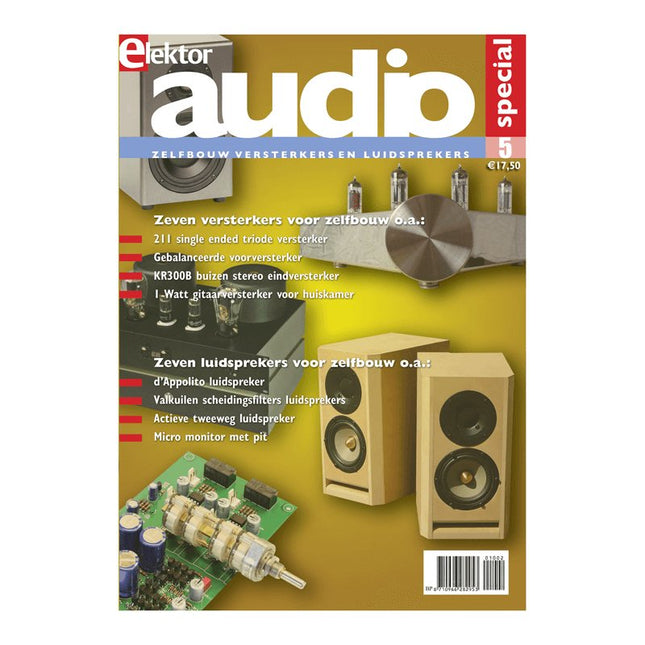
Ook deze vijfde Audio Special staat weer vol met interessante bouwbeschrijvingen en achtergrondartikelen van internationaal gerenommeerde ontwerpers. Ook dit jaar weer de inmiddels bekende mix van buizenversterkers en luidsprekers, zodat er voor iedere zelfbouwer ongetwijfeld iets interessants te lezen of te bouwen valt. Het gaat in alle gevallen om nieuwe, nog niet eerder gepubliceerde artikelen.
Inhoud
Versterkers
Classic Three voorversterker
Lijnvoorversterker met 6C33
De Dirigent – buizenvoorversterker met actief scheidingsfilter
Single ended KR300B stereo eindversterker
1 Watt gitaarversterker – voor huiskamer
Single ended 211 triode versterker – met interstage trafo
Dieper kijken in de uitgangstransformator
Prelude voorversterker – minimalisme in optima forma
Klik aan, klik uit schakelaar – een netschakelaar met legio toepassingen
Luidsprekers
Scheidingsfilters voor luidsprekerboxen – meer valkuilen dan je lief is
Morel Elite 420 – actieve tweeweg boekenplank luidspreker
All back – een verrassend veelzijdige compacte TL
HATT-SE MkII Micro Monitor – kleine luidspreker met pit
Silverado – een d’Appolito met pit
Nebular Monitor – een compacte luidspreker met een groots geluid
LBVS – zelfbouwklassieker van eigen bodem
Solo 201 – er is maar één weg!
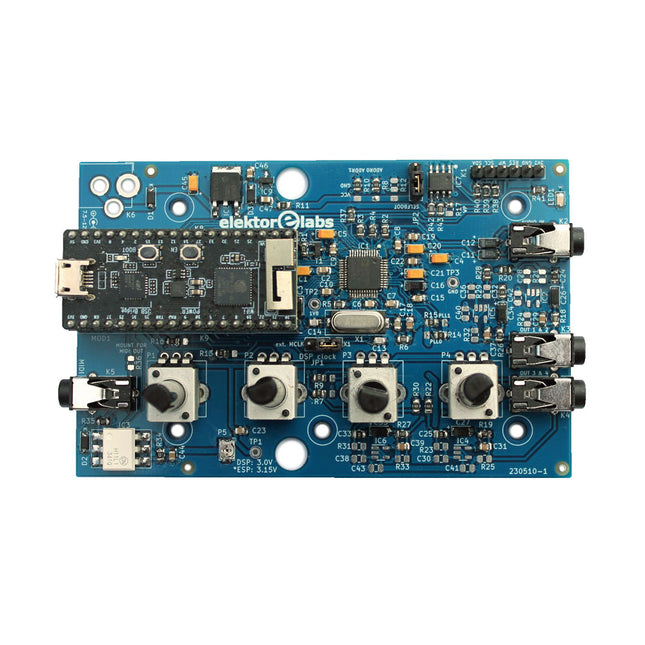
De Elektor Audio DSP FX Processor combineert een ESP32-microcontroller en een ADAU1701 Audio DSP van Analog Devices. Naast een door de gebruiker programmeerbare DSP-kern heeft de ADAU1701 hoogwaardige analoog-naar-digitaal en digitaal-naar-analoog converters ingebouwd en is hij voorzien van een I²S-poort. Dit maakt hem geschikt als hoogwaardige audio-interface voor de ESP32.
Programma's voor de ESP32 kunnen worden gemaakt met Arduino, Platform IO, CMake of door de Espressif IDF op een andere manier te gebruiken. Programma's voor de ADAU7101 audio DSP's worden gemaakt met de gratis visuele programmeertool SigmaStudio door voorgedefinieerde algoritmablokken op een canvas te slepen.
Toepassingen
Bluetooth/Wi-Fi audio sink (bijv. luidspreker) & bron
Gitaareffectpedaal (stompbox)
Muzieksynthesizer
Geluids-/functiegenerator
Programmeerbaar cross-overfilter voor luidsprekers
Geavanceerde audio-effectprocessor (reverb, chorus, pitch shifting, enz.)
Audioapparaat met internetverbinding
DSP-experimentplatform
Draadloze MIDI
MIDI naar CV-converter
en nog veel meer...
Specificaties
ADAU1701 28-/56-bit, 50-MIPS digitale audioprocessor die bemonsteringsfrequenties tot 192 kHz ondersteunt
ESP32 32-bit dual-core microcontroller met Wi-Fi 802.11b/g/n en Bluetooth 4.2 BR/EDR en BLE
2x 24-bit audio-ingangen (2 V RMS, 20 kΩ)
4x 24-bit audio-uitgangen (0,9 V RMS, 600 Ω)
4x Regelpotentiometer
MIDI in- en uitgang
I²C-uitbreidingspoort
Multi-mode werking
Voeding: 5 V DC USB of 7,5-12 V DC (cilinderaansluiting, middelste pin is GND)
Stroomverbruik (gemiddeld): 200 mA
Inbegrepen
1x ESP32 Audio DSP FX Processor board (gemonteerd)
1x ESP32-PICO-KIT
2x Truien
2x 18-pins headers (female)
4x 10 KB potentiometers
Downloads
Documentation
GitHub
Over 45 Builds for the Legendary 555 Chip (and the 556, 558)
The 555 timer IC, originally introduced by the Signetics Corporation around 1971, is sure to rank high among the most popular analog integrated circuits ever produced. Originally called the IC Time Machine, this chip has been used in many timer-related projects by countless people over decades.
This book is all about designing projects based on the 555 timer IC. Over 45 fully tested and documented projects are presented. All projects have been fully tested by the author by constructing them individually on a breadboard. You are not expected to have any programming experiences for constructing or using the projects given in the book. However, it’s definitely useful to have some knowledge of basic electronics and the use of a breadboard for constructing and testing electronic circuits.
Some of the projects in the book are:
Alternately Flashing Two LEDs
Changing LED Flashing Rate
Touch Sensor On/Off Switch
Switch On/Off Delay
Light-Dependent Sound
Dark/Light Switch
Tone Burst Generator
Long Duration Timer
Chasing LEDs
LED Roulette Game
Traffic Lights
Continuity Tester
Electronic Lock
Switch Contact Debouncing
Toy Electronic Organ
Multiple Sensor Alarm System
Metronome
Voltage Multipliers
Electronic Dice
7-Segment Display Counter
Motor Control
7-Segment Display Dice
Electronic Siren
Various Other Projects
The projects given in the book can be modified or expanded by you for your very own applications. Electronic engineering students, people engaged in designing small electronic circuits, and electronic hobbyists should find the projects in the book instructive, fun, interesting, and useful.
Over 45 Builds for the Legendary 555 Chip (and the 556, 558)
The 555 timer IC, originally introduced by the Signetics Corporation around 1971, is sure to rank high among the most popular analog integrated circuits ever produced. Originally called the IC Time Machine, this chip has been used in many timer-related projects by countless people over decades.
This book is all about designing projects based on the 555 timer IC. Over 45 fully tested and documented projects are presented. All projects have been fully tested by the author by constructing them individually on a breadboard. You are not expected to have any programming experiences for constructing or using the projects given in the book. However, it’s definitely useful to have some knowledge of basic electronics and the use of a breadboard for constructing and testing electronic circuits.
Some of the projects in the book are:
Alternately Flashing Two LEDs
Changing LED Flashing Rate
Touch Sensor On/Off Switch
Switch On/Off Delay
Light-Dependent Sound
Dark/Light Switch
Tone Burst Generator
Long Duration Timer
Chasing LEDs
LED Roulette Game
Traffic Lights
Continuity Tester
Electronic Lock
Switch Contact Debouncing
Toy Electronic Organ
Multiple Sensor Alarm System
Metronome
Voltage Multipliers
Electronic Dice
7-Segment Display Counter
Motor Control
7-Segment Display Dice
Electronic Siren
Various Other Projects
The projects given in the book can be modified or expanded by you for your very own applications. Electronic engineering students, people engaged in designing small electronic circuits, and electronic hobbyists should find the projects in the book instructive, fun, interesting, and useful.
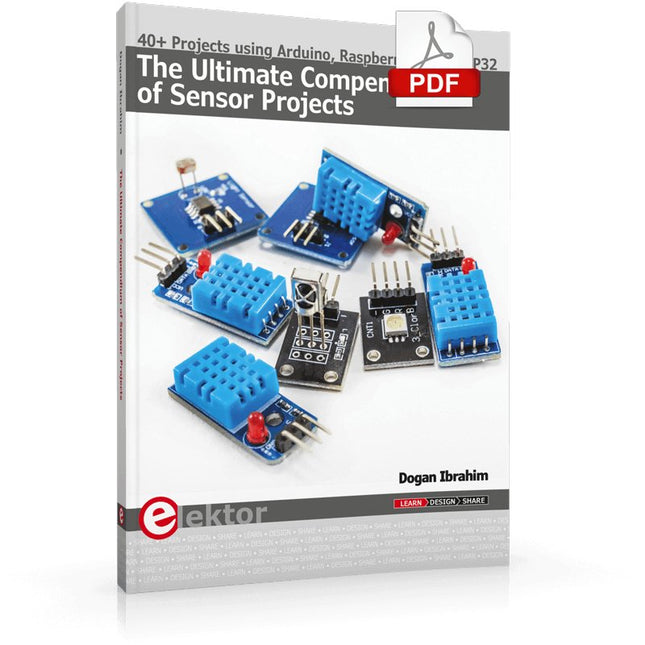
40+ Projects using Arduino, Raspberry Pi and ESP32
This book is about developing projects using the sensor-modules with Arduino Uno, Raspberry Pi and ESP32 microcontroller development systems. More than 40 different sensors types are used in various projects in the book. The book explains in simple terms and with tested and fully working example projects, how to use the sensors in your project. The projects provided in the book include the following:
Changing LED brightness
RGB LEDs
Creating rainbow colours
Magic wand
Silent door alarm
Dark sensor with relay
Secret key
Magic light cup
Decoding commercial IR handsets
Controlling TV channels with IT sensors
Target shooting detector
Shock time duration measurement
Ultrasonic reverse parking
Toggle lights by clapping hands
Playing melody
Measuring magnetic field strength
Joystick musical instrument
Line tracking
Displaying temperature
Temperature ON/OFF control
Mobile phone-based Wi-Fi projects
Mobile phone-based Bluetooth projects
Sending data to the Cloud
The projects have been organized with increasing levels of difficulty. Readers are encouraged to tackle the projects in the order given. A specially prepared sensor kit is available from Elektor. With the help of this hardware, it should be easy and fun to build the projects in this book.
The author Stephan Menzel provides an introduction into capacitor technology and describes the wide range of capacitor types with their properties and parameters.
Basic principles
This chapter imparts basic knowledge on the relationships between the electric field, permittivity, as well as the structure and operating principles of a capacitor.
Capacitor characteristics
The electrical parameters and essential characteristics of a capacitor are explained in greater detail for the reader. This extends from the actual capacitance of a capacitor through to the interdependencies.
Capacitor types
Existing capacitor types and their characteristics are presented. Film, electrolyte and ceramic capacitors are considered in detail.
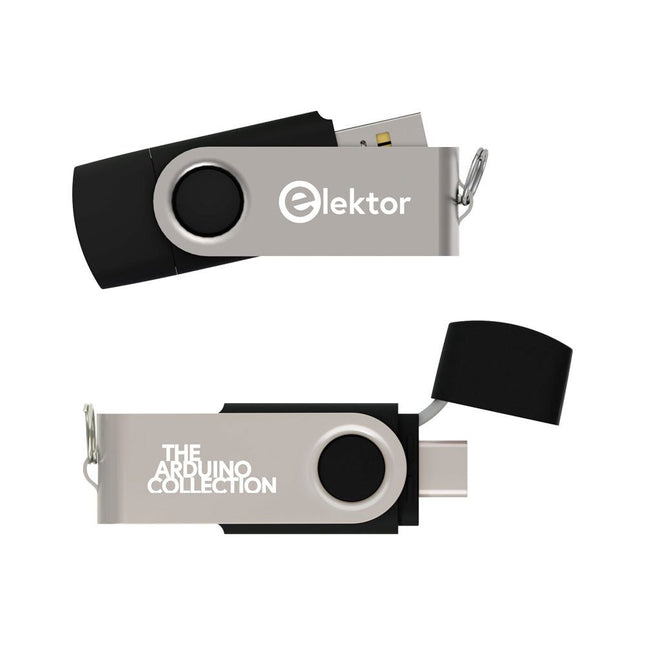
Deze USB-stick bevat een selectie van meer dan 300 artikelen over Arduino gepubliceerd in Elektor Magazine. De inhoud bestaat uit zowel achtergrondartikelen als projecten met de volgende onderwerpen:
Software & hardware ontwikkeling: Tutorials over de ontwikkeling van Arduino-software met behulp van Arduino IDE, Atmel Studio, Shields en essentiële programmeerconcepten.
Educatie: Een microcontroller Bootcamp biedt een gestructureerde aanpak voor het programmeren van embedded systemen.
Data acquisitie & meten: Projecten zoals een 16-bits datalogger, draaibank toerenteller en een AC netanalyser voor het vastleggen en analyseren van real-time signalen.
Draadloze communicatie: Leer hoe je draadloze netwerken implementeert, een Android interface maakt en effectief communiceert met microcontrollers.
Robotica en automatisering: Omvat de Arduino Nano Robot Controller, ondersteunende boards voor automatisering, en een verkenning van verschillende Arduino-shields om de functionaliteit te verbeteren.
Zelfbouw-projecten: Unieke projecten zoals laserprojectie, Numitron klok en thermometer, ELF ontvanger, Theremino, en touch LED interfaces laten creatieve toepassingen zien.
Of u nu een beginner bent of een ervaren maker, deze collectie is een waardevolle bron om te leren, te experimenteren en de grenzen van de Arduino-technologie te verleggen.