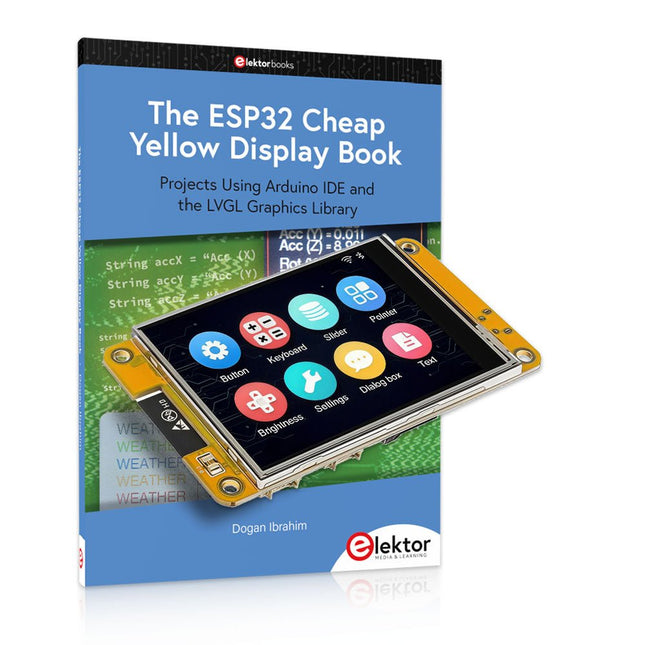
Meer dan 40 volledig geteste ESP32-projecten met Arduino IDE en de LVGL grafische bibliotheek
Deze bundel bevat de ESP32 Cheap Yellow Display (CYD) – een compact ontwikkelbord dat een standaard ESP32-microcontroller combineert met een TFT-kleurendisplay van 320 x 240 pixels. Het bord beschikt ook over meerdere aansluitingen voor GPIO, seriële communicatie (TX/RX), voeding en aarde. Het ingebouwde display is een groot voordeel, omdat gebruikers hiermee complexe, grafische projecten kunnen maken zonder dat er externe LCD's of displays nodig zijn.
Het bijbehorende boek introduceert de hardware en de ingebouwde aansluitingen van het CYD-bord in detail. Het biedt een reeks projecten van beginners- tot gevorderdenniveau, ontwikkeld met de populaire Arduino IDE 2.0. Zowel basis grafische functies als de krachtige LVGL grafische bibliotheek worden behandeld, met praktische projecten die elke aanpak illustreren.
Alle meegeleverde projecten zijn volledig getest en klaar voor gebruik. Het boek bevat blokdiagrammen, circuitschema's, complete codelijsten en stapsgewijze uitleg. Met de LVGL-bibliotheek kunnen lezers moderne, kleurrijke grafische interfaces maken met behulp van widgets zoals knoppen, labels, schuifregelaars, kalenders, toetsenborden, grafieken, tabellen, menu's, animaties en meer.
ESP32 Cheap Yellow Display Board
Dit ontwikkelbord (ook bekend als "Cheap Yellow Display") wordt aangedreven door de ESP-WROOM-32, een dual-core MCU met geïntegreerde Wi-Fi- en Bluetooth-mogelijkheden. Het werkt op een hoofdfrequentie tot 240 MHz, met 520 KB SRAM, 448 KBROM en 4 MB Flash-geheugen. Het bord is voorzien van een 2,8-inch scherm met een resolutie van 240 x 320 en resistieve aanraking.
Bovendien bevat het bord een achtergrondverlichtingsbesturingscircuit, aanraakbesturingscircuit, luidsprekeraandrijfcircuit, lichtgevoelig circuit en RGB-LED-besturingscircuit. Het biedt ook een TF-kaartsleuf, seriële interface, DHT11 temperatuur- en vochtigheidssensorinterface en extra IO-poorten.
De module ondersteunt ontwikkeling in Arduino IDE, ESP-IDE, MicroPython en Mixly.
Toepassingen
Beeldoverdracht voor Smart Home-apparaat
Draadloze bewaking
Slimme landbouw
Draadloze QR-herkenning
Signaal van draadloos positioneringssysteem
En andere IoT-toepassingen
Specificaties
Microcontroller
ESP-WROOM-32 (Dual-core MCU met geïntegreerde Wi-Fi en Bluetooth)
Frequentie
Tot 240 MHz (rekenkracht is maximaal 600 DMIPS)
SRAM
520 KB
ROM
448 KB
Flash
4 MB
Bedrijfsspanning
5 V
Stroomverbruik
ca. 115 mA
Display
2,8" TFT-kleurenscherm (240 x 320)
Touch
Resistief Touch
Driver chip
ILI9341
Afmetingen
50 x 86 mm
Gewicht
50 g
Downloads
GitHub
Inhoud van de bundel
The ESP32 Cheap Yellow Display Book (normale prijs: € 35)
ESP32 Cheap Yellow Display Board (normale prijs: € 25)
1x ESP32 Dev Board met 2,8" display en acryl-behuizing
1x Touchpen
1x Aansluitkabel
1x USB-kabel
Projects Using Arduino IDE and the LVGL Graphics Library
The ESP32 is probably one of the most popular microcontrollers used by many people, including students, hobbyists, and professional engineers. Its low cost, coupled with rich features makes it a popular device to use in many projects. Recently, a board called the ESP32 Cheap Yellow Display (CYD for short) is available from its manufacturers. The board includes a standard ESP32 microcontroller together with a 320x240 pixel TFT display. Additionally, the board provides several connectors for interfaces such as GPIO, serial port (TX/RX), power and Ground. The inclusion of a TFT display is a real advantage as it enables users to design complex graphics-based projects without resorting to an external LCD or graphics displays.
The book describes the basic hardware of the ESP32 CYD board and provides details of its on-board connectors. Many basic, simple, and intermediate-level projects are given in the book based on the ESP32 CYD, using the highly popular Arduino IDE 2.0 integrated development environment. The use of both the basic graphics functions and the use of the popular LVGL graphics library are discussed in the book and projects are given that use both types of approaches.
All the projects given in the book have been tested and are working. The block diagram, circuit diagram, and the complete program listings and program descriptions of all the projects are given with explanations. Readers can use the LVGL graphics library to design highly popular eye-catching full-color graphics projects using widgets such as buttons, labels, calendars, keypads, keyboards, message boxes, spinboxes, sliders, charts, tables, menus, bars, switches, drop-down lists, animations, and many more widgets.
Volledige ESP32-microcontrollercursus met een speciaal ontwikkelde MCU-uitbreidingsprint, praktische projecten en een uitgebreide online gids – ideaal om hardware, programmering en connectiviteit stap voor stap te leren.
Een praktische introductie tot embedded systemen met de ESP32
Deze cursus is bedoeld voor u als lezer die nieuw is in embedded systemen en op zoek bent naar een gestructureerde, voorbeeldgerichte manier om aan de slag te gaan. Als u al algemene elektronica- of Arduino-materialen hebt verkend, maar deze te breed vond of te weinig praktische begeleiding boden, dan biedt deze cursus een meer gerichte aanpak.
Met behulp van de "ESP32 by Example Kit" (EEK) – een compacte en betaalbare set met led’s, sensoren, een OLED-scherm en een bewegingsprocessor – werkt u gedurende de hele cursus met een consistente hardware-opstelling. Eenmaal gemonteerd blijft de EEK grotendeels ongewijzigd, zodat u zich volledig kunt richten op leren en experimenteren zonder telkens opnieuw te hoeven configureren.
Onderwerpen zijn onder andere:
De ESP32-microcontroller begrijpen en programmeren
Code schrijven en implementeren met de Arduino IDE
Cyberfysische systemen verkennen, met als hoogtepunt basis dronebesturing
Er is geen eerdere ervaring met Arduino of embedded development vereist. Elk onderdeel bevat praktische voorbeelden en miniprojecten die zijn ontworpen om belangrijke concepten te versterken en tot een diepere verkenning te inspireren. Aan het einde van de cursus bent u niet alleen in staat de voorbeelden uit het boek te reproduceren, maar er ook op voort te bouwen met uw eigen ideeën en toepassingen.
Of u nu geïnteresseerd bent in embedded programmeren, interactieve systemen of inleidende dronebesturing, deze cursus biedt een duidelijke en praktische manier om aan de slag te gaan.
Wat leert u?
Embedded programmeren met de ESP32 met behulp van de Arduino IDE
Realtime sensorinvoer en -bediening via knoppen, LED's en displays
Gebarengebaseerde interactie met de MPU6050-bewegingssensor
Bluetooth-gamepadintegratie en dronebesturingssimulatie
Wifi- en UDP-netwerken, lokale webservers en NTP
MQTT-communicatie met cloudplatforms zoals AWS en Arduino IoT
Hoe u complete IoT-systemen bouwt en implementeert
Perfect voor
Studenten en autodidacten die embedded systemen verkennen
Makers en IoT-enthousiastelingen die hun hardwarevaardigheden willen verbeteren
Docenten en trainers die op zoek zijn naar lesmateriaal dat direct toepasbaar is
Ontwikkelaars die verder kijken dan de basisprincipes van Raspberry Pi of Arduino
Ondersteuning wanneer u die nodig hebt
Toegang tot instructeurs via Elektor Academy
Nuttige communityforums en essentiële documentatie
Wat zit er in de doos (cursus)?
Nieuw boek van 384 pagina's: "ESP32 by Example" (t.w.v. € 45)
Elektor ESP32 by Example Kit (EEK): Microcontroller-uitbreidingskaart met 6 LED's en 6 knoppen + OLED-display, MPU6050 3-assige accelerometer en gyroscoopmodule (t.w.v. € 40)
Adafruit HUZZAH32 – ESP32 Feather MCU Board (t.w.v. € 30)
ESP32 Cheap Yellow Display Board (t.w.v. € 25)
DHT11 Vochtigheid & Temperatuursensor
Breadboard
Jumperdraden
USB-C-kabel
Toegang tot de volledige cursus op het Elektor Academy Pro Learning Platform
Instructievideo's
Downloadbare Arduino-projectbestanden voor elke module
Leermateriaal (van deze box/cursus)
▶ Klik hier om te openen
Module 1 – Getting Started with the ESP32 & EEK
Module 2 – Digital Output – LEDs and GPIO
Module 3 – Switches and Input Handling
Module 4 – EEK and PWM
Module 5 – OLED and Display Output
Module 6 – Motion Sensing with the MPU6050
Module 7 – Capstone Project (EEK in Action)
Module 8 – WiFi and Web Control with ESP32
Module 9 – Cloud Concepts using EEK
Module 10 – Hands-on: Arduino IoT Cloud and EEK
Module 11 – BlueTooth and EEK GamePad Integration
Module 12 – Why Drones?
Module 13 – Drone Simulator Concepts
Module 14 – Simple Drone Flight Control
Module 15 – Real-Time Drone Flight Control
Module 16 – Drone Control Mini-Projects
Module 17 – Middleware and Python Scripting
Module 18 – Python Applications for Drone Control
Module 19 – Capstone EEK Control Project and Presentation
Over de auteur
Dr. Jim Solderitsch is docent, softwarearchitect, systeemontwikkelaar en cybersecurityonderzoeker met een focus op cyberfysische systemen. Hij is momenteel universitair hoofddocent computerwetenschappen aan de Villanova University in Pennsylvania.
Wat is Elektor Academy Pro?
Elektor Academy Pro biedt gespecialiseerde leeroplossingen voor professionals, engineeringteams en technische experts in de elektronica- en embedded systemenindustrie. Het stelt zowel individuen als organisaties in staat hun praktijkkennis te verdiepen, vaardigheden te versterken en voorop te blijven lopen met hoogwaardige content en praktische trainingstools.
Van praktijkgerichte projecten en cursussen onder leiding van experts tot diepgaande technische inzichten – Elektor ondersteunt ingenieurs bij het aanpakken van de actuele uitdagingen binnen elektronica en embedded systemen. Ons educatieve aanbod bestaat uit Academy-boeken, Pro Boxes, webinars, conferenties en branchespecifieke B2B-magazines – allemaal ontwikkeld met het oog op professionele groei.
Of u nu ingenieur, R&D-specialist of technisch beslisser bent: Elektor Academy Pro slaat de brug tussen theorie en praktijk, helpt u nieuwe technologieën te beheersen en stimuleert innovatie binnen uw organisatie.
A Project-Based Introduction to Microcontrollers and Drone Control
A Practical Introduction to Embedded Systems with the ESP32
This book is intended for readers who are new to embedded systems and looking for a structured, example-driven way to begin. If you’ve explored general-purpose electronics or Arduino-based resources but found them too broad or lacking in practical application, this guide offers a more focused alternative.
Using the ESP32 by Example Kit (EEK)—a small, affordable collection of components including LEDs, sensors, an OLED display, and a motion processor—you’ll build and work with a consistent hardware setup throughout the book. Once assembled, the EEK remains largely unchanged, allowing you to concentrate on learning and experimentation without constant reconfiguration.
Topics include:
Understanding and programming the ESP32 microcontroller
Using the Arduino IDE to write and deploy code
Exploring cyber-physical systems, culminating in basic drone control
No prior experience with Arduino or embedded development is required. Each section includes hands-on examples and mini-projects designed to reinforce core concepts and encourage deeper exploration. By the end, you’ll be equipped not only to reproduce the book’s examples, but also to extend them toward your own ideas and applications.
Whether your interest is in learning embedded programming, building interactive systems, or exploring educational drone control, this book provides a clear and practical path to getting started.
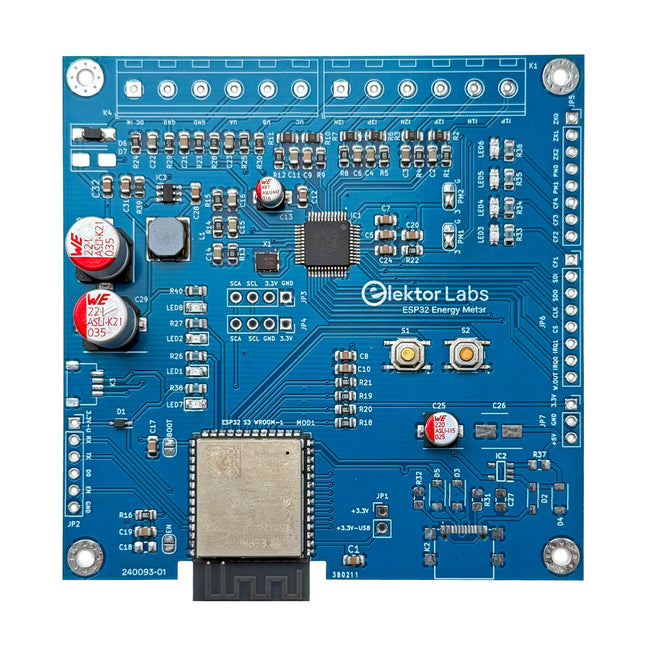
De Elektor ESP32 Energiemeter is een apparaat dat is ontworpen voor realtime energiemonitoring en smart home-integratie. Aangedreven door de ESP32-S3-microcontroller, biedt hij robuuste prestaties met modulaire en schaalbare functies.
Het apparaat maakt gebruik van een 220 V naar 12 V step-down transformator voor spanningsbemonstering, waardoor galvanische isolatie en veiligheid worden gegarandeerd. De compacte PCB-indeling omvat schroefklemmen voor veilige verbindingen, een Qwiic-connector voor extra sensoren en een programmeerheader voor directe ESP32-S3-configuratie. De energiemeter is compatibel met eenfasige en driefasige systemen, waardoor hij aanpasbaar is voor verschillende toepassingen.
De energiemeter is eenvoudig in te stellen en kan worden geïntegreerd met Home Assistant, waardoor realtime monitoring, historische analyses en automatiseringsmogelijkheden worden geboden. Het biedt nauwkeurige metingen van spanning, stroom en vermogen, waardoor het een waardevol hulpmiddel is voor het energiebeheer in huizen en bedrijven.
Kenmerken
Uitgebreide energiemonitoring: Krijg gedetailleerd inzicht in uw energieverbruik voor slimmer beheer.
Aanpasbare software: Pas de functionaliteit aan uw behoeften aan door aangepaste sensoren te programmeren en te integreren.
Klaar voor Smart Home: Compatibel met ESPHome, Home Assistant en MQTT voor volledige Smart Home-integratie.
Veilig & flexibel ontwerp: Werkt met een 220 V naar 12 V step-down transformator en beschikt over een voorgemonteerde SMD-kaart.
Snelle start: Inclusief één Current Transformer-sensor en toegang tot gratis installatiebronnen.
Specificaties
Microcontroller
ESP32-S3-WROOM-1-N8R2
IC voor energiemeting
ATM90E32AS
Statusindicatoren
4x LED's voor indicatie van energieverbruik2x Programmeerbare LED's voor aangepaste statusmeldingen
Gebruikersinvoer
2x drukknoppen voor gebruikersbediening
Uitvoer weergeven
I²C OLED-display voor realtime visualisatie van het energieverbruik
Ingangsspanning
110/220 V AC (via spanningstransformator)
Ingangsvermogen
12 V (via step-down transformator of DC-ingang)
Clampstroomsensor
YHDC SCT013-000 (100 A/50 mA) inbegrepen
Smart Home-integratie
ESPHome, Home Assistant en MQTTvoor naadloze connectiviteit
Connectiviteit
Header voor programmeren, Qwiic voor sensoruitbreiding
Toepassingen
Ondersteunt eenfasige en driefasige energiemonitoringsystemen
Afmetingen
79,5 x 79,5 mm
Inbegrepen
1x Gedeeltelijk gemonteerd bord (SMD-componenten zijn voorgemonteerd)
2x Schroefklemmenblokconnectoren (niet gemonteerd)
1x YHDC SCT013-000 stroomtransformator
Vereist
Voedingstransformator niet inbegrepen
Downloads
Datasheet (ESP32-S3-WROOM-1)
Datasheet (ATM90E32AS)
Datasheet (SCT013-000)
Frequently Asked Questions (FAQ)
Van prototype tot eindproduct
Wat begon als een innovatief project om een betrouwbare en gebruiksvriendelijke energiemeter te creëren met behulp van de ESP32-S3-microcontroller, is uitgegroeid tot een robuust product. Aanvankelijk ontwikkeld als een open-source-project, had de ESP32 Energiemeter tot doel nauwkeurige energiemonitoring, slimme huisintegratie en meer te bieden. Door nauwgezette hardware- en firmware-ontwikkeling is de energiemeter nu een compacte, veelzijdige oplossing voor energiebeheer.
A Project-Based Introduction to Microcontrollers and Drone Control
A Practical Introduction to Embedded Systems with the ESP32
This book is intended for readers who are new to embedded systems and looking for a structured, example-driven way to begin. If you’ve explored general-purpose electronics or Arduino-based resources but found them too broad or lacking in practical application, this guide offers a more focused alternative.
Using the ESP32 by Example Kit (EEK)—a small, affordable collection of components including LEDs, sensors, an OLED display, and a motion processor—you’ll build and work with a consistent hardware setup throughout the book. Once assembled, the EEK remains largely unchanged, allowing you to concentrate on learning and experimentation without constant reconfiguration.
Topics include:
Understanding and programming the ESP32 microcontroller
Using the Arduino IDE to write and deploy code
Exploring cyber-physical systems, culminating in basic drone control
No prior experience with Arduino or embedded development is required. Each section includes hands-on examples and mini-projects designed to reinforce core concepts and encourage deeper exploration. By the end, you’ll be equipped not only to reproduce the book’s examples, but also to extend them toward your own ideas and applications.
Whether your interest is in learning embedded programming, building interactive systems, or exploring educational drone control, this book provides a clear and practical path to getting started.
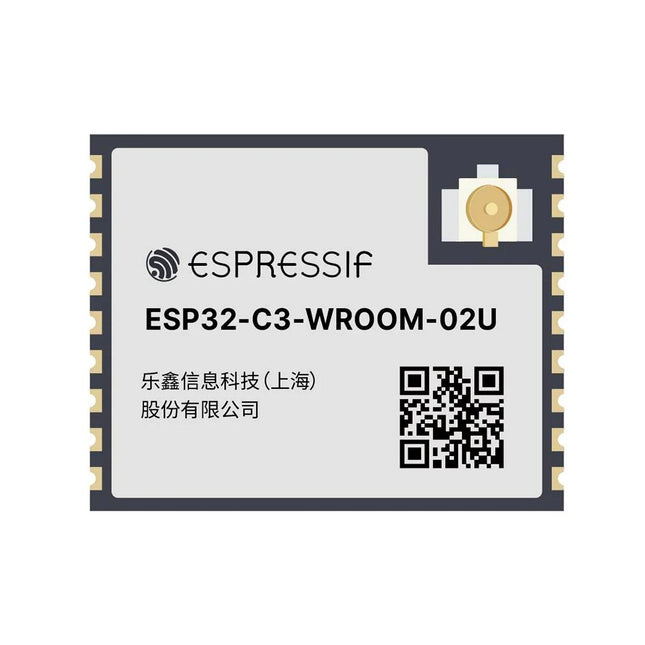
De ESP32-C3-WROOM-02U is een Wi-Fi- en Bluetooth LE module voor algemeen gebruik. Het brede scala aan randapparatuur en de hoge prestaties maken deze module tot een ideale keuze voor smart homes, industriële automatisering, zorgtoepassingen, consumentenelektronica, en meer.
De ESP32-C3-WROOM-02U is voorzien van een externe SPI flash en wordt geleverd met een aansluiting voor een externe antenne.
De ESP32-C3-WROOM-02U werkt in een omgevingstemperatuur van –40 ? 85°C en is ingebouwd in de ESP32-C3 chip. De ESP32-C3 heeft een 32-bits RISC-V single-core processor. Hij bevat een ruime selectie aan randapparatuur, variërend van een UART, I²C, I²S, randapparatuur voor afstandsbediening, een LED PWM controller, een algemene DMA-controller, een TWAI-controller, een USB seriële/JTAG controller, een temperatuursensor, een ADC, enzovoort. Hij bevat ook SPI, Dual SPI en Quad SPI interfaces.
Kenmerken
Flash: 4 MB (Quad SPI)
Afmetingen: 18,0 x 20,0 x 3,2 mm
Downloads
Datasheet
Practical Multitasking Fundamentals
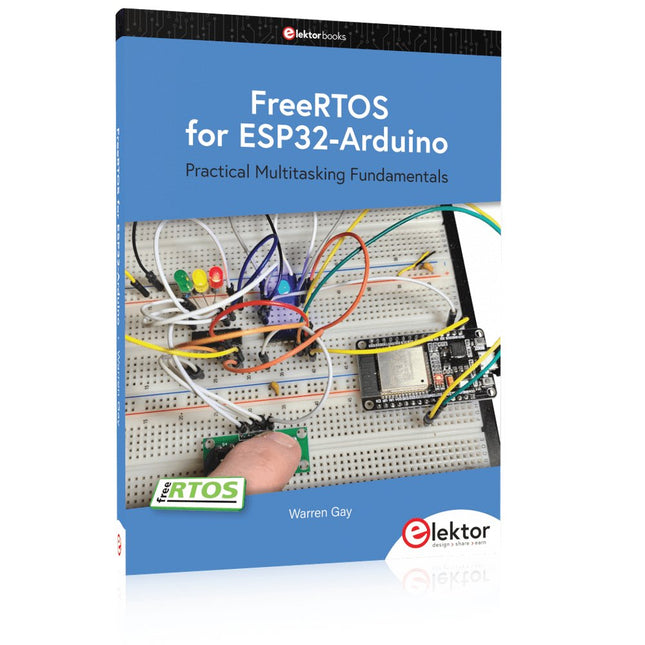
Programming embedded systems is difficult because of resource constraints and limited debugging facilities. Why develop your own Real-Time Operating System (RTOS) as well as your application when the proven FreeRTOS software is freely available? Why not start with a validated foundation?
Every software developer knows that you must divide a difficult problem into smaller ones to conquer it. Using separate preemptive tasks and FreeRTOS communication mechanisms, a clean separation of functions is achieved within the entire application. This results in safe and maintainable designs.
Practicing engineers and students alike can use this book and the ESP32 Arduino environment to wade into FreeRTOS concepts at a comfortable pace. The well-organized text enables you to master each concept before starting the next chapter. Practical breadboard experiments and schematics are included to bring the lessons home. Experience is the best teacher.
Each chapter includes exercises to test your knowledge. The coverage of the FreeRTOS Application Programming Interface (API) is complete for the ESP32 Arduino environment. You can apply what you learn to other FreeRTOS environments, including Espressif’s ESP-IDF. The source code is available from GitHub. All of these resources put you in the driver’s seat when it is time to develop your next uber-cool ESP32 project.
What you will learn:
How preemptive scheduling works within FreeRTOS
The Arduino startup “loopTask”
Message queues
FreeRTOS timers and the IDLE task
The semaphore, mutex, and their differences
The mailbox and its application
Real-time task priorities and its effect
Interrupt interaction and use with FreeRTOS
Queue sets
Notifying tasks with events
Event groups
Critical sections
Task local storage
The gatekeeper task
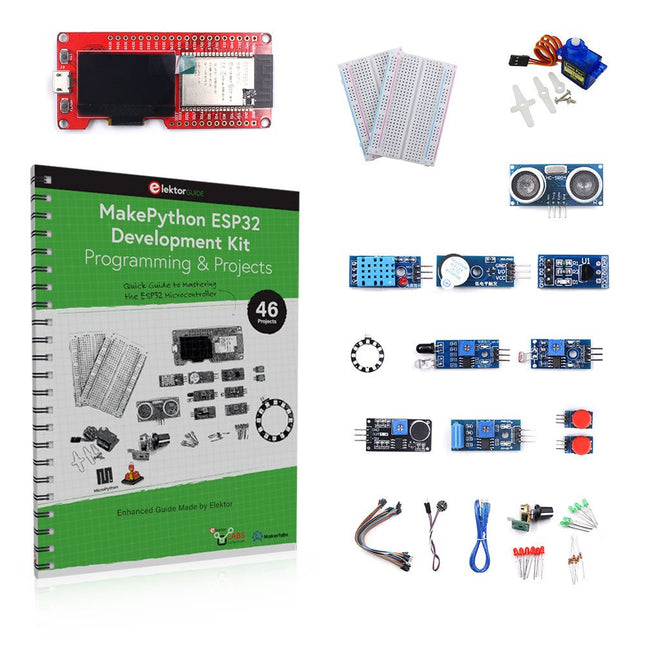
Leer hoe je de ESP32 Microcontroller en het programmeren met MicroPython in je toekomstige projecten kunt gebruiken!
Het (Engelstalige) projectboek, geschreven door de bekende Elektor auteur Dogan Ibrahim, bevat vele software- en hardware-gebaseerde projecten die speciaal voor de MakePython ESP32 ontwikkelkit ontwikkeld zijn. De kit wordt geleverd met verschillende LED's, sensoren, en actuatoren. De kit helpt je de basiskennis op te doen om eigen IoT projecten te maken.
Alle volledig geëvalueerde projecten in het boek zijn voorzien van de bijgeleverde componenten. Elk project bevat een blokschema, een schakelschema, een volledige programmalijst, en een volledige programma beschrijving.
Inbegrepen in de kit
1x MakePython ESP32 ontwikkelingsboard met LCD
1x Ultrasone afstandsmeter
1x Temperatuur- en luchtvochtigheidssensor
1x Zoemer module
1x DS18B20 module
1x Infrarood module
1x Potentiometer
1x WS2812 module
1x Geluidssensor
1x Trilsensor
1x Module met lichtgevoelige weerstand
1x Puls sensor
1x Servo motor
1x USB kabel
2x Knop
2x Breadboard
45x Schakeldraad
10x Weerstand 330R
10x LED (Rood)
10x LED (Groen)
1x Projectboek (Engelstalig, 206 pagina's)
Boek met 46 projecten
LED Projecten
Knipperende LED
SOS knipperende LED
Knipperende LED – met behulp van een timer
Afwisselend knipperende LEDs
Knopbediening
De knippersnelheid van de LED's veranderen met drukknop onderbrekingen
Chasing-LEDs
Binaire teller met LEDs
Kerstverlichting (willekeurig-knipperende 8 LEDs)
Elektronische dobbelsteen
Geluksdag van het week
Projecten voor Pulsewidth Modulation (PWM)
Genereer een PWM golfvorm van 1000 Hz met 50% duty cycle
LED helderheid regelen
Meten van de frequentie en duty cycle van een PWM golfvorm
Melodieën maker
Eenvoudig elektronisch orgel
Servo motor besturing
Servo motor DS18B20 thermometer
Projecten voor analoog naar digitaal converteren (ADC)
Voltmeter
Plotten van de analoge ingangsspanning
Interne temperatuursensor van de ESP32
Ohmmeter
Lichtgevoelige weerstandsmodule
Projecten voor digitaal naar analoog converteren (DAC)
Opwekken van vaste spanningen
Opwekken van een zaagtand-golf signaal
Opwekken van een driehoek-golf signaal
Golfvorm met willekeurige periode
Genereren van een sinus-golf signaal
Genereren van een nauwkeurig sinus-golf signaal met behulp van een timer interrupts
Gebruik van het OLED Display
Seconden teller
Gebeurtenisteller
DS18B20 digitale thermometer met OLED
ON-OFF temperatuur regelaar
Meten van temperatuur en luchtvochtigheid
Ultrasone afstandsmeting
Hoogte van een persoon (stadiometer)
Hartslag (polsslag) meten
Andere bij de set geleverde sensoren
Diefstal alarm
Met geluid geactiveerd licht
Infrarood obstakel-vermijding met zoemer
WS2812 RGB LED ring
Tijdregistratie van temperatuur en luchtvochtigheid
Netwerkprogrammering
Wi-Fi scanner
Bediening op afstand vanuit de Internet browser (met een smartphone of PC) – Webserver
Temperatuur- en luchtvochtigheidsgegevens opslaan in de Cloud
Werking met Low-Power
Gebruik een timer om de processor te laten ontwaken
Easy and Affordable Digital Signal ProcessingThe aim of this book is to teach the basic principles of Digital Signal Processing (DSP) and to introduce it from a practical point of view using the bare minimum of mathematics. Only the basic level of discrete-time systems theory is given, sufficient to implement DSP applications in real time. The practical implementations are described in real time using the highly popular ESP32 DevKitC microcontroller development board. With the low cost and extremely popular ESP32 microcontroller, you should be able to design elementary DSP projects with sampling frequencies within the audio range. All programming is done using the popular Arduino IDE in conjunction with the C language compiler.After laying a solid foundation of DSP theory and pertinent discussions on the main DSP software tools on the market, the book presents the following audio-based sound and DSP projects:
Using an I²S-based digital microphone to capture audio sound
Using an I²S-based class-D audio amplifier and speaker
Playing MP3 music stored on an SD card through an I²S-based amplifier and speaker
Playing MP3 music files stored in ESP32 flash memory through an I²S-based amplifier and speaker
Mono and stereo Internet radio with I²S-based amplifiers and speakers
Text-to-speech output with an I²S-based amplifier and speaker
Using the volume control in I²S-based amplifier and speaker systems
A speaking event counter with an I²S-based amplifier and speaker
An adjustable sinewave generator with I²S-based amplifier and speaker
Using the Pmod I²S2 24-bit fast ADC/DAC module
Digital low-pass and band-pass real-time FIR filter design with external and internal A/D and D/A conversion
Digital low-pass and band-pass real-time IIR filter design with external and internal A/D and D/A conversion
Fast Fourier Transforms (FFT)
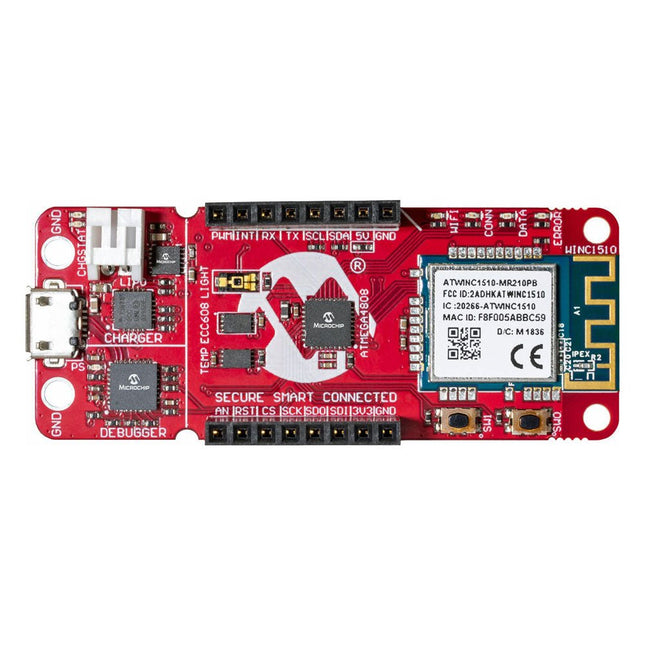
The AVR-IoT WA development board combines a powerful ATmega4808 AVR MCU, an ATECC608A CryptoAuthentication™ secure element IC and the fully certified ATWINC1510 Wi-Fi network controller – which provides the most simple and effective way to connect your embedded application to Amazon Web Services (AWS). The board also includes an on-board debugger, and requires no external hardware to program and debug the MCU.Out of the box, the MCU comes preloaded with a firmware image that enables you to quickly connect and send data to the AWS platform using the on-board temperature and light sensors. Once you are ready to build your own custom design, you can easily generate code using the free software libraries in Atmel START or MPLAB Code Configurator (MCC).The AVR-IoT WA board is supported by two award-winning Integrated Development Environments (IDEs) – Atmel Studio and Microchip MPLAB X IDE – giving you the freedom to innovate with your environment of choice.Features
ATmega4808 microcontroller
Four user LED’s
Two mechanical buttons
mikroBUS header footprint
TEMT6000 Light sensor
MCP9808 Temperature sensor
ATECC608A CryptoAuthentication™ device
WINC1510 WiFi Module
On-board Debugger
Auto-ID for board identification in Atmel Studio and Microchip MPLAB X
One green board power and status LED
Programming and debugging
Virtual COM port (CDC)
Two DGI GPIO lines
USB and battery powered
Integrated Li-Ion/LiPo battery charger
,
van Johan van den Brande
ESP32 Terminal (Review)
De Elecrow ESP32 Terminal is een ESP32-3 aangedreven draagbaar apparaat met een 3,5″ 480 × 320 TFT capacitief touch display en een veelheid aan mogelijkheden. Het apparaat...