
Zoekresultaten voor "loomia OR double OR backlit OR user OR interface"
-
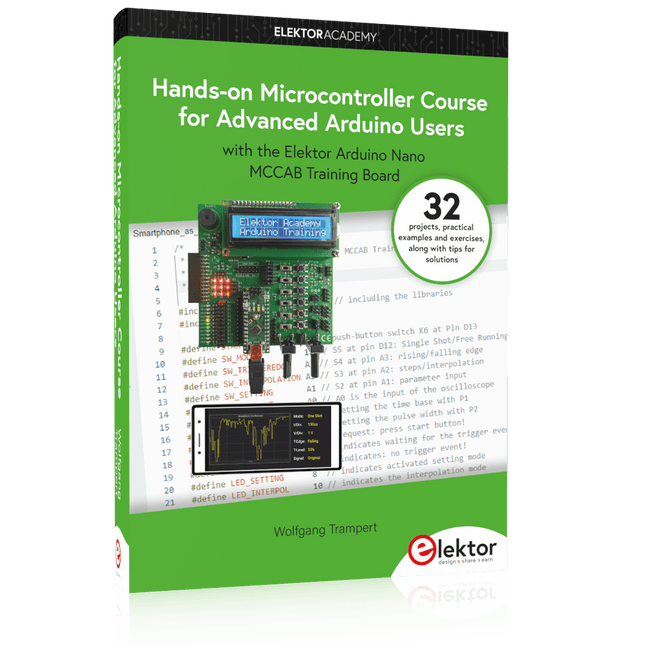
Elektor Publishing Hands-on Microcontroller Course for Advanced Arduino Users
32 new Projects, Practical Examples and Exercises with the Elektor Arduino Nano MCCAB Training Board Electronics and microcontroller technology offer the opportunity to be creative. This practical microcontroller course provides you with the chance to bring your own Arduino projects and experience such moments of success. Ideally, everything works as you imagined when you switch it on for the first time. In practice, however, things rarely work as expected. At that point, you need knowledge to efficiently search for and find the reason for the malfunction. In this book for advanced users, we delve deep into the world of microcontrollers and the Arduino IDE to learn new procedures and details, enabling you to successfully tackle and solve even more challenging situations. With this book, the author gives the reader the necessary tools to create projects independently and also to be able to find errors quickly. Instead of just offering ready-made solutions, he explains the background, the hardware used, and any tools required. He sets tasks in which the reader contributes their own creativity and writes the Arduino sketch themselves. If you don’t have a good idea and get stuck, there is, of course, a suggested solution for every project and every task, along with the corresponding software, which is commented on and explained in detail in the book. This practical course will teach you more about the inner workings of the Arduino Nano and its microcontroller. You will get to know hardware modules that you can use to realize new and interesting projects. You will familiarize yourself with software methods such as ‘state machines,’ which can often be used to solve problems more easily and clearly. The numerous practical projects and exercise sketches are once again realized on the Arduino Nano MCCAB Training Board, which you may already be familiar with from the course book ‘Microcontrollers Hands-on Course for Arduino Starters’, and which contains all the hardware peripherals and operating elements we need for the input/output operations of our sketches. Readers who do not yet own the Arduino Nano MCCAB Training Board can purchase the required hardware separately, or alternatively, build it on a breadboard.
€ 49,95
Leden € 44,96
-

Elektor Digital ARM Microcontroller Interfacing (E-book)
Learn to interface and program hardware devices in a wide range of useful applications, using ARM7 microcontrollers and the C programming language. Examples covered in full detail include a simple LED to a multi-megabyte SD card running the FAT file system. Features of this book Build prototype circuits on breadboard or Veroboard and interface to ARM microcontrollers. A 32-bit ARM7 microcontroller is used in interfacing and software examples. Interfacing principles apply to other ARM microcontrollers and other non-ARM microcontrollers as well. Example programs are written in the C programming language. Use only free or open source software. Download and install all programming tools from the Internet. Template project files are provided for easy project creation. Hardware Interface to LEDs, transistors, optocouplers, relays, solenoids, switches, keypads, LCD displays, seven segment displays, DC motors, stepper motors, external analogue signals using the ADC, RS232, RS-485, TWI, USB, SPI and SD memory cards. Software Once hardware has been interfaced to a microcontroller, software must be written to control the hardware. You will learn how to write programs to operate externally interfaced hardware devices, use timers and interrupts. Also learn how to port FAT file system code for use with an SD memory card, program the PWM to produce an audio sine wave, program the PWM to speed control a DC motor and more. A chapter on more advanced ARM microcontrollers is included with an overview of some of the newest ARM microcontrollers and their features.
€ 29,95
Leden € 23,96
-
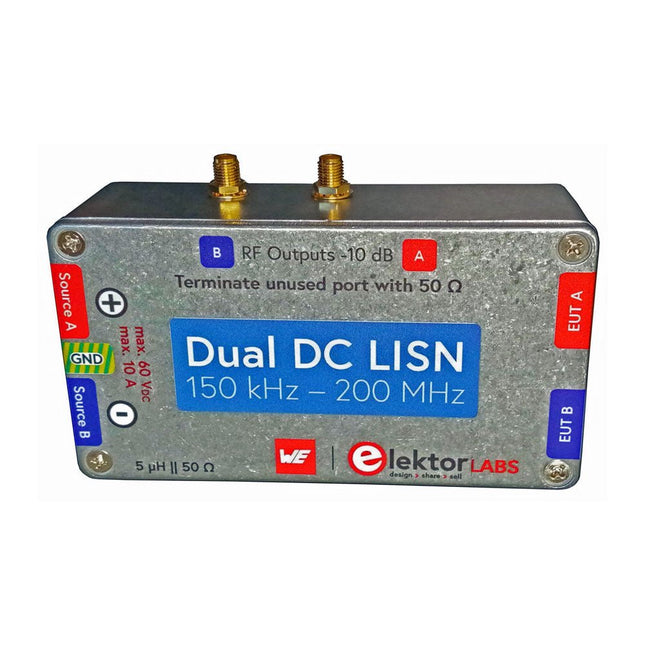
Elektor Labs Elektor Dual DC LISN (150 kHz – 200 MHz)
Het meten van conducted emission is de eenvoudigste en meest betaalbare methode om een indicatie te krijgen of een ontwerp aan de EMI/EMC eisen kan voldoen. Een Line Impedance Stabilization Network (LISN) is daarbij een onmisbaar onderdeel van een EMC pre-compliance testopstelling. Elektor heeft in samenwerking met Würth Elektronik een 5 µH, 50 Ω Dual DC LISN ontwikkeld die geschikt is voor spanningen tot 60 V en stromen tot 10 A. Het instrument meet RF-interferenties op beide kanalen (de voeding) door middel van 5 µH blokkeerspoelen. De interne 10 dB verzwakkingstrap – één per kanaal – bevat een 3e orde hoogdoorlaatfilter met een afsnijfrequentie van 9 kHz om de ingang van instrumenten zoals een spectrum analyzer te beschermen tegen mogelijk schadelijke DC spanningen of lage frequenties afkomstig van de DUT (Device Under Test). Specificaties RF-pad Kanalen 2 (met clamping diodes) Bandbreedte 150 kHz – 200 MHz Impedantie 5 µH || 50 Ω Interne demping 10 dB Connectoren SMA DC-pad Max. stroom < 10 ADC Max. spanning < 60 VDC DC weerstand < 2 x 70 mΩ PCB-formaat 94,2 x 57,4 mm Connectoren 4 mm banaan Hammond-behuizing Type 1590N Afmetingen 121 x 66 x 40 mm Inbegrepen 1x 4-laags PCB met alle SMT-onderdelen gemonteerd 1x Voorgeboorde behuizing met bedrukt frontpaneel 5x Vergulde, geïsoleerde 4 mm banaanstekers, geschikt voor 24 A, 1 kV 1x Hammond-behuizing 1590N1, aluminium (gegoten legering) Meer info Project op Elektor Labs: Dual DC LISN for EMC pre-compliance testing Elektor 9-10/2021: EMC Pre-Compliance Test voor uw DC-gevoed project (deel 1) Elektor 11-12/2021: EMC Pre-Compliance Test voor uw DC-gevoed project (deel 2)
€ 159,95€ 139,95
Leden identiek
-
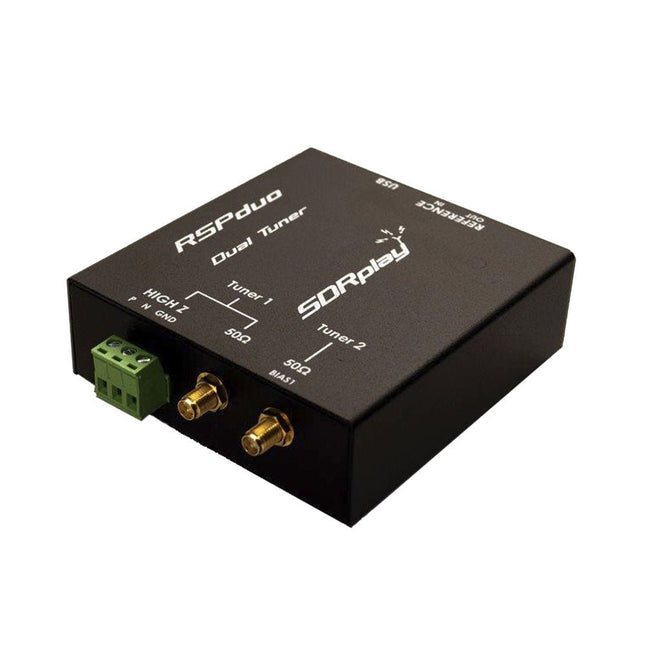
SDRplay SDRplay RSPduo Dual-Tuner 14-bit SDR-ontvanger (1 kHz tot 2 GHz)
De SDRplay RSPduo is een hoogwaardige 14-bit SDR-ontvanger met dubbele tuner. De tuner is ondergebracht in een hoogwaardige stalen behuizing en kan afzonderlijk werken tussen 1 kHz en 2 GHz met een bandbreedte tot 10 MHz. Beide tuners kunnen tegelijkertijd werken tussen 1 kHz en 2 GHz met een bandbreedte tot 2 MHz per tuner. Een zeer stabiele referentie en externe klokfuncties maken dit apparaat ideaal voor industriële, wetenschappelijke en educatieve toepassingen. Kenmerken Dubbele tuner biedt onafhankelijke dekking van 1 kHz tot 2 GHz met behulp van 2 antennepoorten tegelijk 14-bits ADC-siliciumtechnologie Tot 10 MHz zichtbare bandbreedte (enkele tunermodus) of 2 slices van 2 MHz spectrum (dubbele tunermodus) 3 softwarematig selecteerbare antennepoorten (2x 50Ω en 1x 1kΩ hoge impedantie gebalanceerde/ongebalanceerde ingang) Antennepoort met hoge impedantie (1 kHz tot 30 MHz) met selecteerbaar MW-notchfilter en keuze uit 2 voorselectiefilters Softwarematig selecteerbare AM/FM- en DAB-uitzendband-notchfilters voor de 2 SMA-antennepoorten (1 kHz tot 2 GHz) Externe klokinvoer en -uitvoer maken eenvoudige synchronisatie met meerdere RSP's of een externe referentieklok mogelijk Wordt gevoed via de USB-kabel met een eenvoudige type B-aansluiting 11 hoogselectieve, ingebouwde front-end preselectiefilters op beide 2 SMA-antennepoorten Softwarematig selecteerbare multi-level Low Noise voorversterker Bias-T voeding voor het voeden van een op de antenne gemonteerde LNA In een robuuste, zwart gelakte stalen behuizing. SDRuno – SDR-software van wereldklasse voor Windows Gedocumenteerde API voor de ontwikkeling van nieuwe apps Specificaties Frequentiebereik 1 kHz – 2 GHz Antenne-aansluiting SMA Antenne-impedantie 50 ohm Stroomverbruik (typisch) Enkele tunermodus: 180 mA (excl. Bias-T)Dubbele tunermodus: 280 mA (excl. Bias-T) USB-aansluiting USB type B Maximaal ingangsvermogen +0 dBm Continu+10 dBm korte duur ADC-samplefrequenties 2-10,66 MSPS ADC-aantal bits 14 bit 2-6,048 MSPS12 bit 6,048-8,064 MSPS10 bit 8,064-9,216 MSPS8 bit >9,216 MSPS Bias-T 4,7 V100 mA gegarandeerd Referentie Hoge temperatuurstabiliteit (0,5 ppm) 24 MHz TCXOFrequentiefout instelbaar tot 0,01 ppm in het veld Bedrijfstemperatuurbereik −10°C tot +60°C Afmetingen 98 x 94 x 33 mm Gewicht 315 g Downloads Datasheet Detailed Technical Information Software RSPdx-R2 vs RSPduo RSPdx-R2 RSPduo Continue dekking van 1 kHz tot 2 GHz ✓ ✓ Tot 10 MHz zichtbare bandbreedte ✓ ✓ 14-bits ADC siliciumtechnologie plus meerdere krachtige ingangsfilters ✓ ✓ Softwarematig selecteerbare AM/FM & DAB broadcast band notch filters ✓ ✓ 4,7 V Bias-T voor voeding van externe antenneversterker ✓ ✓ Voedt de USB-kabel met een eenvoudige aansluiting type B ✓ ✓ 50Ω SMA-antenne-ingang(en) voor werking van 1 kHz tot 2 GHz (softwarematig instelbaar) 2 2 Extra softwarematig selecteerbare Hi-Z ingang voor werking tot 30 MHz ✓ Extra softwarematig selecteerbare 50Ω BNC-ingang voor werking tot 200 MHz ✓ Extra LF/VLF-filter voor onder 500 kHz ✓ 24 MHz referentieklokingang (+ uitgang op RSPduo) ✓ ✓ Dubbele tuners voor ontvangst op 2 totaal onafhankelijke 2 MHz-bereiken ✓ Dubbele tuners voor diversiteitsontvangst met SDRuno ✓ Robuuste zwartgelakte stalen behuizing ✓ ✓ Algemene prestaties onder 2 MHz voor MW en LF ++ + Meerdere gelijktijdige toepassingen + ++ Prestaties in uitdagende fading-omstandigheden (*met gebruik van diversiteitsafstemming) + *++
€ 287,98
-

Elektor Digital Supersnel PC Interfacen (E-book)
Wilt u in enkele minuten een programma maken op uw PC, dat communiceert met een microcontroller? Dit boek, samen met de Piccolino en gratis software, maakt dat mogelijk!Als hardware wordt gebruik gemaakt van de Piccolino. Dit is een prototype platform met een moderne PIC16F887 microcontroller, dat gebruikt kan worden om razendsnel microcontroller opstellingen te maken. Alle basisvoorzieningen zijn aanwezig op de Piccolino, en door middel van de headers kunnen extra onderdelen eenvoudig aangesloten worden.De Piccolino wordt geprogrammeerd met de krachtige maar eenvoudig te leren gratis programmeertaal JAL. Deze taal wordt zowel door hobbyisten als professionals gebruikt. Bovendien is een serie projectboeken in deze taal verkrijgbaar, en een lesboek waarmee u JAL kunt leren. Aan de PC kant wordt gebruik gemaakt van de eveneens eenvoudig te leren gratis programmeertaal Small Basic van Microsoft. Deze taal is speciaal ontwikkeld om snel Windows programma's te kunnen ontwikkelen, ook voor mensen die weinig of geen PC programmeer ervaring hebben. U leert verschillende technieken om een PC met een microcontroller te laten communiceren zoals losse communicatie, het versterken en verzwakken van signalen, verwerken van valse metingen, master-slave communicatie en synchronisatie met geforceerde reset.Behalve theorie staan in het boek ook 15 leuke en praktische projecten. Door de duidelijke uitleg en instructies kunt u deze projecten zelf uitbreiden en helemaal aan uw eigen wensen aanpassen. Een paar voorbeelden uit het boek: Meet signalen en toon ze op de PC Maak een eigen muis of keyboard besturing. Meet en analyseer componenten (Spoel / Condensator / Transistor / OPAMP) met automatische grafieken op uw PC. Bestuur een servomotor vanaf de PC. Verzamel metingen in de Piccolino en zet ze later over naar uw PC. De combinatie van theorie en praktijkvoorbeelden in dit boek zorgt er voor dat u voor elk interface-probleem een oplossing bij de hand hebt, of weet hoe u er een moet maken.Wat heeft u nodig: Een PC met seriële of USB poort, internetaansluiting en een browser zoals Microsoft Internet Explorer. De gratis download van het softwarepakket (bestand hierboven te vinden), met alle benodigde programma's en voorbeelden De print van het Piccolino-bord is binnenkort verkrijgbaar bij Elektor. Het onderdelenpakket behorende bij dit boek is; verkrijgbaar bij Elektor
€ 29,95
Leden € 23,96
-

Elektor Digital Python 3 Programming and GUIs (E-book)
This is the second edition of a book aimed at engineers, scientists, and hobbyists who want to interface PCs with hardware projects using graphical user interfaces. Desktop and web-based applications are covered. The programming language used is Python 3, which is one of the most popular languages around: speed of programming being a key feature. The book has been revised and updated with an emphasis on getting the user to produce practical designs with ease – a text editor is all that is required to produce Python programs. Hardware interfacing is achieved using an Arduino Uno as a remote slave. A full description and source code of the communication interface is given in the book. The slave provides digital and analog input and outputs. Multiple Unos can be included in one project with all control code written in Python and running on a PC One project involves a PIC microcontroller with the code provided that can be loaded into the PIC using the Uno. The web applications and server are all implemented in Python, allowing you to access your electronic hardware over the Internet. The Raspberry Pi computer can be used as your web server. An introductory chapter is provided to get you started with using Linux. The book is written for use with Debian or variations including Mint or Ubuntu. All of the programs in the book are freely available, ready to use and experiment with by way of a download from Elektor.
€ 29,95
Leden € 23,96
-

Uni-Trend UNI-T UDP3305S-E DC-voeding (328 W)
The UDP3305S-E is a high-performance programmable linear DC power supply. It has a clear LCD user interface, excellent performance indicators, a variety of analysis functions and communication interfaces. It can meet the diversified test needs of users. It aims to provide cost-effective DC programmable power supply equipment for teaching, scientific research, industry and other fields. LCD interactive interface Using a 4.3-inch high-definition display screen, it provides users with a man-machine interface with rich functions and simple operation, which can display the current set output voltage/current, actual output voltage/current and protection output voltage/current value of the power supply in real time. The functional interface is simple and comprehensive, easy to operate. One-key setting for series and parallel The series-parallel connection between CH1 and CH2 of the main channel can be realized without external connection, which simplifies the connection and makes the test easier. List/Delayer function With list and delay setting functions, it can set up to 2048 sets of data according to test requirements, and the number of cycles can reach 99999. It is used with waveform templates, which is very convenient for cycle testing and aging testing. Rich remote control interface Standard RS232 communication interface, Ethernet interface, Digital I/O and master and slave USB interfaces, can be controlled by remote connection to Ethernet, or through RS232 and USB, with the host computer software to achieve software control. Specificaties Type Linear DC power supply Channels 4 Total power 328 W Output voltage CH1/CH2: 0~30 VCH3: 0~6 VCH4: 5 V Output current CH1/CH2: 0~5 ACH3: 0~3 ACH4: 2 A Resolution 10 mV, 1 mA Setting accuracy 0.3% +20 mV<0.2% +5 mA Connectivity USB Device, RS-232, LAN, USB host, Digital I/O Inbegrepen 1x UDP3305S-E DC Power Supply 1x Power cord 1x USB cable Downloads Datasheet User manual Programming manual Software V1.0 Firmware V1.10
€ 396,54
-

Elektor Digital The EAGLE Companion (E-book)
EAGLE – the “Easily Applicable Graphical Layout Editor“ is a professional-grade CAD (computer aided design) software package for the design and drafting of electronic schematics as well as the design and fabrication of printed circuit boards (PCBs). This Advanced User Guide provides the experienced EAGLE user with insight into using some of the more advanced features of EAGLE software. It is not a guide to teach the reader the basic concepts of EAGLE, nor does it discuss the ‘how to’ of the EAGLE interface and the simpler operations and commands of the software. That is the purpose of the author’s previous title EAGLE V6 Getting Started Guide also published by Elektor. This eBook is intended as an enduring document covering the more advanced modules, commands, and functions which make up EAGLE. It is hoped that this eBook will provide a quick, succinct reference to assist with more complex applications and uses of EAGLE – an ‘EAGLE User’s Companion’, if you like. Complementing the EAGLE Advanced User Guide, the EAGLE User Language manual is included in this eBook in unabridged form, reproduced with permission of CadSoft GmbH. At the time of writing, the material in this eBook covers version 7 of the EAGLE software suite.
€ 39,95
Leden € 31,96
-

NXP Semiconductors NXP FRDM-MCXN947 Development Board
The FRDM-MCXN947 is a compact and versatile development board designed for rapid prototyping with MCX N94 and N54 microcontrollers. It features industry-standard headers for easy access to the MCU's I/Os, integrated open-standard serial interfaces, external flash memory, and an onboard MCU-Link debugger. Specificaties Microcontroller MCX-N947 Dual Arm Cortex-M33 cores @ 150 MHz each with optimized performance efficiency, up to 2 MB dual-bank flash with optional full ECC RAM, External flash Accelerators: Neural Processing Unit, PowerQuad, Smart DMA, etc. Memory Expansion *DNP Micro SD card socket Connectivity Ethernet Phy and connector HS USB-C connectors SPI/I²C/UART connector (PMOD/mikroBUS, DNP) WiFi connector (PMOD/mikroBUS, DNP) CAN-FD transceiver Debug On-board MCU-Link debugger with CMSIS-DAP JTAG/SWD connector Sensor P3T1755 I³C/I²C Temp Sensor, Touch Pad Expansion Options Arduino Header (with FRDM expansion rows) FRDM Header FlexIO/LCD Header SmartDMA/Camera Header Pmod *DNP mikroBUS User Interface RGB user LED, plus Reset, ISP, Wakeup buttons Inbegrepen 1x FRDM-MCXN947 Development Board 1x USB-C Cable 1x Quick Start Guide Downloads Datasheet Block diagram
€ 29,95€ 19,95
Leden identiek
-

Elektor Digital Ultimate Arduino Uno Hardware Manual (E-book)
A Reference and User Guide for the Arduino Uno Hardware and Firmware A manual providing up-to-date hardware information for the popular Arduino Uno, the easy to use open-source electronics platform used by hobbyists, makers, hackers, experimenters, educators and professionals. Get all the information that you need on the hardware and firmware found on Arduino Uno boards in this handy reference and user guide. ldeal for the workbench or desktop Contains all of the Arduino Uno hardware information in one place Covers Arduino / Genuino Uno revision 3 and earlier boards Easily find hardware technical specifications with explanations Pin reference chapter with interfacing examples Diagrams and illustrations for easy reference to alternate pin functions and hardware connections Learn to back up and restore firmware on the board, or load new firmware Basic fault finding and repair procedures for Arduino Uno boards Power supply circuits simplified and explained Mechanical dimensions split into five easy to reference diagrams Contains circuit diagrams, parts list and board layout reference to easily locate components
€ 29,95
Leden € 23,96
-
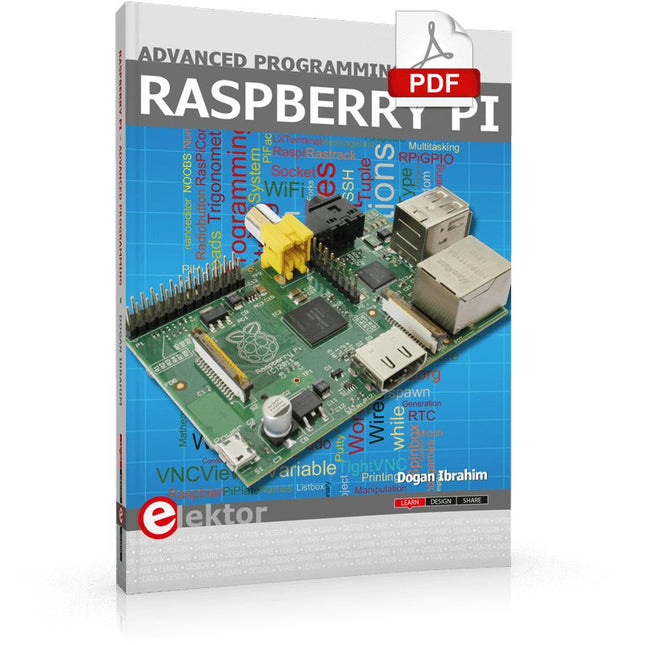
Elektor Digital Raspberry Pi Advanced Programming (E-book)
This book is about advanced programming of the Raspberry Pi computer using the Python programming language. The book explains in simple terms and with examples: How to configure the Raspberry Pi computer; How to install and use the Linux operating system and the desktop; How to write advanced programs using the Python programming language; How to use graphics in our programs; How to develop hardware based projects using the Raspberry Pi. The book starts with an introduction to the Raspberry Pi computer and covers the topics of purchasing all the necessary accessories and installing and operating the Linux operating system in command mode. The network interface of the RPi is explained in simple steps, demonstrating how the computer can be accessed remotely from a desktop or a laptop computer. The remaining parts of the book cover the Python programming language in detail, including advanced topics such as operating system calls, multitasking, interprocess synchronization and interprocess communication techniques. The important topic of network programming using UDP and TCP protocols is described with working examples. The Tkinter graphical user interface module (GUI) is described in detail with example widgets and programs. The last part of the book includes hardware projects based on using the advanced programming topics such as multitasking and interprocess communication techniques. All the projects given in the book have been fully tested and are working. Complete program listings of all projects are provided with detailed explanations.
€ 34,95
Leden € 27,96
-

Siglent Siglent SDG2042X Arbitrary Waveform Generator (40 MHz)
Siglent's SDG2000X is a series of dual-channel function/arbitrary waveform generators with specifications of up to 120 MHz maximum bandwidth, 1.2 GSa/s sampling rate and 16-bit vertical resolution. The proprietary TrueArb & EasyPulse techniques help to solve the weaknesses inherent in traditional DDS generators when generating arbitrary, square and pulse waveforms. With advantages above, SDG2000X can provide users with a variety of high fidelity and low jitter signals, which can meet the growing requirements of complex and extensive applications. Kenmerken Dual-channel, 40 MHz bandwidth, 20Vpp maximum output amplitude, high fidelity output with 80dB dynamic range. High-performance sampling system with 1.2GSa/s sampling rate and 16-bit vertical resolution. No detail in your waveforms will be lost. Innovative TrueArb technology, based on a point-by-point architecture, supports any 8pts~8Mpts Arb waveform with a sampling rate in range of 1?Sa/s~75MSa/s. Innovative EasyPulse technology, capable of generating lower jitter Square or Pulse waveforms, brings a wide range and extremely high precision in pulse width and rise/fall times adjustment. Plenty of analog and digital modulation types: AM, DSB-AM, FM, PM, FSK, ASK and PWM. Sweep and Burst functions. High precision Frequency Counter. Standard interfaces: USB Host, USB DeviceUSBTMC, LAN (VXI-11) Optional interface: GPIB. 4.3” touch screen display for easier operation. Specificaties Maximum output frequency 40 MHz Output channels 2 Sampling rate 1.2 GSa/s (4X Interpolation) Wave length CH1: 16Kpts, CH2: 512Kpts Frequency resolution 1 μHz Vertical resolution 16 bit Standard interfaces Standard interfaces: USB Host, USB Device (USBTMC), LAN (VXI-11) High-performance Sampling System Benefiting from a 1.2GSa/s and 16-bit sampling system, SDG2000X achieves extremely high accuracy performance in both time domain and amplitude, which results in more accurately reconstructed waveforms and lower distortion. Innovative EasyPulse Technology When a Square/Pulse waveform is generated by DDS, there will be a one-clock-jitter if the sampling rate is not an integer-related multiple of the output frequency. SDG2000X EasyPulse technology successfully overcomes this weakness in DDS designs and helps to produce low jitter Square/Pulse waveforms. Innovative TrueArb Technology For arbitrary waveforms, TrueArb not only has all the advantages of traditional DDS, but also eliminates the probability that DDS may cause serious jitter and distortion. Easy controll with 4.3” Touch Screen Display and Arbitrary Waveform Software EasyWave The 4.3” touch screen display, makes operation much more convenient. And EasyWave is a powerful arbitrary waveform editing software that supports several ways to generate arbitrary waveform such as manual drawing, line-drawing, equation-drawing, coordinate-drawing, etc. It is quite convenient for users to edit their own arbitrary waveforms through EasyWave. Inbegrepen Siglent SDG2042X Arbitrary Function Generator User Manual Guarantee Card CD (including EasyWave 1.0 computer software system) Power Cord USB Cable Quick Start Guide
€ 560,39


