
Physical Products
-
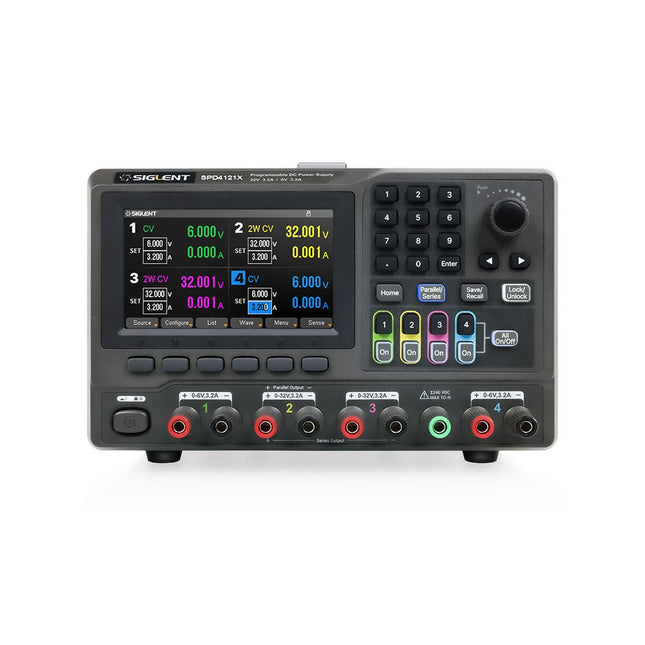
Siglent Siglent SPD4121X 4-kanaals Voeding (285 W)
The Siglent SPD4121X is a 4-channel DC Linear Programmable Power Supply equipped with a 4.3-inch TFT-LCD display, friendly human-machine interface, and excellent performance indicators. Real-time waveform display provides engineers with an informative user interface. SPD4121X offers a total output power of 285 W with a resolution of 1 mV/1 mA. The maximum voltage and current for each channel are as follows: CH1: 15 V/1.5 A CH2: 12 V/10 A CH3: 12 V/10 A CH4: 15 V/1.5 A Kenmerken Rated output power: 285 W Rated voltage: 32 V, 12 V, 30 V Up to four high-precision power supplies with independent controllable outputs, supporting CH2 and CH3 series and parallel connections Clear graphical interface with waveform and timer display modes 5-digit voltage and current display with minimum resolution of 1 mV, 1 mA Fast output response time: <50us The high current channel support remote voltage compensation sense function. The maximum compensation voltage is 0.6 V Overvoltage protection and overcurrent protection or safe and accurate operation Equipped with a 4.3-inch TFT-LCD display (480 x 272 resolution) USB and LAN standard communication USB-GPIB module is optional Excellent channel density with up to 4 channels in a 3U half rack package Internal data storage for setups and parameters Embedded Web Server with instrument communication that doesn’t require software installation Fully SCPI programming command set support as well as a LabView driver for remote control and system automation Specificaties SPD4323X SPD4121X SPD4306X Channel Output CH1: Voltage 0 to 6 V Current 0 to 3.2 ACH2: Voltage 0 to 32 V Current 0 to 3.2 ACH3: Voltage 0 to 32 V Current 0 to 3.2 ACH4: Voltage 0 to 6 V Current 0 to 3.2 A CH1: Voltage 0 to 15 V Current 0 to 1.5 ACH2: Voltage 0 to 12 V Current 0 to 10 ACH3: Voltage 0 to 12 V Current 0 to 10 ACH4: Voltage 0 to 15 V Current 0 to 1.5 A CH1: Voltage 0 to 15 V Current 0 to 1.5 ACH2: Voltage 0 to 30 V Current 0 to 6 ACH3: Voltage 0 to 30 V Current 0 to 6 ACH4: Voltage 0 to 15 V Current 0 to 1 A Resolution 1 mV, 1 mA 1 mV, 1 mA 1 mV, 1 mA Setting Accuracy Voltage: ±(0.03% of reading+10) mV, Current: ±(0.3% of reading+10) mA Voltage: ±(0.03% of reading+10) mV, Current: ±(0.3% of reading+10) mA Voltage: ±(0.03% of reading+10) mV, Current: ±(0.3% of reading+10) mA Readback Accuracy Voltage: ±(0.03% of reading+10) mV, Current: ±(0.3% of reading+10) mA Voltage: ±(0.03% of reading+10) mV, Current: ±(0.3% of reading+10) mA Voltage: ±(0.03% of reading+10) mV, Current: ±(0.3% of reading+10) mA Display 4.3" TFT-LCD 5-digit voltage and current display 4.3" TFT-LCD 5-digit voltage and current display 4.3" TFT-LCD 5-digit voltage and current display Output power 240 W 285 W 400 W Inbegrepen 1x Siglent SPD4121X Power Supply 1x Power cord (EU) 1x Output test cord (3 A) 1x USB cable 1x Quick start guide Downloads Datasheet Manual Quick start
€ 871,20
-
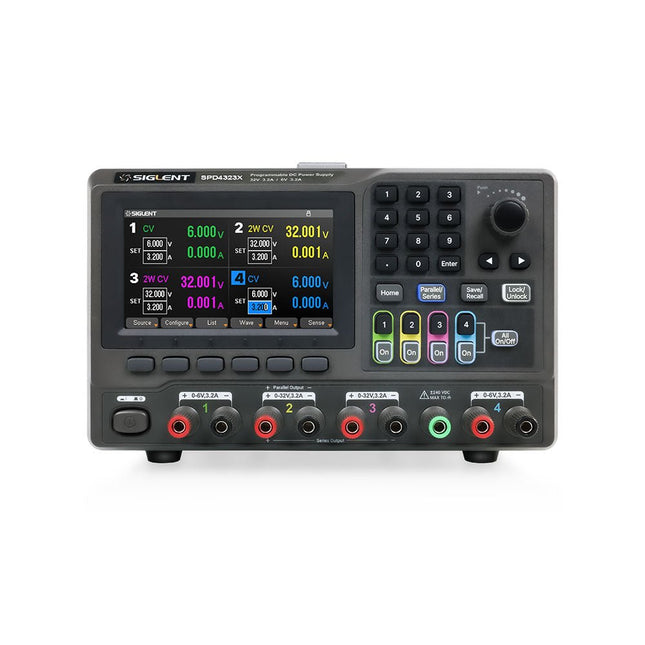
Siglent Siglent SPD4323X 4-kanaals Voeding (240 W)
The Siglent SPD4323X is a 4-channel DC Linear Programmable Power Supply equipped with a 4.3-inch TFT-LCD display, friendly human-machine interface, and excellent performance indicators. Real-time waveform display provides engineers with an informative user interface. SPD4323X offers a total output power of 240 W with a resolution of 1 mV/1 mA. The maximum voltage and current for each channel are as follows: CH1: 6 V/3.2 A CH2: 32 V/3.2 A CH3: 32 V/3.2 A CH4: 6 V/3.2 A Kenmerken Rated output power: 240 W Rated voltage: 32 V, 12 V, 30 V Up to four high-precision power supplies with independent controllable outputs, supporting CH2 and CH3 series and parallel connections Clear graphical interface with waveform and timer display modes 5-digit voltage and current display with minimum resolution of 1 mV, 1 mA Fast output response time: <50us The high current channel support remote voltage compensation sense function. The maximum compensation voltage is 0.6 V Overvoltage protection and overcurrent protection or safe and accurate operation Equipped with a 4.3-inch TFT-LCD display (480 x 272 resolution) USB and LAN standard communication USB-GPIB module is optional Excellent channel density with up to 4 channels in a 3U half rack package Internal data storage for setups and parameters Embedded Web Server with instrument communication that doesn’t require software installation Fully SCPI programming command set support as well as a LabView driver for remote control and system automation Specificaties SPD4323X SPD4121X SPD4306X Channel Output CH1: Voltage 0 to 6 V Current 0 to 3.2 ACH2: Voltage 0 to 32 V Current 0 to 3.2 ACH3: Voltage 0 to 32 V Current 0 to 3.2 ACH4: Voltage 0 to 6 V Current 0 to 3.2 A CH1: Voltage 0 to 15 V Current 0 to 1.5 ACH2: Voltage 0 to 12 V Current 0 to 10 ACH3: Voltage 0 to 12 V Current 0 to 10 ACH4: Voltage 0 to 15 V Current 0 to 1.5 A CH1: Voltage 0 to 15 V Current 0 to 1.5 ACH2: Voltage 0 to 30 V Current 0 to 6 ACH3: Voltage 0 to 30 V Current 0 to 6 ACH4: Voltage 0 to 15 V Current 0 to 1 A Resolution 1 mV, 1 mA 1 mV, 1 mA 1 mV, 1 mA Setting Accuracy Voltage: ±(0.03% of reading+10) mV, Current: ±(0.3% of reading+10) mA Voltage: ±(0.03% of reading+10) mV, Current: ±(0.3% of reading+10) mA Voltage: ±(0.03% of reading+10) mV, Current: ±(0.3% of reading+10) mA Readback Accuracy Voltage: ±(0.03% of reading+10) mV, Current: ±(0.3% of reading+10) mA Voltage: ±(0.03% of reading+10) mV, Current: ±(0.3% of reading+10) mA Voltage: ±(0.03% of reading+10) mV, Current: ±(0.3% of reading+10) mA Display 4.3" TFT-LCD 5-digit voltage and current display 4.3" TFT-LCD 5-digit voltage and current display 4.3" TFT-LCD 5-digit voltage and current display Output power 240 W 285 W 400 W Inbegrepen 1x Siglent SPD4323X Power Supply 1x Power cord (EU) 1x Output test cord (3 A) 1x USB cable 1x Quick start guide Downloads Datasheet Manual Quick start
€ 762,30
-
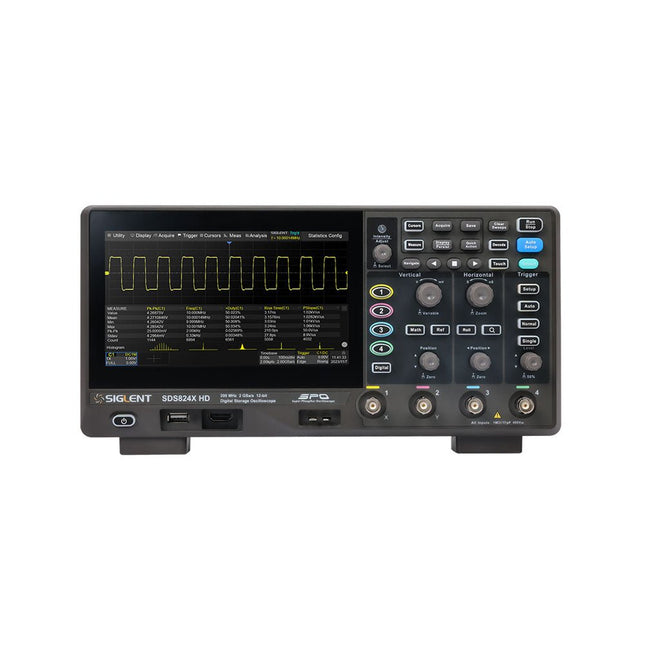
Siglent Siglent SDS814X HD 4-kanaals Oscilloscoop (100 MHz)
The Siglent SDS814X HD digital storage oscilloscope is based on 2 GSa/s, 12-bit Analog-Digital Converters and front ends with excellent noise floor performance. With a 100 MHz bandwidth, and a maximum record length of 50 Mpts, and the capability to analyze 4 analog channels alongside 16 digital channels, the SDS814X HD is perfectly suited for mixed signal analysis. Kenmerken 12-bit High Resolution 12-bit Analog-Digital Convertors with sample rate up to 2 GSa/s Front ends with 70 μVrms noise floor @ 100 MHz bandwidth 2/4 analog channels, up to 700 MHz bandwidth SPO technology Waveform capture rate up to 80,000 wfm/s (normal mode), and 500,000 wfm/s (sequence mode) Supports 256-level intensity grading and color temperature display modes. Up to 50 Mpts record length Digital trigger system Intelligent trigger: Edge, Slope, Pulse width, Window, Runt, Interval, Dropout, Pattern, Video (HDTV supported), Qualified, Nth edge, Delay, Setup/Hold time. Serial bus triggering and decoder, supports protocols I²C, SPI, UART, CAN, LIN. Segmented acquisition (Sequence) mode, dividing the maximum record length into multiple segments (up to 80,000), according to trigger conditions set by the user, with a very small dead time between segments to capture the qualifying event. History waveform record (History) function, the maximum recorded waveform length is 80,000 frames. Automatic measurements on 50+ parameters, supports statistics with histogram, track, trend, Gating measurement, and measurements on Math, History and Ref. 4 Math traces (2 Mpts FFT, addition, subtraction, multiplication, division, integration, differential, square root, etc.), supports formula editor. Abundant data analysis functions such as Search, Navigate, Counter, Bode plot and Power Analysis High Speed hardware-based Mask Test function, with Mask Editor tool for creating user-defined masks 16 digital channels (optional) 25 MHz waveform generator (optional) 7" TFT-LCD display with 1024 x 600 resolution; Capacitive touch screen supports multi-touch gestures. Interfaces include: USB Hosts, USB Device (USBTMC), LAN (VXI-11/Telnet/Socket), Pass/Fail, Trigger Out Built-in web server supports remote control over the LAN port using a web browser. Supports SCPI remote control commands. Supports external mouse and keyboard. Supports NTP. Specificaties Analog Channels 4 Bandwidth 100 MHz Vertical resolution 12-bit Sample rate (Max.) One channel mode: 2 GSa/sTwo channel mode: 1 GSa/sFour channel mode: 500 MSa/s Memory depth (Max.) One channel mode: 50 Mpts/chTwo channel mode: 25 Mpts/chFour channel mode: 10Mpts/ch Waveform capture rate (Max.) Normal mode: 80,000 wfm/sSequence mode: 500,000 wfm/s Trigger type Edge, Slope, Pulse width, Window, Runt, Interval, Dropout, Pattern, Video, Qualified, Nth edge, Delay, Setup/Hold time, Serial Serial trigger and decode (Standard) I²C, SPI, UART, CAN, LIN Measurement 50+ parameters, statistics, histogram, trend, and track supported Math 4 traces 2 Mpts FFT, Filter, +, -, x, ÷, ∫dt, d/dt, √, Identity, Negation, Absolute, Sign, ex, 10x, ln, lg, Interpolation, MaxHold, MinHold, ERES, Average. Supports formula editor Data analysis Search, Navigate, History, Mask Test, Counter, Bode plot, and Power Analysis Digital channel (optional) 16-channel; maximum sample rate up to 1 GSa/s; record length up to 10 Mpts USB AWG module (option) One channel, 25 MHz, sample rate of 125 MHz, wave length of 16 kpts, isolated output I/O 2x USB 2.0 Host, USB 2.0 Device, 10/100 M LAN, Auxiliary output (TRIG OUT, PASS/FAIL), SBUS (Siglent MSO) Probe (Standard) Passive probe PB470 for each channel Display 7 TFT-LCD with capacitive touch screen (1024x600) Inbegrepen 1x Siglent SDS814X Oscilloscope 4x Passive probe (100 MHz) PP510 1x Power cord (EU) 1x USB cable 1x Certificate of calibration 1x Quick start Downloads Datasheet Manual Programming guide
€ 586,85
-
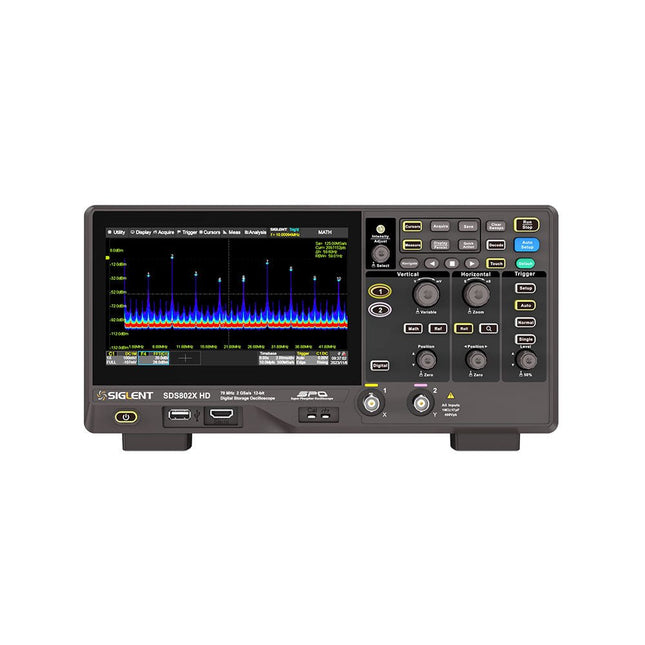
Siglent Siglent SDS822X HD 2-kanaals Oscilloscoop (200 MHz)
The Siglent SDS822X HD digital storage oscilloscope is based on 2 GSa/s, 12-bit Analog-Digital Converters and front ends with excellent noise floor performance. With a 200 MHz bandwidth, and a maximum record length of 100 Mpts, and the capability to analyze 2 analog channels alongside 16 digital channels, the SDS822X HD is perfectly suited for mixed signal analysis. Kenmerken 12-bit High Resolution 12-bit Analog-Digital Convertors with sample rate up to 2 GSa/s Front ends with 70 μVrms noise floor @ 200 MHz bandwidth 2/4 analog channels, up to 700 MHz bandwidth SPO technology Waveform capture rate up to 120,000 wfm/s (normal mode), and 500,000 wfm/s (sequence mode) Supports 256-level intensity grading and color temperature display modes. Up to 50 Mpts record length Digital trigger system Intelligent trigger: Edge, Slope, Pulse width, Window, Runt, Interval, Dropout, Pattern, Video (HDTV supported), Qualified, Nth edge, Delay, Setup/Hold time. Serial bus triggering and decoder, supports protocols I²C, SPI, UART, CAN, LIN. Segmented acquisition (Sequence) mode, dividing the maximum record length into multiple segments (up to 80,000), according to trigger conditions set by the user, with a very small dead time between segments to capture the qualifying event. History waveform record (History) function, the maximum recorded waveform length is 80,000 frames. Automatic measurements on 50+ parameters, supports statistics with histogram, track, trend, Gating measurement, and measurements on Math, History and Ref. 4 Math traces (2 Mpts FFT, addition, subtraction, multiplication, division, integration, differential, square root, etc.), supports formula editor. Abundant data analysis functions such as Search, Navigate, Counter, Bode plot and Power Analysis High Speed hardware-based Mask Test function, with Mask Editor tool for creating user-defined masks 16 digital channels (optional) 25 MHz waveform generator (optional) 7" TFT-LCD display with 1024 x 600 resolution; Capacitive touch screen supports multi-touch gestures. Interfaces include: USB Hosts, USB Device (USBTMC), LAN (VXI-11/Telnet/Socket), Pass/Fail, Trigger Out Built-in web server supports remote control over the LAN port using a web browser. Supports SCPI remote control commands. Supports external mouse and keyboard. Supports NTP. Specificaties Analog Channels 2 Bandwidth 200 MHz Vertical resolution 12-bit Sample rate (Max.) One channel mode: 100 Mpts/chTwo channel mode: Mpts/chFour channel mode: 25 Mpts/ch Memory depth (Max.) One channel mode: 50 Mpts/chTwo channel mode: 25 Mpts/ch Waveform capture rate (Max.) Normal mode: 120,000 wfm/sSequence mode: 500,000 wfm/s Trigger type Edge, Slope, Pulse width, Window, Runt, Interval, Dropout, Pattern, Video, Qualified, Nth edge, Delay, Setup/Hold time, Serial Serial trigger and decode (Standard) I²C, SPI, UART, CAN, LIN Measurement 50+ parameters, statistics, histogram, trend, and track supported Math 4 traces 2 Mpts FFT, Filter, +, -, x, ÷, ∫dt, d/dt, √, Identity, Negation, Absolute, Sign, ex, 10x, ln, lg, Interpolation, MaxHold, MinHold, ERES, Average. Supports formula editor Data analysis Search, Navigate, History, Mask Test, Counter, Bode plot, and Power Analysis Digital channel (optional) 16-channel; maximum sample rate up to 1 GSa/s; record length up to 10 Mpts USB AWG module (option) One channel, 25 MHz, sample rate of 125 MHz, wave length of 16 kpts, isolated output I/O 2x USB 2.0 Host, USB 2.0 Device, 10/100 M LAN, Auxiliary output (TRIG OUT, PASS/FAIL), SBUS (Siglent MSO) Probe (Standard) Passive probe PB470 for each channel Display 7 TFT-LCD with capacitive touch screen (1024x600) Inbegrepen 1x Siglent SDS822X Oscilloscope 2x Passive probe (200 MHz) PP520 1x Power cord (EU) 1x USB cable 1x Certificate of calibration 1x Quick start Downloads Datasheet Manual Programming guide
€ 635,25
-
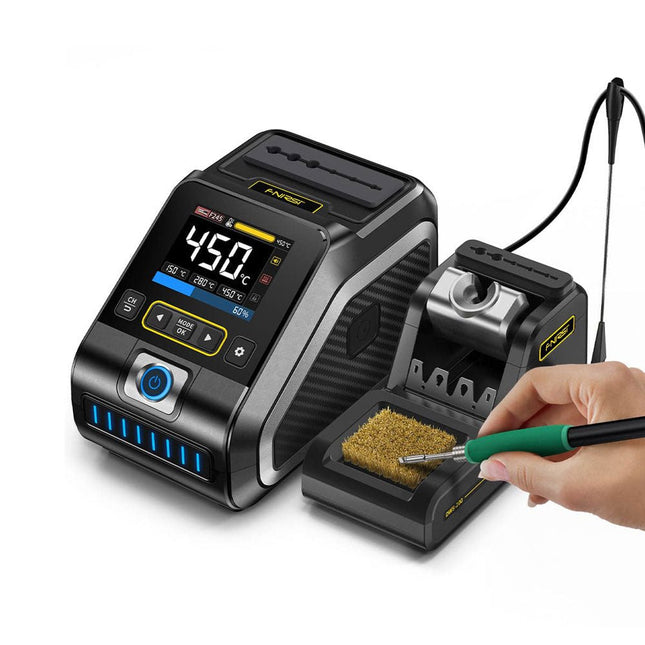
FNIRSI FNIRSI DWS-200 Smart Soldeerstation (met F245-greep + 6 Soldeertips)
De FNIRSI DWS-200 is een krachtig 200 W slim soldeerstation, ideaal voor elektronische soldeertoepassingen. Hij wordt gevoed door een schakelende voeding en werkt soepel met een breed spanningsingangsbereik van 100-240 V. Het station biedt een instelbaar temperatuurbereik van 100°C tot 450°C en maakt eenvoudig schakelen tussen °C en °F mogelijk. Om de efficiëntie te verbeteren, ondersteunt het maximaal drie vooraf ingestelde temperatuurwaarden en kan het worden aangesloten op een soldeerboutstandaard voor activering van de standby-modus. Het station beschikt ook over een dynamische temperatuurcurvemodus voor realtime gegevensbewaking, waardoor nauwkeurige en consistente prestaties bij veeleisende soldeertaken worden gegarandeerd. Kenmerken Maximaal uitgangsvermogen van 200 W, waardoor snelle verwarming mogelijk is Brede adaptieve spanningsingang van 100-240 V 2,8" HD-TFT-kleurenscherm met intelligente bediening Meerdere vooraf ingestelde groepen om snel tussen verschillende instellingen te schakelen Ondersteunt de typen soldeerhandgrepen F245 en F210 en biedt flexibiliteit voor verschillende soldeertoepassingen Realtime slaapmodus om de levensduur van de soldeerpunt te verlengen Multi-mode real-time monitoring van de stroom- en temperatuurstatus, waardoor de veiligheid en precisie worden verbeterd Specificaties Piekvermogen 200 W (max) Temperatuurbereik 100°C~450°C Display 2,8" TFT HD-kleurenscherm Verwarmingstijd 1 seconde Smelttijd 3 seconden Ingangsspanning 100-240 V (AC) Ingangszekering 3 A Type soldeergreep F245 Afmetingen (station) 156 x 96 x 103 mm Gewicht (station) 475 g Inbegrepen 1x FNIRSI DWS-200 soldeerstation 1x Soldeerhandgreep F245 6x Soldeertips (B, KU, K, C2, I, JS) 1x Verbindingskabel 2x Helpende handen 1x Voedingskabel (EU) Downloads Manual Firmware V1.3
€ 179,00
-
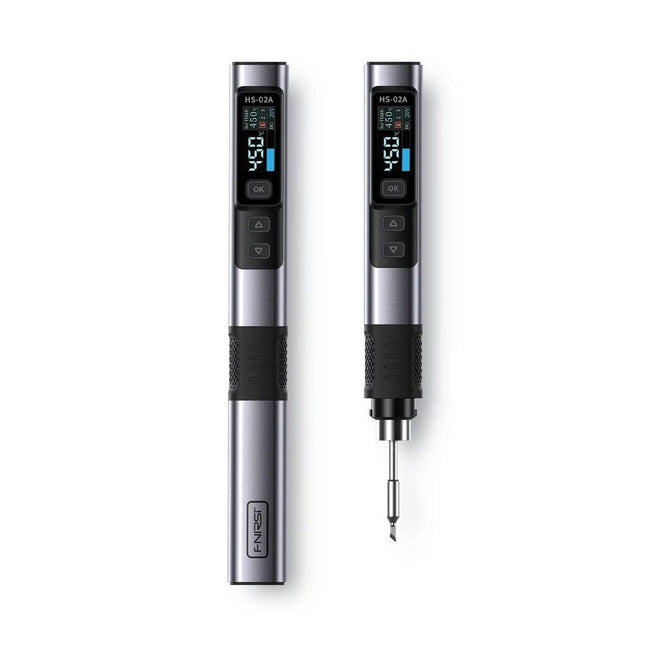
FNIRSI FNIRSI HS-02A Slimme Soldeerbout (incl. 6 soldeertips)
De FNIRSI HS-02A is een verbeterde versie van de HS-01 soldeerbout met een betere grip en een kortere punt voor meer comfort en precisie tijdens gebruik. Het beschikt over een groter 0,96-inch IPS HD-kleurendisplay dat een betere zichtbaarheid van instellingen en status mogelijk maakt. Met een uitgangsvermogen van 100 W warmt de HS-02A snel op en bereikt hij de bedrijfstemperatuur in ongeveer 2 seconden. De temperatuur is instelbaar binnen een bereik van 100-450°C om aan verschillende soldeervereisten te voldoen. Kenmerken Temperatuur: 100-450°C Nauwkeurige aanpassing en controle van de temperatuur Snelle verwarming CNC metalen omhulsel Adaptieve kracht 100 W hoog vermogen Protocollen: PD, QC Specificaties Temperatuurbereik 100-450°C Werkspanning 9-20 V Display 0,96" IPS HD-kleurenscherm Voeding USB-C Snellaadprotocollen PD / QC Vermogen 100 W (max.) Afmetingen 180 x 20 mm Gewicht 61 g Inbegrepen 1x FNRISI HS-02A slimme soldeerbout 6x Soldeerboutpunten (HS02A-KU, HS02A-K, HS02A-JS, HS02A-I, HS02A-C2, HS02A-B) 1x Mini-soldeerboutstandaard 1x Manual Downloads Manual Firmware V1.7
€ 61,95
-

OWON OWON SPS3081 Ventilatorloze DC-voeding (120 W)
De OWON SPS3081 ventilatorloze programmeerbare DC-voeding (120 W) levert ultrastille, uiterst nauwkeurige prestaties met een nauwkeurigheid van 10 mV/1 mA en geavanceerde warmteafvoer voor betrouwbaarheid op lange termijn. Met uitgebreide bescherming, een USB-interface met SCPI-ondersteuning voor afstandsbediening en een 2,8-inch TFT LCD-scherm, is dit de perfecte keuze voor laboratoria, elektronicatests en onderzoek. Kenmerken Ontwerp zonder ventilator: ultrastille werking, vermindert trillingsgeluid en minimaliseert de potentiële storingsrisico's die gepaard gaan met traditionele koelventilatoren. Uitstekend ontwerp voor warmteafvoer: zorgt voor een gecontroleerde temperatuurstijging, waardoor langdurig gebruik onder volledige belasting mogelijk is en de levensduur van de interne componenten wordt verlengd. Lichtgewicht en ultradun ontwerp. Uitgangsnauwkeurigheid tot 10 mV/1 mA. Ondersteunt het bewerken en uitvoeren van golfvormen in de lijst, met vier geheugensnelkoppelingsparameters voor snelle en gemakkelijke toegang. Geïntegreerde beveiligingsfuncties omvatten bescherming tegen overspanning, overstroom, oververhitting en onderspanningsbeveiliging voor verbeterde veiligheid. Ingebouwd ontladingscircuit voorkomt resterende hoogspanningsrisico's wanneer de stroom wordt uitgeschakeld. USB-communicatie-interface met SCPI-protocolondersteuning, waardoor pc-programmering en afstandsbediening mogelijk zijn voor vereenvoudigd gebruikersbeheer. 2,8-inch TFT LCD-scherm Specificaties Model SPS6051 SPS3081 Nominaal vermogen (0°C-40°C) Spanning 0-61 V 0-31 V Stroom 0-5,1 A 0-8,1 A Vermogen 150 W 120 W Belastingsregeling Spanning ≤30 mV Stroom ≤20 mA Vermogensregeling Spanning ≤30 mV Stroom ≤20 mA Resolutie instellen Spanning 10 mV Stroom 1 mA Leesresolutie Spanning 10 mV Stroom 1 mA Instelnauwkeurigheid (25°C ±5°C) Spanning ≤0,05% ±20 mV ≤0,1% ±20 mV Stroom ≤0,05% ±20 mA ≤0,2% ±20 mA Leesnauwkeurigheid (25°C ±5°C) Stroom ≤0,05% ±20 mV ≤0,1% ±20 mV Spanning ≤0,05% ±20 mV ≤0,2% ±20 mA Rimpeling/ruis Spanning ≤30 mVp-p ≤30 mVp-p Spanning ≤4 mVrms ≤5 mVrms Stroom ≤10 mAp-p ≤30 mAp-p Uitgangstemperatuurcoëfficiënt (0°C-40°C) Spanning 100 ppm/°C Stroom 200 ppm/°C Teruglezen temperatuurcoëfficiënt Spanning 100 ppm/°C Stroom 200 ppm/°C Responstijd (50-100% nominale belasting) ≤1,0 ms Opslag 4 groepen gegevens Werktemperatuur 0-40°C Display 2,8-inch LCD-kleurenscherm Interface USB Afmetingen (B x H x D) 82 x 142 x 226 mm Gewicht 1,8 kg Inbegrepen 1x OWON SPS3081 Voeding 2x Testleads 1x Netsnoer 1x Manual Downloads Datasheet User Manual Programming Manual PC Software
€ 137,94
-

OWON OWON SPS6051 Ventilatorloze DC-voeding (150 W)
De OWON SPS6051 ventilatorloze programmeerbare DC-voeding (150 W) levert ultrastille, uiterst nauwkeurige prestaties met een nauwkeurigheid van 10 mV/1 mA en geavanceerde warmteafvoer voor betrouwbaarheid op lange termijn. Met uitgebreide bescherming, een USB-interface met SCPI-ondersteuning voor afstandsbediening en een 2,8-inch TFT LCD-scherm, is dit de perfecte keuze voor laboratoria, elektronicatests en onderzoek. Kenmerken Ontwerp zonder ventilator: ultrastille werking, vermindert trillingsgeluid en minimaliseert de potentiële storingsrisico's die gepaard gaan met traditionele koelventilatoren. Uitstekend ontwerp voor warmteafvoer: zorgt voor een gecontroleerde temperatuurstijging, waardoor langdurig gebruik onder volledige belasting mogelijk is en de levensduur van de interne componenten wordt verlengd. Lichtgewicht en ultradun ontwerp. Uitgangsnauwkeurigheid tot 10 mV/1 mA. Ondersteunt het bewerken en uitvoeren van golfvormen in de lijst, met vier geheugensnelkoppelingsparameters voor snelle en gemakkelijke toegang. Geïntegreerde beveiligingsfuncties omvatten bescherming tegen overspanning, overstroom, oververhitting en onderspanningsbeveiliging voor verbeterde veiligheid. Ingebouwd ontladingscircuit voorkomt resterende hoogspanningsrisico's wanneer de stroom wordt uitgeschakeld. USB-communicatie-interface met SCPI-protocolondersteuning, waardoor pc-programmering en afstandsbediening mogelijk zijn voor vereenvoudigd gebruikersbeheer. 2,8-inch TFT LCD-scherm Specificaties Model SPS6051 SPS3081 Nominaal vermogen (0°C-40°C) Spanning 0-61 V 0-31 V Stroom 0-5,1 A 0-8,1 A Vermogen 150 W 120 W Belastingsregeling Spanning ≤30 mV Stroom ≤20 mA Vermogensregeling Spanning ≤30 mV Stroom ≤20 mA Resolutie instellen Spanning 10 mV Stroom 1 mA Leesresolutie Spanning 10 mV Stroom 1 mA Instelnauwkeurigheid (25°C ±5°C) Spanning ≤0,05% ±20 mV ≤0,1% ±20 mV Stroom ≤0,05% ±20 mA ≤0,2% ±20 mA Leesnauwkeurigheid (25°C ±5°C) Stroom ≤0,05% ±20 mV ≤0,1% ±20 mV Spanning ≤0,05% ±20 mV ≤0,2% ±20 mA Rimpeling/ruis Spanning ≤30 mVp-p ≤30 mVp-p Spanning ≤4 mVrms ≤5 mVrms Stroom ≤10 mAp-p ≤30 mAp-p Uitgangstemperatuurcoëfficiënt (0°C-40°C) Spanning 100 ppm/°C Stroom 200 ppm/°C Teruglezen temperatuurcoëfficiënt Spanning 100 ppm/°C Stroom 200 ppm/°C Responstijd (50-100% nominale belasting) ≤1,0 ms Opslag 4 groepen gegevens Werktemperatuur 0-40°C Display 2,8-inch LCD-kleurenscherm Interface USB Afmetingen (B x H x D) 82 x 142 x 226 mm Gewicht 1,8 kg Inbegrepen 1x OWON SPS6051 Voeding 2x Testleads 1x Netsnoer 1x Manual Downloads Datasheet User Manual Programming Manual PC Software
€ 134,31
-

Elektor Bundles Elektor Raspberry Pi Pico Advanced Kit (Bundel)
Uitgebreide boek-hardwarebundel voor de RP2040-microcontroller met meer dan 80 projecten Ontgrendel het potentieel van moderne controllertechnologie met de Raspberry Pi Pico in deze bundel. Perfect voor zowel beginners als ervaren gebruikers, biedt de eenvoudig te volgen handleiding u de mogelijkheid om te starten bij de basis van elektronica en verder te gaan naar de complexiteit van digitale signaalverwerking. Met de Raspberry Pi Pico, de speciaal ontworpen hardwarekit en het programmeren in MicroPython, leert u de belangrijkste principes van schakelingen ontwerpen, gegevens verzamelen en verwerken. Ga aan de slag met meer dan 80 projecten, zoals een stopwatch met OLED-display, een laserafstandsmeter en een servogestuurde ventilator. Deze projecten zijn bedoeld om u te helpen het geleerde toe te passen in praktijkscenario's. Het boek behandelt ook geavanceerde onderwerpen zoals draadloze RFID-technologie, objectdetectie en sensorintegratie voor robotica. Of u nu uw vaardigheden op het gebied van elektronica wilt uitbreiden of dieper in ingebedde systemen wilt duiken, deze bundel is de perfecte hulpbron om u te helpen het volledige potentieel van de Raspberry Pi Pico te verkennen. Inhoud van de bundel 1x Projectboek (273 pagina's) 1x Smart Car Kit Elektronische onderdelen 2x Soldeerloze broodplank (400 gaten) 1x Soldeerloze broodplank (170 gaten) 5x Kleurrijke 5 mm LED's (groen, rood, blauw, geel en wit) 1x Laserzender 1x Passieve zoemer 1x Micro-USB-kabel (30 cm) 1x 65 doorverbindingsdraden 1x 20 cm mannelijk naar vrouwelijk Dupont-draad 1x Doorzichtig hoesje 1x Magneet (Diameter: 8 mm, Dikte: 5 mm) 1x Draaipotentiometer 10x 2 KΩ-weerstanden 2x M2,5x30 mm koperen pilaren 10x Kruiskopschroeven met kruiskop 10x M2.5 nikkel-zeskantmoeren 1x 2-inch dual-purpose schroevendraaier Modulen 1x RGB-module 1x 9G-servo 1x XY-joystickmodule met dubbele as 1x RC522 RFID-module 1x 4 bits digitale LED-displaymodule 1x Verkeerslichtdisplaymodule 1x Rotary Encoder-module 1x 1602 LCD-displaymodule (blauw) 1x Fotoweerstandsmodule 1x DC-motor met mannelijke Dupont-draad 1x Ventilatorblad 1x Regendruppelsmodule 1x OLED-module 1x Membraanschakelaartoetsenbord 1x Mini magnetische veermodule 1x Infraroodafstandsbediening 1x Infraroodontvangermodule 1x DC stappenmotor driverbord 1x Button Sensoren 1x Trillingssensor 1x Bodemvochtsensor 1x Geluidssensor 1x Mini PIR-bewegingssensor 1x Temperatuur- en vochtigheidssensor 1x Vlamsensor 2x Crashsensor 2x Volgsensor 1x Ultrasone sensor
€ 99,95€ 79,95Beste prijs
-

NXP Semiconductors NXP FRDM-MCXN947 Development Board
The FRDM-MCXN947 is a compact and versatile development board designed for rapid prototyping with MCX N94 and N54 microcontrollers. It features industry-standard headers for easy access to the MCU's I/Os, integrated open-standard serial interfaces, external flash memory, and an onboard MCU-Link debugger. Specificaties Microcontroller MCX-N947 Dual Arm Cortex-M33 cores @ 150 MHz each with optimized performance efficiency, up to 2 MB dual-bank flash with optional full ECC RAM, External flash Accelerators: Neural Processing Unit, PowerQuad, Smart DMA, etc. Memory Expansion *DNP Micro SD card socket Connectivity Ethernet Phy and connector HS USB-C connectors SPI/I²C/UART connector (PMOD/mikroBUS, DNP) WiFi connector (PMOD/mikroBUS, DNP) CAN-FD transceiver Debug On-board MCU-Link debugger with CMSIS-DAP JTAG/SWD connector Sensor P3T1755 I³C/I²C Temp Sensor, Touch Pad Expansion Options Arduino Header (with FRDM expansion rows) FRDM Header FlexIO/LCD Header SmartDMA/Camera Header Pmod *DNP mikroBUS User Interface RGB user LED, plus Reset, ISP, Wakeup buttons Inbegrepen 1x FRDM-MCXN947 Development Board 1x USB-C Cable 1x Quick Start Guide Downloads Datasheet Block diagram
-

Raspberry Pi Foundation Raspberry Pi USB 3.0 Hub
De Raspberry Pi USB 3 Hub breidt de connectiviteit van uw apparaat uit door een enkele USB-A-poort om te zetten in vier USB 3.0-poorten. Met een optionele externe USB-C-voedingsingang kan hij randapparatuur met hoog vermogen ondersteunen, terwijl randapparatuur met een lager vermogen zonder extra voeding werkt. De USB 3 Hub is volledig getest op naadloze compatibiliteit met alle Raspberry Pi-producten. Kenmerken Enkele upstream-verbinding: USB 3.0 Type-A-connector met een kabel van 8 cm Vier downstream-poorten: USB 3.0 Type-A-poorten voor verbindingen met meerdere apparaten Hoge gegevensoverdracht: Ondersteunt snelheden tot 5 Gbps Compatibiliteit: Werkt met USB 3.0 Type-A hostpoorten en is achterwaarts compatibel met USB 2.0-poorten Downloads Datasheet
-
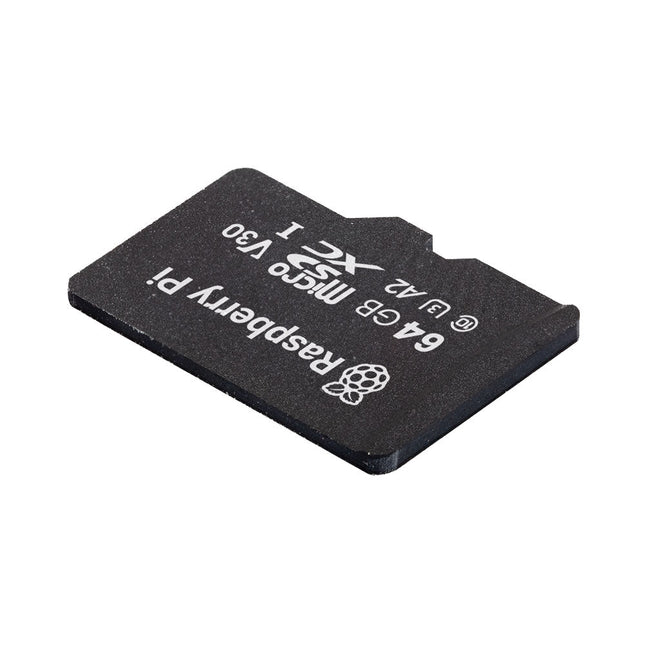
Raspberry Pi Foundation Raspberry Pi A2 microSD-kaart voorgeïnstalleerd met Raspberry Pi OS (64 GB)
SD card quality is crucial for a good Raspberry Pi experience. Raspberry Pi's A2 microSD cards support higher bus speeds and command queuing, improving random read performance and narrowing the gap with NVMe SSDs. These cards are rigorously tested for optimal performance with Raspberry Pi models. Kenmerken Capacity: 64 GB Support for DDR50 and SDR104 bus speeds and command queueing (CQ) extension Speed Class: C10, U3, V30, A2 Random 4 KB read performance: 3,200 IOPS (Raspberry Pi 4, DDR50) 5,000 IOPS (Raspberry Pi 5, SDR104) Random 4 K write performance: 1,200 IOPS (Raspberry Pi 4, DDR50) 2,000 IOPS (Raspberry Pi 5, SDR104) Shock-proof, X-ray–proof, and magnet-proof microSDHC/microSDXC formats Downloads Datasheets
-
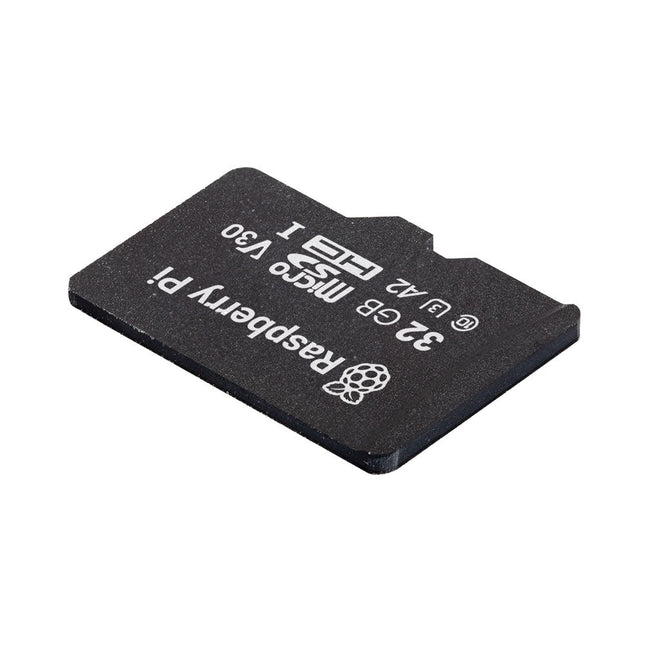
Raspberry Pi Foundation Raspberry Pi A2 microSD-kaart voorgeïnstalleerd met Raspberry Pi OS (32 GB)
SD card quality is crucial for a good Raspberry Pi experience. Raspberry Pi's A2 microSD cards support higher bus speeds and command queuing, improving random read performance and narrowing the gap with NVMe SSDs. These cards are rigorously tested for optimal performance with Raspberry Pi models. Kenmerken Capacity: 32 GB Support for DDR50 and SDR104 bus speeds and command queueing (CQ) extension Speed Class: C10, U3, V30, A2 Random 4 KB read performance: 3,200 IOPS (Raspberry Pi 4, DDR50) 5,000 IOPS (Raspberry Pi 5, SDR104) Random 4 K write performance: 1,200 IOPS (Raspberry Pi 4, DDR50) 2,000 IOPS (Raspberry Pi 5, SDR104) Shock-proof, X-ray–proof, and magnet-proof microSDHC/microSDXC formats Downloads Datasheets
-

Raspberry Pi Foundation Raspberry Pi AI Camera
De Raspberry Pi AI Camera is een compacte cameramodule gebaseerd op de Sony IMX500 Intelligent Vision Sensor. De IMX500 combineert een 12 MP CMOS beeldsensor met inferencing-acceleratie aan boord voor verschillende gangbare neurale netwerkmodellen, zodat gebruikers geavanceerde vision-gebaseerde AI toepassingen kunnen ontwikkelen zonder een aparte accelerator. De AI-camera verbetert vastgelegde foto's of video met tensormetadata, terwijl de processor van de Raspberry Pi vrij blijft voor andere taken. Ondersteuning voor tensor metadata in de libcamera en Picamera2 bibliotheken, evenals de rpicam-apps applicatie suite, zorgt voor gebruiksgemak voor beginners, terwijl het ongeëvenaarde kracht en flexibiliteit biedt voor geavanceerde gebruikers. De Raspberry Pi AI Camera is compatibel met alle Raspberry Pi-modellen. Kenmerken 12 MP Sony IMX500 intelligente zichtsensor Sensormodi: 4056 x 3040 (@ 10fps), 2028 x 1520 (@ 30fps) Celgrootte van 1,55 x 1,55 µm Gezichtsveld van 78° met handmatig instelbare focus Geïntegreerde RP2040 voor neuraal netwerk- en firmwarebeheer Specificaties Sensor Sony IMX500 Resolutie 12,3 MP (4056 x 3040 pixels) Sensorgrootte 7,857 mm (type 1/2,3) Pixelgrootte 1,55 x 1,55 μm IR-sperfilter Geïntegreerd Autofocus Handmatig instelbare focus Focusbereik 20 cm – ∞ Brandpuntsafstand 4,74 mm Horizontaal gezichtsveld 66 ±3° Verticaal gezichtsveld 52,3 ±3° Focale verhouding (F-stop) F1.79 Uitvoer Afbeelding (Bayer RAW10), ISP-uitvoer (YUV/RGB), ROI, metadata Maximale grootte van de invoertensor 640 x 640 (H x V) Framerate • 2x2 weggegooid: 2028x1520 10-bit 30fps• Volledige resolutie: 4056x3040 10-bit 10fps Lengte van de lintkabel 20 cm Kabelconnector 15 x 1 mm FPC of 22 x 0,5 mm FPC Afmetingen 25 x 24 x 11,9 mm Downloads Datasheet Documentation
-
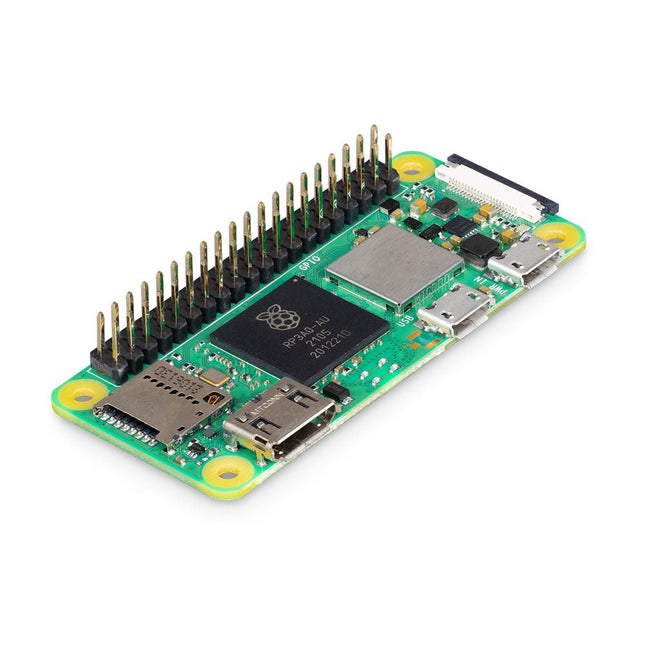
Raspberry Pi Foundation Raspberry Pi Zero 2 WH (met Header)
Raspberry Pi Zero 2 WH is de opvolger van de baanbrekende Raspberry Pi Zero W(H). Het bord bevat een quad-core 64-bit Arm Cortex-A53 CPU, geklokt op 1 GHz. Het hart is een Raspberry Pi RP3A0 system-in-package (SiP), waarin een Broadcom BCM2710A1 chip is geïntegreerd met 512 MB LPDDR2 SDRAM. De verbeterde processor biedt Raspberry Pi Zero 2 WH 40% meer single-threaded prestaties, en vijf keer meer multi-threaded prestaties, dan de originele single-core Raspberry Pi Zero. Kenmerken 64-bit quad core-processor VideoCore IV GPU 512 MB LPDDR2 DRAM 802.11b/g/n draadloos LAN Bluetooth 4.2 / Bluetooth Low Energy (BLE) Slot voor MicroSD-kaart Mini HDMI- en USB 2.0 OTG-poorten Micro-USB-voeding Met gemonteerde 40-pins header Composiet video- en reset-pinnen via soldeer testpunten CSI-cameraconnector Specificaties SoC Broadcom BCM2710A1 CPU 64-bit ARM Cortex-A53 (4x 1 GHz) GPU Broadcom VideoCore VI RAM 512 MB LPDDR2 Wireless LAN 2,4 GHz IEEE 802.11b/g/n Bluetooth Bluetooth 4.2, BLE USB 1x micro USB (voor data)1x micro USB (voor voeding) GPIO HAT-compatibele 40-pins GPIO-header Video & audio 1080P HD-video en stereo-audio via mini-HDMI-connector SD-kaart microSD (voor besturingssysteem en opslag) Voeding 5 VDC / 2,5 A (geleverd via micro-USB-connector) Afmetingen 65 x 30 x 5 mm Raspberry Pi Zero 2 WH is footprint-compatibel met eerdere Zero-modellen.
-
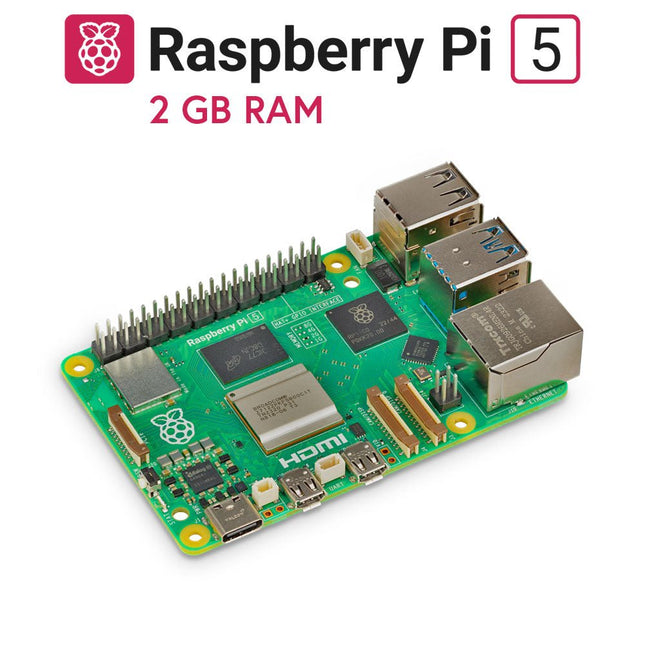
Raspberry Pi Foundation Raspberry Pi 5 (2 GB RAM)
De Raspberry Pi 5 levert meer prestaties dan ooit tevoren. Dankzij de snellere CPU, GPU en RAM is de Raspberry Pi 5 tot 3x sneller dan zijn ook al snelle voorganger. Naast de snelheidsboost biedt de Raspberry Pi 5 (die beschikt over het nieuwe Raspberry Pi RP1 silicium voor geavanceerde I/O-mogelijkheden) voor het eerst ook de volgende functies: RTC, een aan/uit-knop en een PCIe-interface. Kenmerken 64-bit quad-core ARM Cortex-A76 processor (2,4 GHz) VideoCore VII GPU (800 MHz) 2 GB LPDDR4X RAM (4267 MHz) Raspberry Pi silicon RP1 I/O-controllerchip Real-time clock Aan/uit-knop PCIe 2.0 UART-connector Ventilatorconnector Specificaties SoC Broadcom BCM2712 CPU ARM Cortex-A76 (ARM v8) 64-bit Kloksnelheid 4x 2,4 GHz GPU VideoCore VII (800 MHz) RAM 2 GB LPDDR4X (4267 MHz) WiFi IEEE 802.11b/g/n/ac (2,4 GHz/5 GHz) Bluetooth Bluetooth 5.0, BLE Ethernet Gigabit Ethernet (met PoE+ ondersteuning) USB 2x USB-A 3.0 (5 GBit/s)2x USB-A 2.0 PCI Express 1x PCIe 2.0 GPIO Standaard 40-pins GPIO-header Video 2x micro-HDMI poorten (4K60)2x 4-lane MIPI (DSI/CSI) Multimedia H.265 (4K60 decode)OpenGL ES 3.1, Vulkan 1.2 SD-kaart microSD Stroomvoorziening 5 V/5 A (via USB-C)Power over Ethernet (PoE+) Raspberry Pi 4 vs Raspberry Pi 5 Raspberry Pi 4 Raspberry Pi 5 SoC Broadcom BCM2711 Broadcom BCM2712 CPU ARM Cortex-A72 (ARM v8) 64-bit ARM Cortex-A76 (ARM v8) 64-bit Kloksnelheid 4x 1,5 GHz 4x 2,4 GHz L2-cache 1 MByte gedeeld 4x 512 KByte L3-cache N/A 2 MByte gedeeld GPU VideoCore VI (500 MHz) VideoCore VII (800 MHz) RAM 2 GB LPDDR4 (3200 MHz) 2 GB LPDDR4X (4267 MHz) WiFi IEEE 802.11b/g/n/ac (2,4 GHz/5 GHz) IEEE 802.11b/g/n/ac (2,4 GHz/5 GHz) Bluetooth Bluetooth 5.0, BLE Bluetooth 5.0, BLE Ethernet Gigabit Ethernet (met PoE ondersteuning) Gigabit Ethernet (met PoE+ ondersteuning) USB 2x USB-A 3.02x USB-A 2.0 2x USB-A 3.0 (5 GBit/s)2x USB-A 2.0 I/O-controllerchip N/A Raspberry Pi Silicon RP1 PCI Express N/A 1x PCIe 2.0 Real Time Clock (RTC) N/A RTC en RTC-batterijconnector Aan/uit-knop N/A Aan/uit-knop aan boord Koeling N/A Ventilatorconnector GPIO Standaard 40-pins GPIO-header Standaard 40-pins GPIO-header UART via GPIO 1x UART-connector SD-kaart microSD-slot (DDR50) microSD-slot (SDR104) Video 2x micro-HDMI-poorten (4K60)1x 2-lane MIPI DSI-poort (beeldscherm)1x 2-lane MIPI CSI-poort (camera) 2x micro-HDMI-poorten (4K60)2x 4-lane MIPI (DSI/CSI) Audio 4-polige 3,5 mm audio jack (stereo audio en composite video) N/A Multimedia H.265 (4K60 decode)H.264 (1080p60 decode, 1080p30 encode)OpenGL ES, 3.0 graphics H.265 (4K60 decode)OpenGL ES 3.1, Vulkan 1.2 Stroomvoorziening 5 V/3 A (15 W)Power over Ethernet (PoE) 5 V/5 A (25 W), USB PDPower over Ethernet (PoE+) Raspberry Pi 5 4 GB RAM 8 GB RAM 16 GB RAM Downloads Datasheet Unboxing the Raspberry Pi 5 First Insights
-
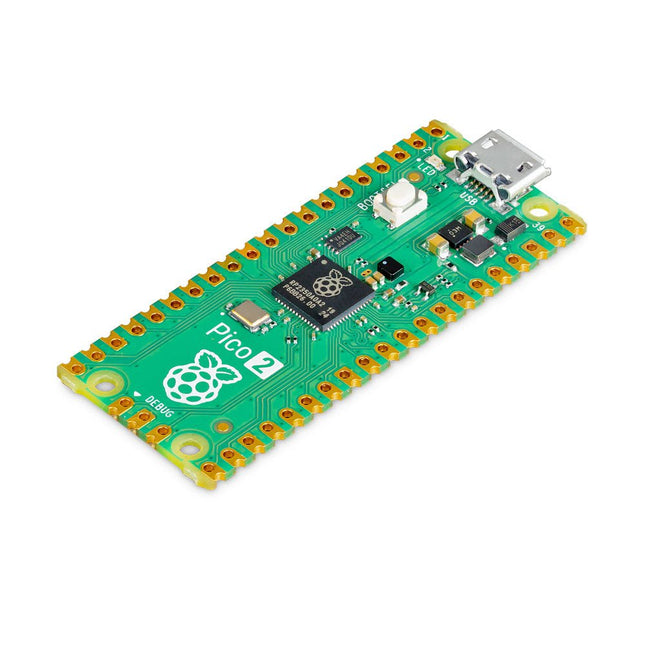
Raspberry Pi Foundation Raspberry Pi Pico 2
De Raspberry Pi Pico 2 is een nieuw microcontrollerbord van de Raspberry Pi Foundation, gebaseerd op de RP2350. Het beschikt over een hogere kloksnelheid, het dubbele van de on-chip SRAM, het dubbele van het ingebouwde flashgeheugen, krachtigere Arm-cores, optionele RISC-V-cores, nieuwe beveiligingsfuncties en verbeterde interfacemogelijkheden. De Raspberry Pi Pico 2 biedt een aanzienlijke verbetering in prestaties en functies, terwijl de hardware- en softwarecompatibiliteit met eerdere leden van de Raspberry Pi Pico-serie behouden blijft. De RP2350 biedt een uitgebreide beveiligingsarchitectuur gebouwd rond Arm TrustZone voor Cortex-M. Het bevat ondertekend opstarten, 8 KB antifuse OTP voor sleutelopslag, SHA-256-versnelling, een hardware TRNG en snelle glitch-detectoren. Dankzij de unieke dual-core en dual-architectuurmogelijkheden van de RP2350 kunnen gebruikers kiezen tussen een paar industriestandaard Arm Cortex-M33-kernen en een paar open-hardware Hazard3 RISC-V-kernen. Programmeerbaar in C/C++ en Python, en ondersteund door gedetailleerde documentatie, is de Raspberry Pi Pico 2 het ideale microcontrollerbord voor zowel liefhebbers als professionele ontwikkelaars. Specificaties CPU Dual Arm Cortex-M33 of dubbele RISC-V Hazard3-processors @ 150 MHz Geheugen 520 KB SRAM op de chip; 4 MB ingebouwde QSPI-flitser Interfaces 26 multifunctionele GPIO-pinnen, waaronder 4 die kunnen worden gebruikt voor AD Randapparatuur 2x UART 2x SPI-controllers 2x I²C-controllers 24x PWM-kanalen 1x USB 1.1-controller en PHY, met host- en apparaatondersteuning 12x PIO-statusmachines Ingangsvermogen 1,8-5,5 V DC Afmetingen 21 x 51 mm Downloads Datasheet (Pico 2) Datasheet (RP2350)
-

Elektor Publishing The Book of 555 Timer Projects
Over 45 Builds for the Legendary 555 Chip (and the 556, 558) The 555 timer IC, originally introduced by the Signetics Corporation around 1971, is sure to rank high among the most popular analog integrated circuits ever produced. Originally called the IC Time Machine, this chip has been used in many timer-related projects by countless people over decades. This book is all about designing projects based on the 555 timer IC. Over 45 fully tested and documented projects are presented. All projects have been fully tested by the author by constructing them individually on a breadboard. You are not expected to have any programming experiences for constructing or using the projects given in the book. However, it’s definitely useful to have some knowledge of basic electronics and the use of a breadboard for constructing and testing electronic circuits. Some of the projects in the book are: Alternately Flashing Two LEDs Changing LED Flashing Rate Touch Sensor On/Off Switch Switch On/Off Delay Light-Dependent Sound Dark/Light Switch Tone Burst Generator Long Duration Timer Chasing LEDs LED Roulette Game Traffic Lights Continuity Tester Electronic Lock Switch Contact Debouncing Toy Electronic Organ Multiple Sensor Alarm System Metronome Voltage Multipliers Electronic Dice 7-Segment Display Counter Motor Control 7-Segment Display Dice Electronic Siren Various Other Projects The projects given in the book can be modified or expanded by you for your very own applications. Electronic engineering students, people engaged in designing small electronic circuits, and electronic hobbyists should find the projects in the book instructive, fun, interesting, and useful.
€ 34,95
Leden: € 31,46
-
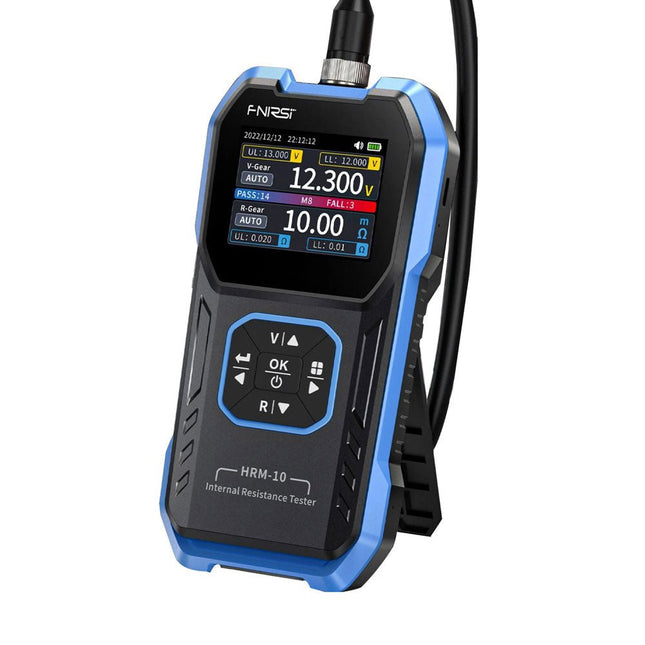
FNIRSI FNIRSI HRM-10 Interne weerstands- en spanningstester voor batterijen
De FNIRSI HRM-10 is een draagbare, zeer nauwkeurige interne weerstands- en spanningstester voor batterijen. Dit apparaat biedt echte vierdraadsmetingen en is ontworpen voor zowel nauwkeurigheid als gebruiksgemak. Het meet automatisch tegelijkertijd de interne weerstands- en spanningswaarden en geeft de resultaten op het HD-kleurenscherm weer. Gebruikers hebben de mogelijkheid om het spannings- en weerstandsbereik handmatig aan te passen aan hun behoeften. Het apparaat bevat ook een sorteermodus die automatisch de goede en slechte batterijen filtert op basis van door de gebruiker ingestelde drempels. Bovendien ondersteunt het de opslag van historische gegevens en is het mogelijk meetgegevens in tabelformaat te exporteren. Kenmerken Hoge meetnauwkeurigheid Tabelgegevens exporteren Meetresultaten automatisch evalueren 8 drempelinstellingen HD-kleurenscherm Opvouwbare standaard 1000 mAh lithiumbatterij Specificaties Spanning Weerstand Meetbereik 0-100 V (DC) 0-200 Ω Nauwkeurigheid ±0,5% ±0,5% Uitrusting Automatisch, 1 V, 10 V, 100 V Automatisch, 20 mΩ, 200 mΩ, 2 Ω, 20 Ω, 200 Ω Instrumenttestsignaalfrequentie 1 Khz (AC) Oplaadbaar USB-C (5 V/1 A) Ingebouwde batterij 1000 mAh lithiumbatterij Gebruikerskalibratie Ja Sorteermodus Ja Geschiedenisrecord Ja Export van opgenomen gegevens Ja Werkomgeving –10°C tot +45°C, relatieve vochtigheid <80% Opslagomgeving –20°C tot +80°C, relatieve vochtigheid <80% Afmetingen 158,7 x 80,5 x 28,4 mm Gewicht 225 g Inbegrepen 1x FNIRSI HRM-10 interne weerstandstester 1x Clip-testlijn 1x USB-C datakabel 1x Manual Downloads Manual Firmware V0.3
€ 49,95
-

Elektor Bundles KiCad Like A Pro (Bundel)
Deze bundel bevat beide delen van "KiCad Like a Pro" (4e editie 2024). In Fundamentals and Projects (normale prijs: € 49,95) leert u hoe u KiCad kunt gebruiken via een praktische aanpak, waardoor u snel productief wordt en uw eigen borden kunt ontwerpen. Met Advanced Projects and Recipes (normale prijs: € 44,95) kunt u uw nieuwe KiCad-vaardigheden oefenen door uzelf uit te dagen met een reeks echte projecten. De nieuwste versie van KiCad, 's werelds beste gratis te gebruiken Printed Circuit Board-tool, zit boordevol functies die normaal gesproken alleen in dure commerciële CAD-tools te vinden zijn. Deze moderne, platformonafhankelijke applicatiesuite die is opgebouwd rond schema- en ontwerpeditors, met hulpapplicaties, is een stabiele en volwassen PCB-tool. KiCad 8 is perfect voor elektronica-ingenieurs en -makers. Hier zijn de belangrijkste verbeteringen en functies in KiCad 8, zowel van boven als van onder de motorkap: Moderne gebruikersinterface, volledig opnieuw ontworpen ten opzichte van eerdere versies Verbeterde en aanpasbare elektrische en ontwerpregelcontroles Thema-editor waarmee u KiCad op uw scherm kunt aanpassen Mogelijkheid om projecten te importeren van Eagle, CADSTART en meer Python-scripting-API Verbeterde geïntegreerde SPICE-circuitsimulator Schema's met meerdere bladen Filters definiëren selecteerbare elementen Verbeterde interactieve router helpt u om afzonderlijke sporen en differentiële paren met precisie te tekenen Nieuwe of verbeterde tools om sporen te tekenen, afstanden te meten, spoorlengtes af te stemmen, enz. Geavanceerd interactieve router Ingebouwde stuklijstgenerator Realistische ray-tracing capabele 3D viewer Aanpasbare teardrops Plug-in manager voor snelle installatie van thema's, bibliotheken en functionaliteiten zoals autorouters en BOM-generatoren Het eerste boek KiCad Like A Pro – Fundamentals and Projects leert u KiCad te gebruiken via een praktische aanpak. Het helpt u snel productief te worden en uw eigen boards te ontwerpen. Voorbeeldprojecten illustreren de basisfuncties van KiCad, zelfs als u geen voorkennis hebt van PCB-ontwerp. De auteur beschrijft de volledige workflow van schema-invoer tot de complexiteit van het finaliseren van de bestanden voor PCB-productie en biedt gedegen begeleiding bij het proces. Het tweede boek KiCad Like A Pro – Advanced Projects and Recipes helpt u uw nieuwe KiCad-vaardigheden te oefenen door u uit te dagen in een reeks echte projecten. De projecten worden ondersteund door een uitgebreide set recepten met gedetailleerde instructies over hoe u een verscheidenheid aan eenvoudige en complexe taken kunt uitvoeren. Ontwerp de PCB's voor een zonne-energievoorziening, een LED-matrixarray, een Arduino-aangedreven datalogger en een aangepast ESP32-bord. Begrijp de fijnere details van de interactieve router, hoe u KiCad-projectteams met Git kunt beheren, hoe u een autorouter op 2- en 4-laags PCB's kunt gebruiken en nog veel meer.
-
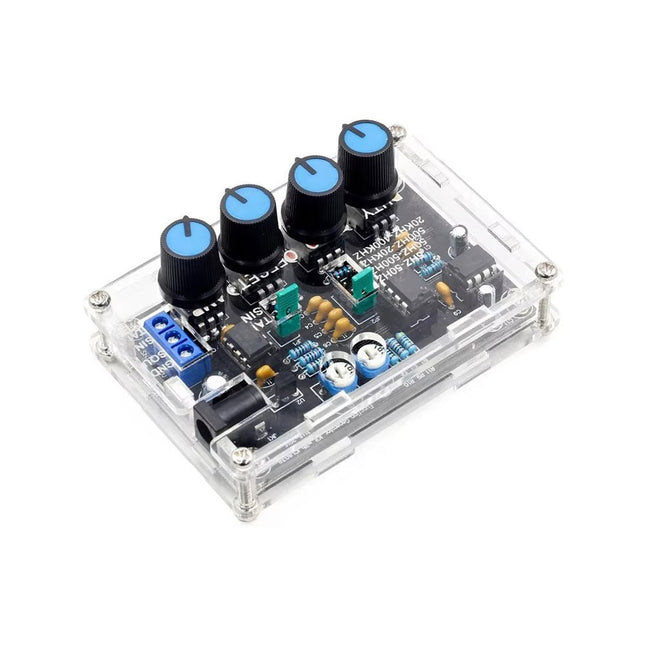
Generic ICL8038 Signaalgenerator DIY-kit (5 Hz – 400 kHz)
De ICL8038-signaalgenerator levert veelzijdige golfvormen, waaronder sinus, driehoek, vierkant en voorwaartse/achterwaartse zaagtand, waardoor hij geschikt is voor een breed scala aan toepassingen. Aangedreven door de ICL8038-chip en snelle operationele versterkers, zorgt het voor uitzonderlijke precisie en signaalstabiliteit. Met een frequentiebereik van 5 Hz tot 400 kHz ondersteunt het toepassingen van audio- tot radiofrequenties. De instelbare werkcyclus, variërend van 2% tot 95%, maakt nauwkeurige aanpassing van de golfvorm mogelijk om aan verschillende behoeften te voldoen. De DIY-kit is beginnersvriendelijk en bevat componenten met doorlopende gaten voor eenvoudige montage. Het bevat alle benodigde onderdelen, een acrylomhulsel en een gedetailleerde handleiding, die alles biedt wat nodig is om de signaalgenerator efficiënt te bouwen en te gebruiken. Specificaties Frequentiebereik 5 Hz~400 KHz (instelbaar) Voedingsspanning 12 V~15 V Bereik van de werkcyclus 2%~95% (instelbaar) Sinusgolf met lage vervorming 1% Lage temperatuurafwijking 50 ppm/°C Uitvoer van driehoekige golflineariteit 0,1% DC-biasbereik −7,5 V~7,5 V Uitgangsamplitudebereik 0,1 V~11 VPP (werkspanning 12 V) Afmetingen 89 x 60 x 35 mm Gewicht 81 g Inbegrepen PCB incl. alle benodigde componenten Acrylbehuizing Manual
-
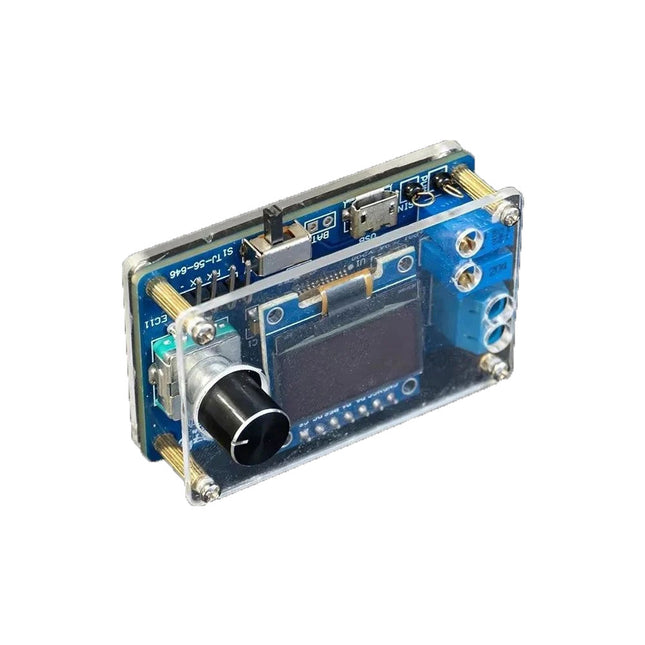
Generic DIY Mini Digitale Oscilloscoop Kit
De DIY Mini Digitale Oscilloscoop Kit (met behuizing) is een eenvoudig te bouwen bouwpakket voor een kleine digitale oscilloscoop. Naast de aan/uit-schakelaar heeft het slechts één andere regelaar, een roterende encoder met een ingebouwde drukknop. De microcontroller van de kit is voorgeprogrammeerd. Het OLED-scherm van 0,96" heeft een resolutie van 128 x 64 pixels. De oscilloscoop heeft één kanaal dat signalen tot 100 kHz kan meten. De maximale ingangsspanning is 30 V, de minimale spanning is 0 V. De kit bestaat uit through-hole componenten (THT) en surface-mount devices (SMD). Daarom betekent het in elkaar zetten van de kit het solderen van SMD-onderdelen, waarvoor enige soldeerervaring nodig is. Specificaties Verticaal bereik: 0 tot 30 V Horizontaal bereik: 100 µs tot 500 ms Triggertype: Automatisch, Normaal en Single Triggerflank: Stijgen en dalen Triggerniveau: 0 tot 30 V Run/Stop-modus Automatische frequentiemeting Voeding: 5 V micro-USB 10 Hz, 5 V sinusgolfuitgang 9 kHz, 0 tot 4,8 V blokgolfuitgang Weergave: 0,96-inch OLED-scherm Afmetingen: 57 x 38 x 26 mm Downloads Documentation
-
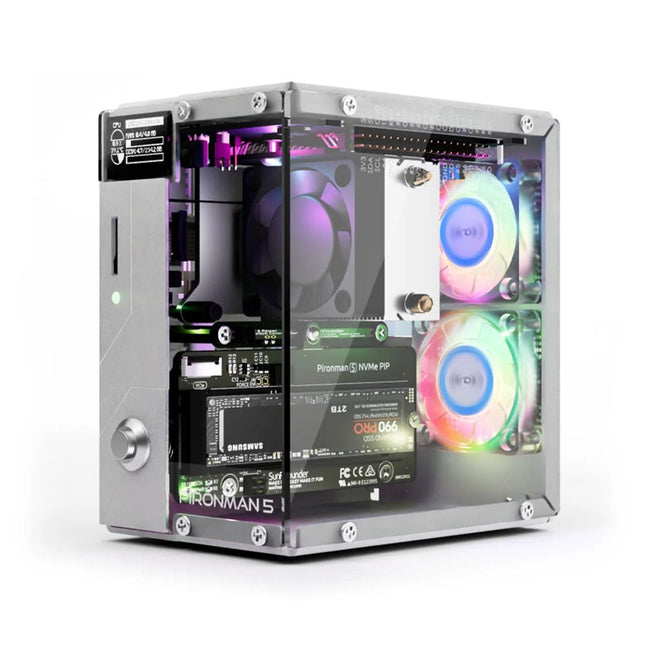
SunFounder Pironman 5 NVMe M.2 SSD PCIe Mini PC-behuizing voor Raspberry Pi 5
Verbeter je Raspberry Pi 5 met de Pironman 5, gebouwd met stevig aluminium, superieure koeling, NVMe M.2 SSD-ondersteuning, OLED-display, RGB-verlichting, standaard HDMI-poorten x2 en een veilige aan/uit-schakelaar. Het is perfect voor NAS, Home Assistant, Media en Game Centers. De Pironman 5 is niet zomaar een behuizing; het is een upgrade die uw Raspberry Pi 5 verandert in een krachtig, efficiënt en stijlvol apparaat. De Pironman 5 bevat de Pi 5 NVMe PIP (PCIe Peripheral Board), een PCIe-adapterkaart die speciaal is ontworpen voor NVMe solid-state drives. Dit bord ondersteunt NVMe SSD's in vier formaten: 2230, 2242, 2260 en 2280, die allemaal in een M.2 M key-slot kunnen worden geïnstalleerd. De verbinding is gecertificeerd voor Gen2.0-snelheden (5 GT/sec), maar kan worden geforceerd naar Gen 3.0 (10 GT/sec) voor snellere prestaties. Uitbreidbaar NVMe M.2 SSD-slot Verbeter de prestaties van uw Raspberry Pi 5 met de NVMe M.2 SSD-sleuf van de Pironman 5, die meerdere formaten ondersteunt (2230, 2242, 2260, 2280) voor meer opslag en snellere systeemreactie. Geavanceerd koelsysteem Houd je Raspberry Pi 5 koel en stijlvol met de torenkoeler en dubbele RGB-ventilatoren van de Pironman 5, voorzien van stoffilters voor een duurzame en onderhoudsarme werking. OLED-display voor direct inzicht De Pironman 5 heeft een OLED-scherm van 0,96 inch, dat onmiddellijke updates biedt over CPU- en RAM-gebruik, temperatuur, IP-adres en meer. Verbeterde functionaliteit en veiligheid De Pironman 5 beveiligt je Raspberry Pi 5 met functies zoals veilig uitschakelen, aanpasbare RGB-LED's, HDMI-poorten, een IR-ontvanger en een externe GPIO-extender, waardoor de functionaliteit en connectiviteit worden verbeterd. Kenmerken Raspberry Pi 5 mini-pc OLED-display van 0,96 inch waarop het CPU-gebruik, de temperatuur, het schijfgebruik, het IP-adres, het RAM-gebruik enz. van de Raspberry Pi worden weergegeven. Torenkoeler kan een CPU-belasting Pi van 100% koelen tot 39°C bij een kamertemperatuur van 25°C 2 RGB-ventilatoren, met GPIO-bediening 1 PWM-ventilator op de torenkoeler wordt bestuurd door het Raspberry Pi-systeem. Ondersteunt vier (PCIe Gen 2.0 / PCIe Gen 3.0) NVMe M.2 SSD-formaten: 2230, 2242, 2260 en 2280. 4 WS2812 adresseerbare RGB-LED's verlichten de hele behuizing met een cool lichteffect IR-ontvanger voor multimediacentra zoals Kodi of Volumio Retro metalen aan/uit-knop voor veilig uitschakelen Externe GPIO-extender met pinnaamlabel, voor gemakkelijke toegang Uitgerust met een veerbelaste aansluiting voor eenvoudig verwijderen van de kaart Aluminium hoofdgedeelte met helder acryl zijpaneel Beschikt over twee standaard HDMI-poorten Downloads Documentation
€ 79,95
Leden: € 71,96
-
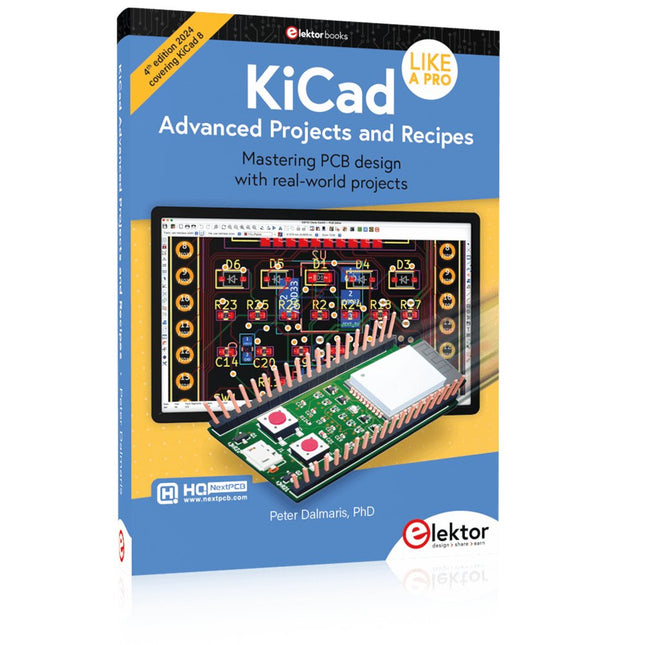
Elektor Publishing KiCad Like A Pro – Advanced Projects and Recipes
Mastering PCB design with real-world projects This book builts on KiCad Like a Pro – Fundamentals and Projects and aims to help you practice your new KiCad skills by challenging you in a series of real-world projects. The projects are supported by a comprehensive set of recipes with detailed instructions on how to achieve a variety of simple and complex tasks. Design the PCBs for a solar power supply, an LED matrix array, an Arduino-powered datalogger, and a custom ESP32 board. Understand the finer details of the interactive router, how to manage KiCad project teams with Git, how to use an autorouter on 2 and 4-layer PCBs, and much more. KiCad 8 is a modern, cross-platform application suite built around schematic and design editors. This stable and mature PCB tool is a perfect fit for electronic engineers and makers. With KiCad 8, you can create PCBs of any complexity and size without the constraints associated with the commercial packages. Here are the most significant improvements and features in KiCad 8, both over and under the hood: Modern user interface, completely redesigned from earlier versions Improved and customizable electrical and design rule checkers Theme editor allowing you to fully customize the look of KiCad on your screen Ability to import projects from Eagle, CADSTART, and more An improved and tightly integrated SPICE circuit simulator Autorouting with the Freerouting plugin Filters define which elements of a layout are selectable Enhanced interactive router helps you draw single tracks and differential pairs with precision New or enhanced tools to draw tracks, measure distances, tune track lengths, etc. Enhanced tool for creating filled zones A customizable coordinate system facilitates data exchange with other CAD applications Realistic ray-tracing capable 3D viewer Differential pair routing Rich repositories of symbol, footprint, and 3D shape libraries Python scripting API for programmatic customization and extensions Improved footprint wizard for fast custom footprints


