
Zoekresultaten voor "elektor OR magazine OR june OR 2010 OR en"
-

Elektor Digital Programmiertechniken für AVR-Mikrocontroller (E-book)
Programmiertechniken für AVR-Mikrocontroller (E-book)
€ 39,80
Leden: € 35,82
-

Elektor Digital AVR-Mikrocontroller (PDF)
Programmierung in Assembler und C am Beispiel der ATtiny-Familie Dieses Buch bietet einen eingehenden Blick auf die 8-Bit-AVR-Architektur in ATtiny- und ATmega-Mikrocontrollern, hauptsächlich aus der Sicht der Software und der Programmierung. Erforschen Sie die AVR-Architektur unter Verwendung von C und Assembler in Microchip Studio (früher Atmel Studio) mit ATtiny-Mikrocontrollern. Lernen Sie die Details der internen Funktionsweise von AVR-Mikrocontrollern kennen, einschließlich der internen Register und des Speicherplans von ATtiny-Bausteinen. Programmieren Sie ATtiny-Mikrocontroller mit einem Atmel-ICE-Programmiergerät/Debugger oder verwenden Sie ein preiswertes Hobby-Programmiergerät oder sogar einen Arduino Uno als Programmiergerät. Die meisten Code-Beispiele können mit dem Microchip Studio AVR-Simulator ausgeführt werden. Lernen Sie, Programme für ATtiny-Mikrocontroller in Assembler zu schreiben. Erfahren Sie, wie Assemblersprache in Maschinencodebefehle umgewandelt wird. Finden Sie heraus, wie Programme, die in der Programmiersprache C geschrieben wurden, in Assemblersprache und schließlich in Maschinencode umgewandelt werden. Verwenden Sie den Microchip Studio Debugger in Kombination mit einem Hardware-USB-Programmierer/Debugger, um Assembler- und C-Programme zu testen oder verwenden Sie den Microchip Studio AVR-Simulator. ATtiny-Mikrocontroller im DIP-Gehäuse werden verwendet, um eine einfache Nutzung auf Breadboards zu ermöglichen. Erfahren Sie mehr über Timing und Taktimpuls in AVR-Mikrocontrollern mit ATtiny-Bausteinen. Werden Sie zu einem AVR-Experten mit fortgeschrittenen Debugging- und Programmierfähigkeiten.
€ 32,80
Leden: € 29,52
-
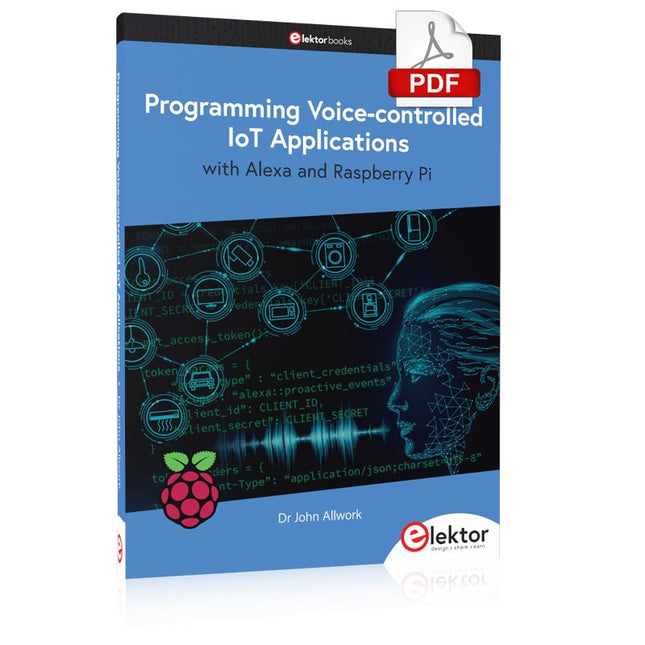
Elektor Digital Programming Voice-controlled IoT Applications with Alexa and Raspberry Pi (E-book)
Learn programming for Alexa devices, extend it to smart home devices and control the Raspberry Pi The book is split into two parts: the first part covers creating Alexa skills and the second part, designing Internet of Things and Smart Home devices using a Raspberry Pi. The first chapters describe the process of Alexa communication, opening an Amazon account and creating a skill for free. The operation of an Alexa skill and terminology such as utterances, intents, slots, and conversations are explained. Debugging your code, saving user data between sessions, S3 data storage and Dynamo DB database are discussed. In-skill purchasing, enabling users to buy items for your skill as well as certification and publication is outlined. Creating skills using AWS Lambda and ASK CLI is covered, along with the Visual Studio code editor and local debugging. Also covered is the process of designing skills for visual displays and interactive touch designs using Alexa Presentation Language. The second half of the book starts by creating a Raspberry Pi IoT 'thing' to control a robot from your Alexa device. This covers security issues and methods of sending and receiving MQTT messages between an Alexa device and the Raspberry Pi. Creating a smart home device is described including forming a security profile, linking with Amazon, and writing a Lambda function that gets triggered by an Alexa skill. Device discovery and on/off control is demonstrated. Next, readers discover how to control a smart home Raspberry Pi display from an Alexa skill using Simple Queue Service (SQS) messaging to switch the display on and off or change the color. A node-RED design is discussed from the basic user interface right up to configuring MQTT nodes. MQTT messages sent from a user are displayed on a Raspberry Pi. A chapter discusses sending a proactive notification such as a weather alert from a Raspberry Pi to an Alexa device. The book concludes by explaining how to create Raspberry Pi as a stand-alone Alexa device.
€ 32,95
Leden: € 29,66
-

Elektor Digital Systemprogrammierung für AVR-Mikrocontroller (E-book)
Systemprogrammierung für AVR-Mikrocontroller (E-book)
€ 39,80
Leden: € 35,82
-

Elektor Digital Microcontroller Basics (E-book)
Microcontrollers have become an indispensable part of modern electronics. They make things possible that vastly exceed what could be done previously. Innumerable applications show that almost nothing is impossible. There’s thus every reason to learn more about them, but that raises the question of where to find a good introduction to this fascinating technology. The answer is easy: this Microcontroller Basics book, combined with the 89S8252 Flash Board project published by Elektor Electronics. However, this book offers more than just a basic introduction. It clearly explains the technology using various microcontroller circuits and programs written in several different programming languages. Three microcontrollers from the 8051 family are used in the sample applications, ranging from the simple 89C2051 to the AN2131, which is designed to support USB applications. The programming tools include assemblers, Basic-52 and BASCOM-51, and several C compilers. Every reader can thus find the programming environment most suitable to his or her needs. In the course of the book, the reader gradually develops increased competence in converting his or her ideas into microcontroller circuitry. All of the sample programs can be downloaded from the Elektor Electronics website or the author’s website. That has the added advantage that the latest versions are always available.
€ 19,95
Leden: € 17,96
-

Elektor Digital Assembly Language Essentials (E-book)
A Guide to Powerful Programming for Embedded Systems You must be a well-rounded professional to excel in the ever-evolving, rapidly developing embedded design and programming industry. Simply put, when it comes to electronics design and programming, the more topics you can master, the more you’ll flourish at your workplace and at your personal workbench. This shouldn’t be a surprise, as the line between the skills of a hardware engineer and software engineer is blurring. The former should have a good grasp of programming in order to build efficient systems. The latter should understand the details of the design (whether it’s a physical or virtual application) for which he or she is writing code. Thus, to be successful, a modern professional electronics engineer must have a solid grasp of both hardware design and programming. Assembly Language Essentials is a matter-of-fact guide to Assembly that will introduce you to the most fundamental programming language of a processor. Unlike other resources about Assembly that focus exclusively on specific processors and platforms, this book uses the architecture of a fictional processor with its own hardware and instruction set. This enables you to consider the importance of Assembly language without having to deal with predetermined hardware or architectural restrictions. You’ll immediately find this thorough introduction to Assembly to be a valuable resource, whether you know nothing about the language or you have used it before. The only prerequisite is that you have a working knowledge of at least one higher-level programming language, such as C or Java. Assembly Language Essentials is an indispensible resource for electronics engineering professionals, academics, and advanced students looking to enhance their programming skills. The book provides the following, and more: An introduction to Assembly language and its functionality Significant definitions associated with Assembly language, as well as essential terminology pertaining to higher-level programming languages and computer architecture Important algorithms that may be built into high-level languages, but must be done the “hard way” in Assembly language — multiplication, division, and polynomial evaluation A presentation of Interrupt Service Routines with examples A free, downloadable Assembler program for experimenting with Assembly
€ 29,95
Leden: € 26,96
-

Elektor Publishing KiCad Like a Pro – Getting Started
From Your First Design to a Finished PCB Turn your PCB ideas into real, working hardware with KiCad 10. Whether you are designing your first circuit board or looking to take your next steps with KiCad, this practical, hands-on guide walks you from schematic capture to pro-quality boards ready for manufacturing. This book teaches printed circuit board design with KiCad 10, the free, open-source and unrestricted PCB suite used by hobbyists, students, and professional engineers alike. It assumes no previous experience. By the end of it, you will be designing original boards with parts, rules and layouts of your own. Part A takes you from a blank schematic sheet to two manufactured boards: a USB-C breadboard power supply and a tiny solar power supply. Along the way you learn two 8-step workflows, one for the schematic and one for the layout, which you can apply to every board you design afterwards. Part B makes you self-sufficient. You draw the symbols and footprints that no library has for you, set up a board for the current it carries and the factory that will build it, and finish with an original capstone project: a dual H-bridge motor driver built around the DRV8833. Topics include: schematic capture, annotation, ERC and footprint assignment layout, routing, DRC and manufacturing outputs finding, importing and managing parts custom symbols and footprints net classes, custom design rules and copper zones bills of materials, design variants and DNP parts design for manufacturing design reuse on a 4×8×8 LED matrix and a four-motor driver assembly by reflow or with a soldering iron a Mini Encyclopedia of PCB terms and KiCad techniques
€ 69,95
Leden: € 62,96
-

Elektor Academy Pro Raspberry Pi Pico with Arduino C/C++ (programmeercursus)
Deze complete microcontroller-programmeercursus op basis van de Raspberry Pi Pico bevat een leerboek, een componentenkit, praktische projecten en een uitgebreide online cursus met simulaties. Ideaal om embedded systems stap voor stap te leren programmeren met Arduino via een praktische hands-on aanpak. Een praktische introductie tot embedded systems met de Raspberry Pi Pico Deze cursus is ontworpen voor beginners in embedded systems die op zoek zijn naar een gestructureerde en voorbeeldgerichte start. Een kit met LED’s en weerstanden, schakelaars, sensoren en actuatoren, displays, een breadboard en draden is inbegrepen. Deze worden in de cursus gebruikt om voorbeeldtoepassingen te demonstreren. Er is geen voorkennis van Arduino of embedded ontwikkeling vereist. Elke sectie bevat praktische voorbeelden en mini-projecten om belangrijke concepten te versterken en verdere verkenning te stimuleren. Aan het einde van de cursus kunt u niet alleen de voorbeelden reproduceren, maar ook uitbreiden met uw eigen ideeën en toepassingen. Wat leert u? Microcontroller programmeren in C/C++ met de Raspberry Pi Pico met behulp van de Arduino IDE Werken met digitale I/O, knoppen en encoders uitlezen, LED’s en relais aansturen Analoge ingangen, spanningen en sensoren uitlezen Genereren van analoge uitgangssignalen en PWM Gebruik van seriële communicatie zoals UART, I²C en SPI om displays aan te sturen en digitale sensoren en SD-kaarten uit te lezen Tijdbeheer Werken met interrupts Realtime sensorinput en besturing via knoppen, LED’s en displays Aansturen van actuatoren zoals relais en servomotoren Voor wie is dit? Studenten en zelflerenden die embedded systems willen ontdekken Makers en IoT-enthousiastelingen die hun hardwarevaardigheden willen verbeteren Docenten en trainers die kant-en-klaar lesmateriaal zoeken Wat zit er in de doos? Toegang tot de volledige cursus op het Elektor Academy Pro leerplatform Raspberry Pi Pico microcontrollerboard + USB-kabel Boek: Programming Microcontrollers in C/C++ Using Arduino Downloadbare projectbestanden voor elke module Componentenkit: 2× LED, rood, 5 mm LED, groen, 5 mm 3× weerstand, 470 Ω, 0,25 W LDR Potentiometer, 10 kΩ, lineair Drukknop Rotary encoder module Relaismodule DHT22 temperatuur- en vochtigheidssensor TM1637-compatibel 4-digit 7-segment display MPU-6050 IMU met headers SSD1306-compatibel I²C OLED display Micro SD-kaartadapter met header Buzzer SG90 micro servo ILI9341-compatibel SPI 240×320 TFT display 20× jumper wires Breadboard Alle programmeercursussen (en verschillen in inhoud) Cursus Arduino Raspberry Pi Pico with Arduino C/C++ ESP32 with Arduino C/C++ Raspberry Pi Pico with MicroPython ESP32 with MicroPython Online cursus Access to Arduino Course Access to Pico with Arduino C/C++ Course Access to ESP32 with Arduino C/C++ Course Access to Pico with MicroPython Course Access to ESP32 with MicroPython Course Board Uno R3 Raspberry Pi Pico ESP32 Raspberry Pi Pico ESP32 Boek Programming Microcontrollers in C/C++ Using Arduino Programming Microcontrollers in C/C++ Using Arduino Programming Microcontrollers in C/C++ Using Arduino Programming Microcontrollers in MicroPython Programming Microcontrollers in MicroPython Kit 40-delige componenten-kit 40-delige componenten-kit 40-delige componenten-kit 40-delige componenten-kit 40-delige componenten-kit
€ 69,95
Leden: € 62,96
-

Elektor Publishing Das 1-Wire-Praxisbuch
Das 1-Wire-Praxisbuch
€ 39,80
Beste prijs
-

Elektor Digital Computer Vision (PDF) DE
Computer Vision ist das wohl spannendste Gebiet der Bildverarbeitung und die Zahl der Anwendungen in der Robotik, Automatisierungstechnik und Qualitätssicherung nimmt stetig zu. Leider gestaltet sich der Zugang zu diesem Forschungsbereich bisher nicht einfach. Interessierte müssen sich zunächst durch viele Bücher, Publikationen und Software-Bibliotheken arbeiten. Mit dem vorliegenden Buch dagegen fällt der Einstieg leicht. Die theoretisch fundierten Inhalte sind gut verständlich dargestellt und werden durch viele Beispiele aus der Praxis ergänzt. Die abgedruckten und online verfügbaren Implementierungen sind in der Programmiersprache C/C++ mit der am Lehrstuhl entwickelten, plattformunabhängigen Open-Source-Bibliothek IVT erstellt. Die Verwendung der IVT ist dabei keine Voraussetzung, erleichtert jedoch wesentlich den Einstieg und ermöglicht schnell erste eigene Entwicklungen. Die Autorenschaft setzt sich aus Mitarbeitern des Lehrstuhls von Herrn Prof. Dr.-Ing. Rüdiger Dillmann am Institut für Technische Informatik (ITEC) der Universität Karlsruhe (TH) zusammen, die in vielen Forschungs- und Industrieprojekten umfangreiche Erfahrung in der Bildverarbeitung sammeln konnten und auch in der Lehre gelernt haben, dieses Wissen weiterzugeben. Im Grundlagenteil des Buches werden u. a. behandelt: Beleuchtung, Optik, Kameratechnik, Übertragungsstandards, Kamerakalibrierung, Bildaufbereitung, Segmentierung, Filter, Korrelation und Stereosehen. Im Praxisteil wird die effiziente Implementierung der Algorithmen vermittelt, gefolgt von vielen interessanten und erprobten Anwendungen wie Barcode-Leser, Stereokamerasystem, Sicherheitstechnik, Objekterkennung, 3D-Scannen, 3D-Tracking und vieles mehr.
€ 39,80
Leden: € 35,82
-

Elektor Digital Analogtechnik in Theorie und Praxis (E-book)
Mit seinem Buch möchte der Autor dem Einsteiger in die analoge Elektronik helfen, sich im Dschungel der oft verwirrenden Fachbegriffe zurecht zu finden, ohne ihn dabei mit abschreckenden Formeln zu verwirren. In der Absicht, dem Leser eine möglichst breite Themenpalette darzubieten, hat er auf allzu tiefschürfende Erläuterungen verzichtet und sich auf das Wesentliche konzentriert, wobei er es sich natürlich nicht nehmen ließ, seine Lieblingsthemen, Messtechnik und Musikelektronik mit Operationsverstärkern, in den Vordergrund zu stellen. Der Autor zeigt (nachdem er die Funktionsweise der bekanntesten elektronischen Bauelemente erklärt hat), dass sich hinter vielen komplexen Schaltungen immer wieder dieselben Grundelemente verbergen und verdeutlicht anhand zahlreicher Beispiele, wie man durch geschickte Kombination solcher „Module“ nahezu alle an die analoge Messtechnik gestellten Anforderungen erfüllen kann (Stichwort „Signalkonditionierung“), was besonders für Anwender von Mikrocontrollern im Bereich von Umweltmessungen interessant sein dürfte. Die zahlreichen Anekdoten aus der Zeit, in welcher sich der Autor selbst noch an die „Geheimnisse“ der Elektronik herantastete, sind der Beweis dafür, dass es sich hier in erster Linie nicht um ein mit Fachchinesisch und Formeln vollgestopftes Lehrbuch handelt, sondern um einen leichten und mit Humor gewürzten Überblick über die Themen, über die ein Newcomer Bescheid wissen sollte. Das Buch, das sich stellenweise fast wie ein Roman liest, wird abgerundet durch wertvolle, auf praktischen Erfahrungen basierende Tipps. Erfahrungen, die der Autor beim Ätzen von Platinen, beim Herstellen von Frontplatten und beim Bau von Gehäusen im Laufe der Zeit gesammelt hat. Kurzum: Ein Buch, das nicht nur Kenntnisse vermittelt, sondern den Leser auch zum Entwickeln eigener Schaltungen inspiriert.
€ 32,80
Leden: € 29,52
-

Elektor Digital ARM Microcontrollers 2 (NL) | E-book
Dit is een ideaal boek voor hobbyisten, studenten en ingenieurs die op een leuke manier C en het gebruik van een mbed ARM microcontroller willen leren, rechtstreeks op internet zonder ingewikkelde software-installatie. De projecten in dit boek zijn bedoeld voor gevorderden op het gebied van ARM microcontrollers of de programmeertaal C. Dat wil zeggen dat de kennis uit deel 1 van deze serie bekend verondersteld wordt. Cloud technologie De in dit boek gebruikte mbed NXP LPC1768 maakt gebruik van cloud-technologie, een revolutionair concept voor software-ontwikkeling. Dit houdt in dat u geen software hoeft te installeren om de mbed te kunnen programmeren! Het enige dat u nodig heeft, is een internet-browser zoals Microsoft Internet Explorer, en een USB-poort op uw PC. U kunt vanaf elke willekeurige PC waar dan ook ter wereld toegang krijgen tot uw project en er aan verder werken. Wanneer u klaar bent, kunt u met een paar eenvoudige klikjes met uw muis het programma overzetten naar uw mbed-hardware. Uiteraard kunt u de projecten ook downloaden en op uw eigen PC opslaan wanneer u dat liever heeft. In een deel van de projecten wordt Visual Basic gebruikt; dit gratis pakket is nog niet in de cloud beschikbaar en moet wel op uw PC geïnstalleerd worden. Onderwerpen die aan de orde komen Leer het programmeren van een ARM microcontroller via cloud-technologie. Geen ARM ontwikkelsoftware-installatie op uw eigen PC. Leer hoe u een ARM microcontroller met internet kunt verbinden, hoe u via internet uw ARM kunt bedienen en hoe u vanaf de ARM microcontroller tweets kunt versturen. Leer hoe u een CMUcam camera kunt aansturen en toepassen in uw applicaties, bijvoorbeeld als alarm. Leer hoe u met behulp van de gratis PC programmeertaal Visual Basic met uw ARM microcontroller kunt communiceren met gebruik van multi-threading. Voorbeelden van projecten in dit boek: internet-server, automatisch twitteren, digitaal naar analoog conversie, USB HID, automatisch metingen in een spreadsheet plaatsen, met een camera bewegingen waarnemen, seriële communicatie met een zelfgeschreven PC-programma, gebruik van een LCD en SPI en I²C communicatie.
€ 29,95
Leden: € 26,96


