
Zoekresultaten voor "elektor or special or introduction or to or electronics or with or arduino"
-

Zhongdi ZD-8962B ESD-soldeerstation (70 W)
Het ZD-8962B soldeerstation heeft een instelbaar temperatuurbereik van 160°C tot 480°C met een uitgangsvermogen van 70 W. Dankzij het geïntegreerde verwarmingselement in de soldeerpunt bereikt het station de gewenste bedrijfstemperatuur in slechts 8 seconden. Een groot digitaal display biedt real-time monitoring en toont zowel de ingestelde doeltemperatuur als de actuele temperatuur van de soldeerbout voor nauwkeurige controle. Bovendien is het station ESD-veilig, waardoor gevoelige elektronische componenten volledig beschermd zijn tegen elektrostatische ontlading tijdens gebruik. Specificaties Vermogen 70 W Ingangsspanning 220-240 V AC/50 Hz Uitgangsspanning 20 V Temperatuurbereik 160°C – 480°C Opwarmtijd ~8 s Display Groot LED-display met twee regels voor weergave van de gewenste en actuele temperatuur Speciale functies ESD-bescherming, Slaapstand/energiebesparende functie, Schakelen tussen °C en °F Inbegrepen ZD-8962B Soldeerstation Soldeerbout Soldeerpunt N12-1 Soldeerbouthouder met koperborstel en spons Soldeerdraadhouder met loodvrije soldeerdraad (10 g) Stroomkabel (EU) Manual
€ 69,95€ 59,95Beste prijs
-

Elecrow Elecrow ThinkNode M5 – Meshtastic LoRa-transceiver (868 MHz)
Hoogwaardig LoRa-communicatieapparaat De Elecrow ThinkNode M5 is een compact, draagbaar LoRa-communicatieapparaat dat is ontworpen voor berichtenverkeer en het delen van locaties buiten het bereik van mobiele netwerken (off-grid) en voor gebruik in de buitenlucht. Het apparaat wordt aangestuurd door een ESP32-S3-processor en een SX1262 LoRa-chip, is voorzien van vooraf geïnstalleerde Meshtastic-firmware en kan eenvoudig via Bluetooth worden geconfigureerd met de officiële Meshtastic-app. De geïntegreerde multi-GNSS-module ondersteunt GPS, GLONASS, BeiDou en QZSS voor betrouwbare positionering en het delen van locaties. Berichten en apparaatgegevens worden weergegeven op het energiezuinige 1,54-inch e-paper-scherm, terwijl de ingebouwde oplaadbare accu van 1.200 mAh zorgt voor langdurig mobiel gebruik. Dankzij de geïntegreerde LoRa-antenne, de compacte behuizing, de RTC en de ondersteuning voor zowel Meshtastic- als MeshCore-firmware is de ThinkNode M5 een praktische communicatieoplossing voor wandelen, kamperen, afgelegen locaties en noodsituaties waarin conventionele mobiele netwerken niet beschikbaar zijn. Kenmerken LoRa-communicatie Multi-GNSS-positionering Oplaadbare accu van 1200 mAh 1,54-inch e-paper-display Ingebouwde RTC Compatibel met MeshCore Compatibel met Meshtastic Specificaties Hoofdprocessor (ESP32-S3) CPU/SoC Xtensa 32-bit LX7 dual-core processor, geklokt op maximaal 240 MHz Systeemgeheugen 512 KB SRAM, 8 MB PSRAM Opslag 4 MB Flash, 384 KB ROM Firmware Volledig compatibel met Meshtastic-firmware; signaaloverdracht via LoRa-modus EPD (Electronic Paper Display) Displaygrootte 1,54-inch EPD (monochroom E-Ink-scherm) Displaymateriaal E-Ink (Electronic Ink) Resolutie 200 x 200 Driver-chip SSD1681 (via SPI- of I²C-interface) Volledige verversingstijd 2 s Draadloze communicatie Bluetooth Bluetooth Low Energy en Bluetooth 5.0 (configuratie via telefoon) LoRa SX1262 LoRa-module, EU 868 MHz (externe antenne) Hardware Interfaces USB-C, RP-SMA Functies GPS-locatie (GPS, GLONASS, BeiDou, QZSS), EPD-scherm, RTC, USB 2.0, PMU-energiebeheer (ingebouwde 1200 mAh-lithiumaccu), zoemer, enz. Knoppen Draaischakelaar, functieknop, paginaknop, GPS-schakelaar, resetknop LED-indicator Voeding, GPS/LoRa-indicatie Overige Voeding 5 V/1 A, ondersteunt voeding via USB of lithiumbatterij Stroomverbruik De maximale bedrijfsstroom bedraagt ongeveer 340 mA (CPU + LoRa-module); het verbruik in de energiezuinige modus bedraagt ongeveer 34 uA Bedrijfstemperatuur -10~50°C Opslagtemperatuur -20~60°C Relatieve luchtvochtigheid 10-95% bij 40°C (niet-condenserend) Behuizing ABS-kunststof Afmetingen 82 x 51,6 x 26,3 mm Gewicht 81 g Inbegrepen 1x Elecrow ThinkNode M5 1x LoRa-antenne 1x USB-C kabel 1x Manual Downloads Manual
€ 74,95
Leden: € 67,46
-

Elektor Digital Technisches Konstruieren mit OpenSCAD (E-book)
Technisches Konstruieren mit OpenSCAD (E-book)
€ 29,80
Leden: € 26,82
-

Elektor Digital LPWAN Decoded (E-book)
LoRaWAN, Sigfox, NB-IoT & LTE-M Compared The Internet of Things depends on a critical question. How do you connect devices that must operate for years on tiny batteries, often miles from the nearest power outlet? This Elektor Technical Brief provides a practical guide to the technologies that have become the backbone of long-range, low-power IoT connectivity. Compiled by the Elektor Content Team, this concise technical brief examines the real engineering tradeoffs behind today’s leading Low-Power Wide-Area Network (LPWAN) technologies: LoRaWAN, Sigfox, NB-IoT, and LTE-M. By referencing a wide range of Elektor articles and other online content, this document explains why link budget, noise, bandwidth, and power consumption ultimately determine system performance. From there, it explores the architectures, strengths, limitations, and deployment realities of each major LPWAN technology, helping you understand not just how they work, but when and why to use them. Whether you’re designing smart meters, industrial sensors, agricultural monitoring systems, asset trackers, or connected infrastructure, this guide provides the insights needed to make informed connectivity decisions. Along the way, you’ll discover: Why LPWAN technologies emerged and where they fit in the IoT landscape The RF fundamentals that drive range, reliability, and battery life Details about LoRaWAN, Sigfox, NB-IoT, and LTE-M Practical comparisons of power, coverage, latency, cost, and deployment models Guidance for selecting the right LPWAN technology for your application Emerging trends shaping the future of long-range IoT connectivity Clear, accessible, and grounded in real engineering practice, this Technical Brief helps you move beyond specifications and marketing claims to understand what matters most. If you’re building connected products that need to survive in the field — not just in the lab — this is the LPWAN guide you’ll want at your side. Elektor helped launch the first wave of electronics makers in 1961. Since then, our global community has grown by hundreds of thousands of active members (comprising professional engineers, makers, and students) and more than 500 contributing experts. Every day, we inspire members to design and earn money with electronics.
€ 14,95
Leden: € 13,46
-

Elektor Digital ESP8266 and MicroPython (E-book)
Recently, the development of a tiny chip called the ESP8266 has made it possible to interface any type of microcontroller to a Wi-Fi AP. The ESP8266 is a low-cost tiny Wi-Fi chip having fully built-in TCP/IP stack and a 32-bit microcontroller unit. This chip, produced by Shanghai based Chinese manufacturer Espressif System, is IEEE 802.11 b/g/n Wi-Fi compatible with on-chip program and data memory, and general purpose input-output ports. Several manufacturers have incorporated the ESP8266 chip in their hardware products (e.g. ESP-xx, NodeMCU etc) and offer these products as a means of connecting a microcontroller system such as the Android, PIC microcontroller or others to a Wi-Fi. The ESP8266 is a low-power chip and costs only a few Dollars. ESP8266 and MicroPython – Coding Cool Stuff is an introduction to the ESP8266 chip and describes the features of this chip and shows how various firmware and programming languages such as the MicroPython can be uploaded to the chip. The main aim of the book is to teach the readers how to use the MicroPython programming language on ESP8266 based hardware, especially on the NodeMCU. Several interesting and useful projects are given in the e-book (pdf) to show how to use the MicroPython in NodeMCU type ESP8266 hardware: Project “What shall I wear today?”: You will be developing a weather information system using a NodeMCU development board together with a Text-to-Speech processor module. Project “The Temperature and Humidity on the Cloud”: You will be developing a system that will get the ambient temperature and humidity using a sensor and then store this data on the cloud so that it can be accessed from anywhere. Project “Remote Web Based Control”: You will be developing a system that will remotely control two LEDs connected to a NodeMCU development board using an HTTP Web Server application.
€ 29,95
Leden: € 26,96
-

Elektor Publishing Daten mit dem Raspberry Pi im Netz speichern und visualisieren
Datenbankmodelle und -software für Elektronikanwendungen Mit seiner Energieeffizienz und seinem reichen Spektrum an quelloffener Software eignet sich der Einplatinencomputer Raspberry Pi auch für die Speicherung von Daten und deren grafische Aufbereitung lokal oder im World Wide Web (WWW). Dieses Buch stellt verschiedene Datenbankmodelle und diverse Datenbanksoftware vor: SQL: MariaDB, SQLite InfluxDB: Telegraf Grafana MQTT Verschlüsselung mit RPi Apache PHP Node RED Docker Es zeigt darüber hinaus ausgewählte Ansätze, gespeicherte Daten anzuzeigen und zu verwalten. Ein eigener Abschnitt ist sowohl der SSL-Verschlüsselung der Verbindung als auch dem Betrieb von Servern im WWW gewidmet. Das Buch richtet sich an alle, die neugierig sind und gerne die Möglichkeiten des Raspberry Pi ausloten möchten, die einen Einstieg in das Datenmanagement mit Datenbanken suchen, die mit einfachen Mitteln schnell loslegen möchten, die Alternativen aufgezeigt bekommen möchten, die in komprimierter Form Tipps für eigene Entwicklungen suchen, die Freude am eigenen Entwickeln und Realisieren haben. Programmierkenntnisse und -erfahrungen sind für die Installation der Software nicht erforderlich. Jeder einzelne Schritt wird detailliert beschrieben und mit Screenshots visuell unterlegt.
€ 39,80
Beste prijs
-
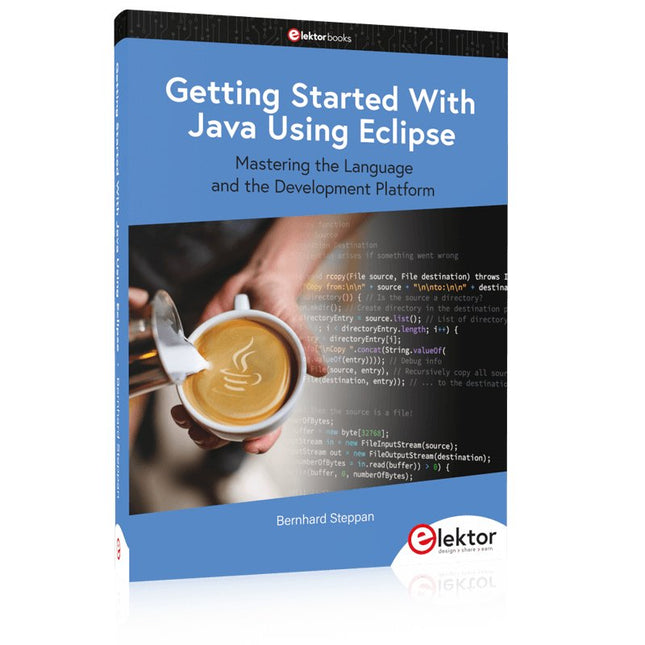
Elektor Publishing Getting Started With Java Using Eclipse
Mastering the Language and the Development Platform Many people would like to learn Java but getting started is not easy since programming with Java requires at least two things: mastering the programming language and the development environment. With the help of many examples, this book shows how the language is structured. In addition, it employs the Eclipse development environment as an example of a powerful tool to teach developing Java programs. In Basics, the first part of the book, you acquire your Java and Eclipse basic knowledge. This part lays the programming foundations, gives you an overview of Java technology, and shows you what is special about object-oriented programming. In the second part called Java Language, everything revolves around the subtleties of the Java language and this is where the first small Java applications are created, aided by a fine blend of the knowledge part and practical exercises. Java Technology is both the name and the focus of the third part which also introduces you to the rules to observe when programming, what class libraries are and what advantages they have. In addition, you will learn how to test programs, what algorithms are, and how to program them. The fourth part, Java Projects, enables you to apply all the previous elements in an application with a graphical user interface. The project shows how to develop a larger application piece by piece with the Eclipse development environment. The Appendix concludes with a section on frequent errors that can occur when working with Eclipse, and a Glossary.
€ 44,95
Leden: € 40,46
-

FNIRSI FNIRSI 2D15P (3-in-1) (3-in-1) 2-kanaals Oscilloscoop (100 MHz) + Multimeter + Signaalgenerator
De FNIRSI 2D15P is een compact 3-in-1 testapparaat dat een 2-kanaals digitale oscilloscoop, True RMS-multimeter en golfvormgenerator in één apparaat combineert. Met een capacitief touchscreen van 4,3 inch, een bandbreedte van 100 MHz, een bemonsteringsfrequentie van 500 MSa/s en een opnamesnelheid tot 1200 fps is het ideaal voor snelle probleemoplossing, signaalanalyse en het testen van elektronica. Kenmerken Dubbelkanaals ingang (100 MHz enkelkanaals, 50 MHz dubbelkanaals werking) Selecteerbare geheugendieptes Bandbreedtelimiet van 20 MHz Grijsschaal- en kleurtemperatuurvisualisatie Wiskundige bewerkingen (optellen, aftrekken, vermenigvuldigen, delen, enz.) XY-modus en oneindige persistentie Cursorfunctie en 13 automatische metingen Auto / Normal / Single triggermodi True RMS-multimeter (19.999 counts) 10 MHz DDS-signaalgenerator Specificaties Algemeen Display 4,3" IPS capacitief touchscreen Bediening Touchscreen + draaiknop + fysieke knoppen Opladen USB-C (12 V/1 A snelladen) Batterij 5000 mAh lithiumbatterij Afmetingen 19,6 x 12,9 x 5,7 cm Gewicht 1,1 kg Oscilloscoop Kanalen 2 Analoge bandbreedte 100 MHz Sample rate 500 MSa/s Geheugendiepte 10K, 100K, 1M Ingangsimpedantie 1 MΩ Tijdbasisbereik 5ns - 50s Verticale gevoeligheid 10 mV - 10 V/div Maximale ingangsspanning 800 V (x10 probe) Triggermodus Auto, Normal, Single Triggertype Stijgend, Dalend, Beide flanken Koppeling AC/DC Persistentie min / 2s / 5s / 10s / 20s / 50s / ∞ Wiskunde Bewerkingen Ja Golfvorm vastleggen Ja Golfvorm exporteren Ja Cursor meten Ja Multimeter DC-spanning 1.9999V / 19.999V / 199.99V / 1000V AC-spanning 1.9999V / 19.999V / 199.99V / 750.0V DC-stroom 19.999mA / 199.99mA / 1.9999A / 9.999A AC-stroom 19.999mA / 199.99mA / 1.9999A / 9.999A Weerstand 19.999MΩ / 1.9999MΩ / 199.99KΩ / 19.999KΩ / 1.9999KΩ / 199.99Ω Capaciteit 999.9uF / 99.99uF / 9.999uF / 999.9nF / 99.99nF / 9.999nF / 9.999mF / 99.99mF Diode Ja Continuïteit Ja Signaalgenerator Kanalen 1 Frequentie 0–10 MHz Amplitude 0,1–3,0 Vpp Duty Cycle 0–100% Inbegrepen 1x FNIRSI 2D15P Oscilloscoop 2x P6100 Oscilloscoopsondes 1x Multimetersonde 1x Krokodillenklemsonde 1x USB-datakabel 1x Manual Downloads Manual Firmware V2.7.0.7
€ 209,00€ 179,95Beste prijs
-

Elektor Digital Experimenting with Red Pitaya STEMlab Gen 2 (E-book)
Practical Projects and Programs With Experimenting with Red Pitaya STEMlab Gen 2, Red Pitaya goes beyond a versatile board. It becomes a powerful laboratory instrument for precision measurement, analysis, and control. From the fundamentals of electronic project development, monitoring, control, and design to testing, this book walks you step-by-step through everything you need to know to harness the full potential of Red Pitaya hardware and software. The book presents real-time, FPGA-based projects that are developed on a PC using the Vivado environment, then transferred to the Red Pitaya for execution and testing. You will learn about enhanced performance, expanded I/O capabilities, improved FPGA features, and advanced connectivity options that open up new frontiers for precision measurement, monitoring, and control in your embedded applications. Inside the book you will discover: A deep dive into Red Pitaya architecture and hardware design Electronic experiments using Red Pitaya for measurement and monitoring Hands-on projects using the Python programming language Practical guidance for FPGA programming using Red Pitaya Red Pitaya FPGA projects using the Verilog HDL under Vivado IDE Practical design of electronic projects including measurement and testing Step-by-step examples that bridge theory and real-world implementation Whether you are designing your own electronic circuits, developing signal analysis tools, or creating real-time control or monitoring systems, this book provides you the knowledge and confidence you need to fully learn and customize the Red Pitaya platform.
€ 32,95
Leden: € 29,66
-

Elektor Digital Verstärker in Röhrentechnik (E-book)
Selbst für so manchen an der Elektronik Interessierten ist die Röhrentechnologie ein technischer Anachronismus, Röhrenverstärkern könne doch allenfalls noch ein Ehrenplatz im Museum zugewiesen werden. Das ist einerseits durchaus richtig, Röhren haben eine fast hundertjährige Geschichte hinter sich. Seit der Erfindung des Transistors, der Öffentlichkeit vorgestellt am 23.12.1947, war das Ende der Röhrenära eingeläutet. Von da ab sollte es immerhin noch mehr als zwanzig Jahre dauern, bis die Röhren – von Sonderanwendungen abgesehen – aus dem Blickfeld des durchschnittlichen Elektronikgeräte-Konsumenten weitgehend verschwunden waren. So gesehen, sind Röhren tatsächlich veraltet, haben Röhren Museumcharakter. Niemand käme wohl heute auch mehr ernsthaft auf die Idee, sein leistungsfähiges Digitalmessinstrument gegen ein Röhrenvoltmeter auszutauschen; hochintegrierte Halbleiterchips können nun einmal bei eigentlich unvergleichlich geringerem Platz- und Energiebedarf mehr. Auf die Überlegenheit moderner Mikroprozessoren in Bezug auf Rechengeschwindigkeit und Speicherkapazität braucht man eigentlich gar nicht zu verweisen. Der erste programmgesteuerte Elektronikrechner Eniac im Jahre 1945 wog rund 30 Tonnen, enthielt neben insgesamt etwa 500.000 übrigen Bauteilen 18.000 Elektronenröhren und füllte eine mittlere Halle. In einem Bereich allerdings, im Bereich der Audio-Signalverarbeitung, haben Röhren bei Kennern und Musikliebhabern ihre Bedeutung bewahrt oder zurückerlangt: Für eine mittlerweile gestiegene Zahl kritischer Hi-Fi-Hörer steht "ihr" Röhrenverstärker im Zentrum der heimischen Anlage und für unzählige Musiker ist der Gitarrenröhrenverstärker nach wie vor ein Garant für guten Sound. Dieses Book spricht jeden an, der sich für Röhren aus den verschiedensten Gründen interessiert, den "Audiophilen" ebenso wie den aktiven Musiker und natürlich auch den, der einfach nur etwas über die Geschichte und die gegenwärtige Anwendbarkeit von Röhren wissen will. Aus diesem Grund hat der Autor sowohl Informationen über ein interessantes Stück Technikgeschichte als auch – praxisorientiert – Schaltungen und Selbstbauanleitungen zusammengetragen.
€ 32,80
Leden: € 29,52
-

Elektor Digital PC Programming (E-book)
A Small Basic Approach There are many different PC programming languages available on the market. Some have beautiful names; some have easy to use development tools. Others have incredible power. They all have one thing in common: they assume that you have, or want to have, a knack for technology and difficult to read commands. In this book we take a practical approach to programming. We assume that you simply want to write a PC program, and write it quickly. Not in a professional environment, not in order to start a new career, but for plain and simple fun... or just to get a task done. Therefore we use Small Basic. You will have an application up and running in a matter of minutes. You will understand exactly how it works and be able to write text programs, graphical user interfaces, and advanced drivers. It is so simple; you don't even need to be an adult!
€ 29,95
Leden: € 26,96
-
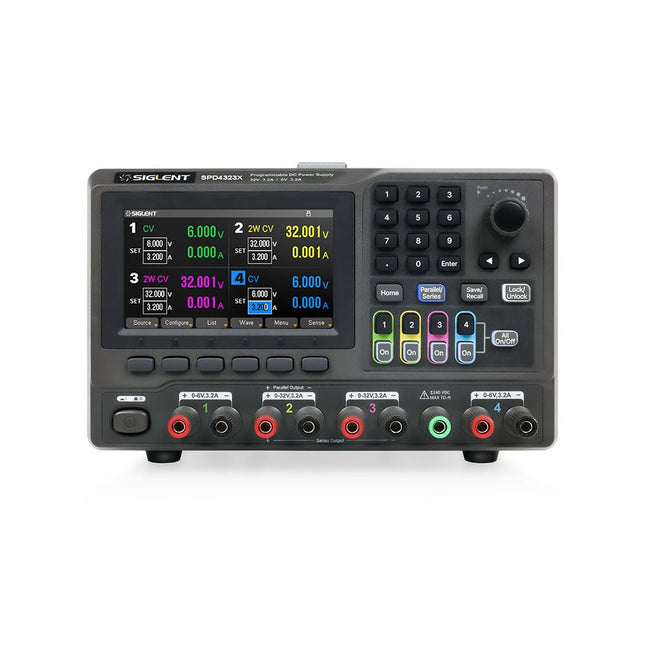
Siglent Siglent SPD4323X 4-kanaals Voeding (240 W)
The Siglent SPD4323X is a 4-channel DC Linear Programmable Power Supply equipped with a 4.3-inch TFT-LCD display, friendly human-machine interface, and excellent performance indicators. Real-time waveform display provides engineers with an informative user interface. SPD4323X offers a total output power of 240 W with a resolution of 1 mV/1 mA. The maximum voltage and current for each channel are as follows: CH1: 6 V/3.2 A CH2: 32 V/3.2 A CH3: 32 V/3.2 A CH4: 6 V/3.2 A Kenmerken Rated output power: 240 W Rated voltage: 32 V, 12 V, 30 V Up to four high-precision power supplies with independent controllable outputs, supporting CH2 and CH3 series and parallel connections Clear graphical interface with waveform and timer display modes 5-digit voltage and current display with minimum resolution of 1 mV, 1 mA Fast output response time: <50us The high current channel support remote voltage compensation sense function. The maximum compensation voltage is 0.6 V Overvoltage protection and overcurrent protection or safe and accurate operation Equipped with a 4.3-inch TFT-LCD display (480 x 272 resolution) USB and LAN standard communication USB-GPIB module is optional Excellent channel density with up to 4 channels in a 3U half rack package Internal data storage for setups and parameters Embedded Web Server with instrument communication that doesn’t require software installation Fully SCPI programming command set support as well as a LabView driver for remote control and system automation Specificaties SPD4323X SPD4121X SPD4306X Channel Output CH1: Voltage 0 to 6 V Current 0 to 3.2 ACH2: Voltage 0 to 32 V Current 0 to 3.2 ACH3: Voltage 0 to 32 V Current 0 to 3.2 ACH4: Voltage 0 to 6 V Current 0 to 3.2 A CH1: Voltage 0 to 15 V Current 0 to 1.5 ACH2: Voltage 0 to 12 V Current 0 to 10 ACH3: Voltage 0 to 12 V Current 0 to 10 ACH4: Voltage 0 to 15 V Current 0 to 1.5 A CH1: Voltage 0 to 15 V Current 0 to 1.5 ACH2: Voltage 0 to 30 V Current 0 to 6 ACH3: Voltage 0 to 30 V Current 0 to 6 ACH4: Voltage 0 to 15 V Current 0 to 1 A Resolution 1 mV, 1 mA 1 mV, 1 mA 1 mV, 1 mA Setting Accuracy Voltage: ±(0.03% of reading+10) mV, Current: ±(0.3% of reading+10) mA Voltage: ±(0.03% of reading+10) mV, Current: ±(0.3% of reading+10) mA Voltage: ±(0.03% of reading+10) mV, Current: ±(0.3% of reading+10) mA Readback Accuracy Voltage: ±(0.03% of reading+10) mV, Current: ±(0.3% of reading+10) mA Voltage: ±(0.03% of reading+10) mV, Current: ±(0.3% of reading+10) mA Voltage: ±(0.03% of reading+10) mV, Current: ±(0.3% of reading+10) mA Display 4.3" TFT-LCD 5-digit voltage and current display 4.3" TFT-LCD 5-digit voltage and current display 4.3" TFT-LCD 5-digit voltage and current display Output power 240 W 285 W 400 W Inbegrepen 1x Siglent SPD4323X Power Supply 1x Power cord (EU) 1x Output test cord (3 A) 1x USB cable 1x Quick start guide Downloads Datasheet Manual Quick start
€ 762,30


