
Zoekresultaten voor "picee OR development OR system"
-

Elektor Publishing Programming Microcontrollers in MicroPython
With Examples for Raspberry Pi Pico and ESP32 Creating and programming small electronic systems is now easier than ever before. With inexpensive development boards and modern software tools, anyone curious about embedded design can quickly move from an idea to a working piece of hardware. At the heart of this change is MicroPython—a clear, interactive, and beginner-friendly way to program microcontrollers while still remaining closely connected to the underlying electronics. This book introduces embedded programming through MicroPython on popular platforms such as the Raspberry Pi Pico and the ESP32. You will discover how to use microcontrollers for reading inputs, processing data, and controlling outputs in a predictable, real-time loop. With just a few lines of code, you can blink LEDs, read sensors, drive motors, and communicate with the outside world. The interactive REPL programming interface encourages experimentation and fast learning, making concepts tangible from the very first chapter. While different boards offer different capabilities, they all share the same core principles. Timers, GPIO, analog I/O, PWM, interrupts, and communication interfaces form the foundation of every embedded system. By focusing on these universal building blocks, this book helps you build skills that transfer across platforms and scale naturally toward more advanced development. Whether you are a beginner or an experienced programmer entering embedded systems, you will find that working with MicroPython is both practical and genuinely enjoyable.
€ 29,95
Leden: € 26,96
-

Elektor Digital Build Your Own Software-Defined Radio (E-book)
Practical Guide to Modular RF Design Build Your Own Software-Defined Radio combines RF circuitry with hardware programming and PC-based signal processing. The e-book presents a modular approach to building a complete SDR system using RF Bricks – from the mechanical framework and RF modules to measurement tools, PC software, and FPGA implementations. Practical explanations guide readers through real signal paths, construction steps, and measurement routines, linking hardware and software into a flexible SDR platform. Key topics include: Mechanical setup: RF Brick template, chassis, and 19-inch module carrier Bridges: USB isolator, I²C level shifter, I²C power switch, and practical examples Signal-chain design with RF Bricks: antennas, band filters, NanoVNA work, preamplifiers, PLLs, demodulators, direct-conversion chains, multiband options, and narrowband bricks RF measurement Bricks: single- and dual-tone sources, NPR methods, noise generators, notch filters, broadband amplifiers, and impedance bridges Useful accessories: ATU-100 tuner, X-Phase QRM eliminator, and firmware notes PC host software: SoapyAudio adjustments, GQRX, SDR++, and added functionality GnuRadio elements: control blocks, SSB demodulation, GUI components, messaging, and filter handling FPGA-based SDR: VHDL, toolchains, ADC/DAC blocks, oversampling, and a complete SSB/CW signal chain With its modular structure and detailed working examples, this e-book offers a practical path to building and extending modern SDR systems. Downloads Software
€ 32,95
Leden: € 29,66
-
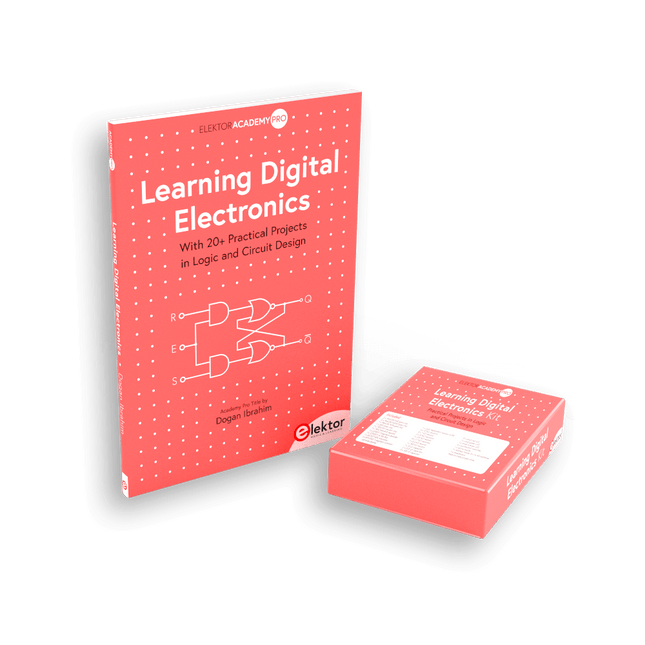
Elektor Bundles Learning Digital Electronics (Bundel)
Beheers digitale elektronica – op een praktische manier! Deze bundel bevat het boek Learning Digital Electronics met meer dan 20 praktische projecten in logica- en schakelingontwerp, evenals een 100-delige starterkit – zodat u meteen aan de slag kunt met het bouwen van logische schakelingen, tellers, displays en meer. Learning Digital Electronics (Boek) Dit boek is een praktische gids voor digitale elektronica en behandelt de essentiële componenten van moderne digitale systemen: getallensystemen, logische poorten, Booleaanse algebra, combinatorische en sequentiële logica, en meer. Via meer dan 20 gestructureerde projecten ontwerp en bouw je digitale systemen met behulp van echte componenten zoals logische poorten, multiplexers, decoders, flipflops, tellers en schuifregisters. De projecten variëren van eenvoudige LED-logicacircuits tot digitale sloten, displaysystemen, verkeerslichtcontrollers en timinggebaseerde ontwerpen. Geselecteerde projecten introduceren het gebruik van tools zoals CircuitVerse voor circuitsimulatie, terwijl verschillende ontwerpen gebruikmaken van logische componenten uit de 74HC-serie, die veel worden gebruikt bij het maken van digitale hardwareprototyping. Binnenin vindt u: Duidelijke uitleg over getallensystemen en binaire rekenkunde Fundamentele principes van logische poorten en universele poortimplementaties Stapsgewijze projecten met flipflops, tellers en registers Real-world ontwerp met 74HC-serie logische chips Technieken voor het ontwerpen van combinatorische en sequentiële systemen Dit boek hanteert een ontwerpgerichte, toepassingsgerichte benadering van digitale elektronica – opgebouwd rond werkende circuits, geteste logica en praktische experimenten. Learning Digital Electronics (Kit) Deze kit is speciaal ontwikkeld als aanvulling op het boek "Learning Digital Electronics". Omdat alle benodigde componenten zijn inbegrepen, kunt u elk praktisch project in het boek direct uitvoeren. Inhoud van de kit 2x 74HC08 EN-poortchip 2x 74HC00 NAND-poortchip 1x 74HC86 XOR-poortchip 1x 555 timerchip 1x 74HC161 tellerchip 1x 74HC164 schuifregister 1x CD4511 7-segments decoder 1x CD4027 JK flipflop 1x BC337 NPN-transistor 1x KPS-5161 7-segments gemeenschappelijke-kathodedisplay 1x lichtgevoelige weerstand (LDR) 4x 10 KΩ-weerstanden 8x 1 KΩ weerstand 2x 47 KΩ-weerstanden 1x 100 KΩ weerstand 4x 2,7 KΩ-weerstanden 1x 5,6 KΩ weerstand 1x 150 KΩ weerstand 1x 10 μF condensator 2x 0,01 μF condensator 2x 100 nF condensator 8x Kleine rode LED 1x Kleine groene LED 1x Kleine oranje LED 4x Drukknopschakelaars 1x Actieve zoemer 1x Batterijhouder voor 3x AA-batterijen (batterijen niet inbegrepen) 1x Breadboard 40x Male-to-male jumperdraden (lengte: 200 mm)
€ 69,95€ 59,95Beste prijs
-
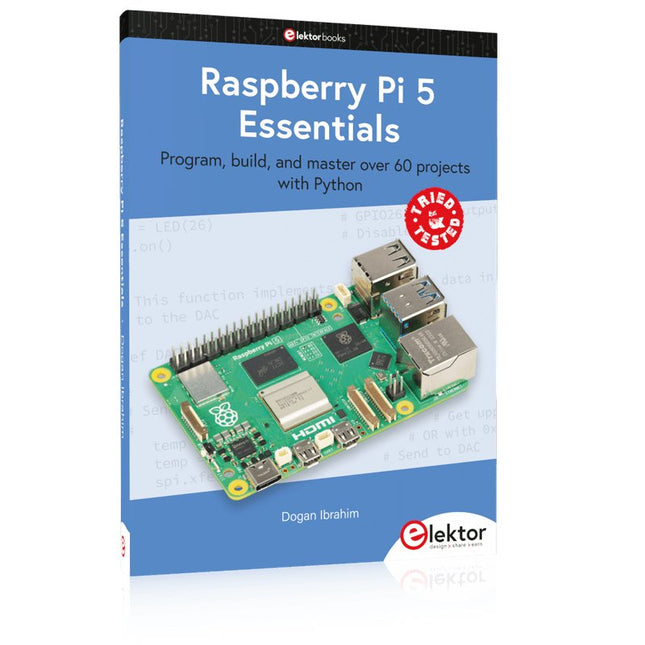
Elektor Publishing Raspberry Pi 5 Essentials
Program, build, and master over 60 projects with Python The Raspberry Pi 5 is the latest single-board computer from the Raspberry Pi Foundation. It can be used in many applications, such as in audio and video media centers, as a desktop computer, in industrial controllers, robotics, and in many domestic and commercial applications. In addition to the well-established features found in other Raspberry Pi computers, the Raspberry Pi 5 offers Wi-Fi and Bluetooth (classic and BLE), which makes it a perfect match for IoT as well as in remote and Internet-based control and monitoring applications. It is now possible to develop many real-time projects such as audio digital signal processing, real-time digital filtering, real-time digital control and monitoring, and many other real-time operations using this tiny powerhouse. The book starts with an introduction to the Raspberry Pi 5 computer and covers the important topics of accessing the computer locally and remotely. Use of the console language commands as well as accessing and using the desktop GUI are described with working examples. The remaining parts of the book cover many Raspberry Pi 5-based hardware projects using components and devices such as LEDs and buzzers LCDs Ultrasonic sensors Temperature and atmospheric pressure sensors The Sense HAT Camera modules Example projects are given using Wi-Fi and Bluetooth modules to send and receive data from smartphones and PCs, and sending real-time temperature and atmospheric pressure data to the cloud. All projects given in the book have been fully tested for correct operation. Only basic programming and electronics experience are required to follow the projects. Brief descriptions, block diagrams, detailed circuit diagrams, and full Python program listings are given for all projects described.
€ 39,95
Leden: € 35,96
-
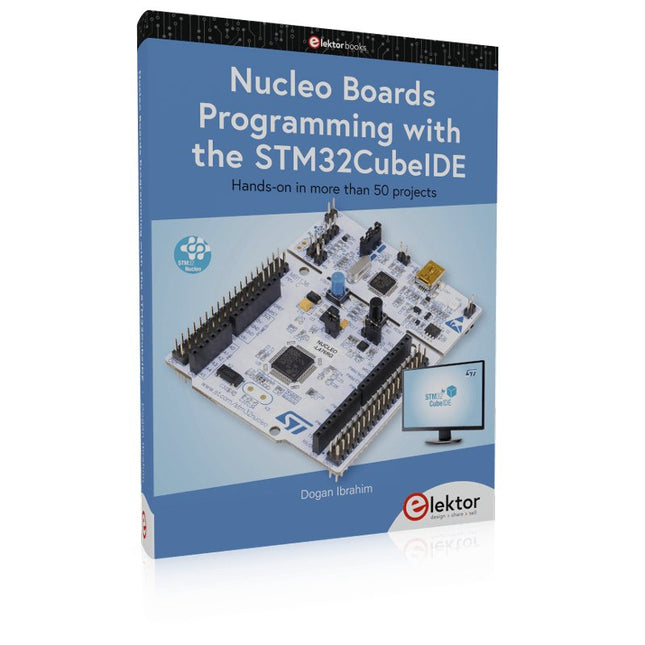
Elektor Publishing Nucleo Boards Programming with the STM32CubeIDE
Hands-on in more than 50 projects STM32 Nucleo family of processors are manufactured by STMicroelectronics. These are low-cost ARM microcontroller development boards. This book is about developing projects using the popular STM32CubeIDE software with the Nucleo-L476RG development board. In the early Chapters of the book the architecture of the Nucleo family is briefly described. The book covers many projects using most features of the Nucleo-L476RG development board where the full software listings for the STM32CubeIDE are given for each project together with extensive descriptions. The projects range from simple flashing LEDs to more complex projects using modules, devices, and libraries such as GPIO, ADC, DAC, I²C, SPI, LCD, DMA, analogue inputs, power management, X-CUBE-MEMS1 library, DEBUGGING, and others. In addition, several projects are given using the popular Nucleo Expansion Boards. These Expansion Boards plug on top of the Nucleo development boards and provide sensors, relays, accelerometers, gyroscopes, Wi-Fi, and many others. Using an expansion board together with the X-CUBE-MEMS1 library simplifies the task of project development considerably. All the projects in the book have been tested and are working. The following sub-headings are given for each project: Project Title, Description, Aim, Block Diagram, Circuit Diagram, and Program Listing for the STM32CubeIDE. In this book you will learn about STM32 microcontroller architecture; the Nucleo-L476RG development board in projects using the STM32CubeIDE integrated software development tool; external and internal interrupts and DMA; DEBUG, a program developed using the STM32CubeIDE; the MCU in Sleep, Stop, and in Standby modes; Nucleo Expansion Boards with the Nucleo development boards. What you need a PC with Internet connection and a USB port; STM32CubeIDE software (available at STMicroelectronics website free of charge) the project source files, available from the book’s webpage hosted by Elektor; Nucleo-L476RG development board; simple electronic devices such as LEDs, temperature sensor, I²C and SPI chips, and a few more; Nucleo Expansion Boards (optional).
€ 49,95
Leden: € 44,96
-
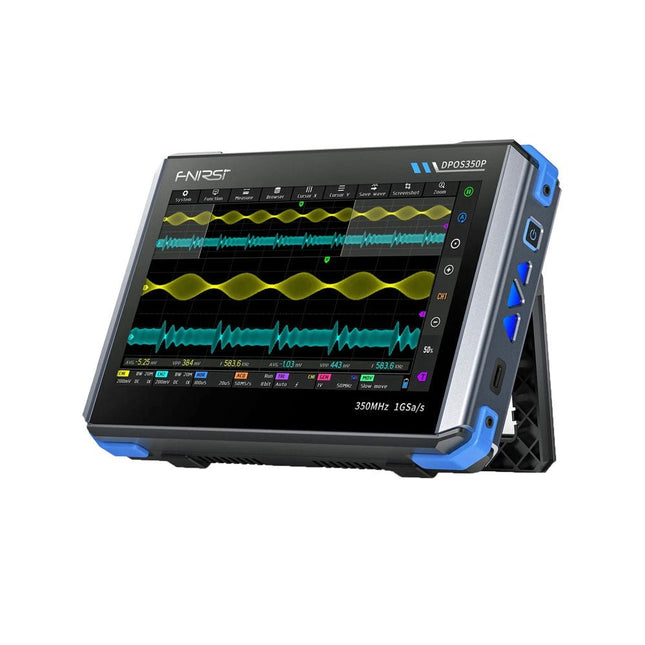
FNIRSI FNIRSI DPOS350P (4-in-1) 2-kanaals Tablet-oscilloscoop (350 MHz) + Signaalgenerator + Frequentieresponsanalyzer + Spectrumanalyzer
2 kanalen • 350 MHz • 1 GSa/s • 50.000 wfm/s • 7 inch Touchscreen De FNIRSI DPOS350P is een gestroomlijnde 4-in-1 krachtpatser in tabletvorm! Dit compacte en draagbare apparaat biedt serieuze functionaliteit: het combineert een 2-kanaals oscilloscoop (350 MHz), een signaalgenerator (50 MHz), een frequentieresponsanalyzer (50 MHz) en een spectrumanalyzer (200 kHz–350 MHz) – alles in één apparaat. Of u nu bezig bent met R&D, probleemoplossing of veldtesten, de DPOS350P biedt de tools die u nodig hebt om elektronische signalen nauwkeurig en helder te meten, genereren, analyseren en visualiseren. Het responsieve touchscreen met hoge resolutie en de intuïtieve bediening maken signaalanalyse snel, flexibel en efficiënt. Kenmerken Krachtige multifunctionele integratie 350 MHz 2-kanaals oscilloscoop met 1 GSa/s realtime sampling 50 MHz signaalgenerator met 14 standaard + aangepaste golfvormen Spectrum analyzer (200 kHz–350 MHz): Perfect voor EMI, RF en HF-testen Frequentieresponsanalyzer (FRA) tot 50 MHz Hoogwaardige golfvormregistratie Vernieuwingsfrequentie van 50.000 wfm/s voor realtime signaalhelderheid Bandbreedte van 350 MHz (enkelkanaalsmodus) Detecteert zeldzame en onwaarschijnlijke afwijkingen Scherp display & Soepele werking 7" IPS-touchscreen (resolutie 1024 x 600) Schakelen tussen grijstinten- en kleurtemperatuurweergave Eenvoudig te bedienen in verschillende testomgevingen Betrouwbaar, beveiligd en snel opladen Hoogspanningsbeveiliging tot 400 V Snel opladen met QC 18 W (volledig opladen in 2 uur) Gebouwd voor stabiele, langdurige werking Gegevensopslag en -export Sla tot 500 golfvormrecords + 90 screenshots op USB-export voor eenvoudige rapportage en offline analyse Specificaties Algemeen Scherm 7 inch (IPS, volledige kijkhoek) Resolutie 1024 x 600 pixels Interactiemodus Capacitief touchscreen Totaal stroomverbruik 10 W Inschakelconfiguratie 5 voorinstellingen Opladen QC 18 W, 12 V/1,5 A (USB-C) Accu 3,7 V, 8000 mAh lithiumbatterij Accuduur ca. 3 uur in gebruik, 5 uur stand-by Warmteafvoer Luchtkoeling Uitbreidingsinterface USB-poort Automatische uitschakeling 15 tot 60 minuten / uit Firmware-upgrade Ondersteunt .iso-image-upgrade Talen Engels / Portugees / Russisch / Chinees Afmetingen 190 x 128 x 37 mm Oscilloscoop Analoge kanalen 2 Analoge bandbreedte 350 MHz Stijgtijd 1 ns Real-time bemonsteringsfrequentie 1 GSa/s Geheugendiepte 60 Kpts Ingangsimpedantie 1 MΩ / 14PF Tijdbasisbereik 5 ns ~ 50 s Roltijdbasis 50 ms ~ 50 s Verticale gevoeligheid 2 mV ~ 20 V (1X) Verticaal bereik 16 mV ~ 160 V (1X) DC-nauwkeurigheid ±2% Tijd nauwkeurigheid ±0,01% Ingangskoppeling DC / AC Probe-verzwakking 1X / 10X / 100X Hardwarebandbreedtelimiet 150M / 20M Hoge-resolutiemodus 8 bit ~ 16 bit Parametermetingen 12 typen Cursormeting Tijd, periode, frequentie, niveau, spanning Triggerdetectie Digitale trigger Triggerkanaal CH1 / CH2 Triggermodus Auto / Single / Normal Triggerflank Rising edge / Falling edge Triggeronderdrukking L1 ~ L3 Triggerniveau Handmatig / automatisch 10% ~ 90% Screenshot-opslag 90 afbeeldingen Golfvormopslag 500 groepen Achtergrondraster Weergeven/verbergen Golfvormbeweging Grof/fijn afstellen Overspanningsbeveiliging Bestandsspanning 400 V Helderheid golfvorm Instelbaar Eenvoudig FFT-display Ja Digitale fluorescentie Ja Kleurtemperatuurweergave Ja X-Y-modus Ja ZOOM-tijdbasis Ja Automatische aanpassing met één druk op de knop Ja Terug naar nul met één druk op de knop Ja Gegevensbrowser Ja Signaalgenerator Golfvormtypen 14 standaardfuncties + vastgelegde golfvorm Frequentie 0~50 MHz (alleen sinusgolf, andere golfvormen tot 10M/5M/3M) Amplitude 0~5 VPP Offset -2,5 V ~ +2,5 V Bedrijfstype cyclus 0,1~99,9% Frequentieresolutie 1 Hz Amplituderesolutie 1 mV Offsetresolutie 1 mV Inschakelduurresolutie 0,1% Aanpasbare vastgelegde golfvorm 500 groepen Frequentieresponsanalyzer (FRA) Frequentie van het excitatiesignaal 100 Hz ~ 50 MHz Ampitude van het excitatiesignaal 0~5 VPP Offset van het excitatiesignaal -2,5 V ~ +2,5 V Aantal excitatiefrequenties 20~500 Cursormeting Frequentie / versterking / fase Bedrijfsmodus Enkelvoudig / cyclisch Systeemkalibratie Ja Spectrumanalyzer Conversiemethode FFT FFT-lengte 4K ~ 32K Frequentiebereik 200 kHz ~ 350 MHz Niveaubereik -60 dBmV ~ +260 dBmV Cursormeting Frequentie / amplitude Markeringsparameter Maximale energieharmonischen Watervalgrafiek Ja 3D-watervalgrafiek Ja Automatische afstelling Ja Systeemkalibratie Ja Inbegrepen 1x FNIRSI DPOS350P (4-in-1) 2x 350 MHz-sondes 1x QC 18 W snellader (EU) 1x USB-datakabel 1x Krokodillenklem 1x Opbergtas 1x Manual Downloads Manual Firmware
€ 309,00€ 259,00Beste prijs
-

Elektor Digital Programming the Finite State Machine (E-book)
Programming the Finite State Machine with 8-Bit PICs in Assembly and C Andrew Pratt provides a detailed introduction to programming PIC microcontrollers, as well as a thorough overview of the Finite State Machine (FSM) approach to programming. Most of the book uses assembly programming, but do not be deterred. The FSM gives a structure to a program, making it easy to plan, write, and modify. The last two chapters introduce programming in C, so you can make a direct comparison between the two techniques. The book references the relevant parts of the Microchip datasheet as familiarity with it is the best way to discover detailed information. This book is aimed at Microsoft Windows and Linux users. To keep your costs to a minimum and to simplify the toolchain, specific applications are provided as a free download to enable you to use an FTDI serial lead as the programmer. The assembler used is the open-source "gpasm". All programming can be done in a text editor. There are detailed instructions on how to perform the necessary installations on Windows, Linux Debian, and derivatives such as Ubuntu and Fedora. For programming in C, Microchip's XC8 compiler is used from the command line. In addition to the programming applications, two serial read and serial write applications can be used for communicating with the PICs from a computer. A voltmeter project including practical instructions on building a circuit board from scratch is included. All theory is covered beforehand, including how to do integer arithmetic in assembly. Two PICs are covered: the PIC12F1822 and the PIC16F1823. Both can run at 32 MHz with an internal oscillator. You do not need to buy a factory-made development board and programmer. With relatively inexpensive parts including a serial lead, microcontroller, a few resistors, and LEDs, you can get started exploring embedded programming. Links Updated Programmer
€ 32,95
Leden: € 29,66
-

Elektor Academy Pro Arduino for STM32 (programmeercursus)
Deze complete cursus programmeren voor STM32-microcontrollers omvat een leerboek, een onderdelenpakket, praktijkgerichte projecten en een uitgebreide online cursus. Het is de ideale manier om stap voor stap te leren programmeren voor embedded systemen met Arduino, via een praktische en hands-on aanpak. Een praktische introductie tot embedded systemen met de STM32 Deze cursus is bedoeld voor iedereen die nog geen ervaring heeft met embedded systemen en op zoek is naar een gestructureerde, op voorbeelden gebaseerde manier om aan de slag te gaan. Er wordt een onderdelenpakket meegeleverd met onder meer leds, weerstanden, schakelaars, sensoren, actuatoren, displays, een breadboard en bedrading. Deze onderdelen worden in de cursus gebruikt om praktijkvoorbeelden te demonstreren. Er is geen voorkennis van Arduino of embedded development vereist. Elk onderdeel bevat praktische voorbeelden en miniprojecten die zijn ontworpen om de belangrijkste concepten te verankeren en uit te nodigen tot verdere verdieping. Aan het einde van de cursus ben je niet alleen in staat om de voorbeelden na te maken, maar kun je er ook op voortbouwen met je eigen ideeën en toepassingen. Wat leert u? Microcontrollerprogrammering in C/C++ voor de STM32 met de Arduino IDE Werken met digitale I/O, knoppen en encoders uitlezen, LED’s en relais aansturen Analoge ingangen, spanningen en sensoren uitlezen Genereren van analoge uitgangssignalen en PWM Gebruik van seriële communicatie zoals UART, I²C en SPI om displays aan te sturen en digitale sensoren en SD-kaarten uit te lezen Tijdbeheer Werken met interrupts Realtime sensorinput en besturing via knoppen, LED’s en displays Aansturen van actuatoren zoals relais en servomotoren Programma's debuggen met behulp van breakpoints en door de code stappen Voor wie is dit? Studenten en zelflerenden die embedded systems willen ontdekken Makers en IoT-enthousiastelingen die hun hardwarevaardigheden willen verbeteren Docenten en trainers die kant-en-klaar lesmateriaal zoeken Wat zit er in de doos? Toegang tot de volledige cursus op het Elektor Academy Pro leerplatform STM32 NUCLEO-F411RE microcontrollerboard Boek: Arduino for STM3 Downloadbare projectbestanden voor elke module Componentenkit: 2× LED, rood, 5 mm LED, groen, 5 mm 3× weerstand, 470 Ω, 0,25 W LDR Potentiometer, 10 kΩ, lineair Drukknop Rotary encoder module Relaismodule DHT22 temperatuur- en vochtigheidssensor TM1637-compatibel 4-digit 7-segment display MPU-6050 IMU met headers SSD1306-compatibel I²C OLED display Micro SD-kaartadapter met header Buzzer SG90 micro servo ILI9341-compatibel SPI 240×320 TFT display 20× jumper wires Breadboard
€ 99,95€ 84,95Beste prijs
-

Raspberry Pi Foundation Le guide officiel du débutant Raspberry Pi (5ème édition)
Entièrement mise à jour pour le Raspberry Pi 5 Raspberry Pi 5 est un petit ordinateur intelligent, de construction britannique qui regorge de potentiel. Fabriqué à l'aide d'un processeur économe en énergie, le Raspberry Pi est conçu pour vous aider à apprendre le codage, découvrir comment fonctionne un ordinateur et construire vos propres projets uniques et incroyables. Ce guide est conçu pour vous montrer à quel point il est facile de démarrer. Apprendre à : Configurez votre Raspberry Pi, installez son système d'exploitation, et commencez à utiliser cet ordinateur entièrement fonctionnel. Commencez à coder des projets, avec des guides étape par étape utilisant les langages de programmation Scratch 3, Python et MicroPython. Expérimentez en connectant des composants électroniques, et amusez-vous à créer des projets incroyables. Nouveauté de la 5ème édition : Mise à jour pour les derniers ordinateurs Raspberry Pi : Raspberry Pi 5 et Raspberry Pi Zèro 2 W. Couvre le dernier système d'exploitation Raspberry Pi. Comprend un nouveau chapitre sur le Raspberry Pi Pico ! Téléchargements GitHub
€ 24,95€ 9,95Beste prijs
-

Elektor Digital PIC Cookbook for Virtual Instrumentation (E-book)
The software simulation of gauges, control-knobs, meters and indicators which behave just like real hardware components on a PC’s screen is known as virtual instrumentation. In this book, the Delphi program is used to create these mimics and PIC based external sensors are connected via a USB/RS232 converter communication link to a PC. Detailed case studies in this Book include a virtual compass displayed on the PC’s screen, a virtual digital storage oscilloscope, virtual -50 to +125 degree C thermometer, and FFT sound analyser, a joystick mouse and many examples detailing virtual instrumentation Delphi components. Arizona’s embedded microcontrollers – the PIC's are used in the projects and include PIC16F84A, PIC16C71, DSPIC30F6012A, PIC16F877, PIC12F629 and the PIC16F887. Much use is made of Microchip’s 44 pin development board (a virtual instrument ‘engine)’, equipped with a PIC16F887 with an onboard potentiometer in conjunction with the PIC’s ADC to simulate the generation of a variable voltage from a sensor/transducer, a UART to enable PC RS232 communications and a bank of 8 LED's to monitor received data is also equipped with an ISP connector to which the ‘PICKIT 2’ programmer may easily be connected. Full source code examples are provided both for several different PIC’s, both in assembler and C, together with the Pascal code for the Delphi programs which use different 3rd party Delphi virtual components.
€ 19,95
Leden: € 17,96
-

Sensepeek Sensepeek 6012 PCBite-kit incl. 2x SQ10-sonde voor DMM
De SQ-serie handsfree PCBite-sondes van Sensepeek zijn geïsoleerd, worden geleverd met meegeleverde kleurgecodeerde kabelhouders en hebben een lager zwaartepunt waardoor ze nog stabieler zijn vergeleken met de originele SP-serie sondes. Alle geliefde kenmerken van handsfree meten, een verwisselbare testnaald met veertip en het minimalistische ontwerp zijn behouden gebleven, waardoor traditionele en draagbare sondes overbodig zijn geworden. Kenmerken Alle handsfree sondes van Sensepeek maken directe metingen of lange triggersessies een fluitje van een cent. Geen soldeerdraden meer om uw sonde aan te sluiten of ingewikkelde gereedschappen om in te stellen, u hoeft alleen maar de sondenaald op een willekeurig testpunt of onderdeel in het signaalpad te plaatsen en los te laten. Bespaart tijd en frustratie tijdens ontwikkeling, verificatie en reparaties. Het minimalistische ontwerp en de veerbelaste testnaald maken het mogelijk om tegelijkertijd te meten op fijne toonhoogtecomponenten en signalen in de buurt. Zowel de lengte als het gewicht van de SQ-sondes zijn perfect uitgebalanceerd voor gebruik met PCBite PCB-houders en basisplaat, wat een must is voor handsfree functioneren. De sondehouder wordt geleverd met een krachtige magneet in de basis, zoals bij alle PCBite-sondes en -houders, waardoor de sonde gemakkelijk te plaatsen en te verplaatsen is. De sondes uit de SQ-serie kunnen zonder de sondehouder in de hand worden gebruikt, omdat ze een geïsoleerde handgreep hebben, maar hun volledige potentieel wordt benut bij handsfree meten. Inbegrepen 4x PCBite PCB-houders 2x SQ10-sondes en testnaalden met pintip (rood/zwart) 2x Banaan naar dupont-testdraden (rood/zwart) 1x Grote bodemplaat (A4) 1x Isolatiehoes voor de bodemplaat (A4) 1x Set gele isolatieringen voor de PCB-houders 1x Set kabelhouders (rood/zwart) 2x Extra testnaalden 1x Microvezeldoek Downloads User Guide (PCBite Kit) User Guide (SQ10)
€ 127,05
-

Great Scott Gadgets Great Scott Gadgets HackRF Pro SDR (100 kHz – 6 GHz) + GRATIS e-book
ACTIE: Bestel de HackRF Pro nu en ontvang het nieuwe e-book "SDR with HackRF One & HackRF Pro" ter waarde van € 20 gratis! HackRF Pro is de nieuwste Software Defined Radio (SDR) van Great Scott Gadgets en de krachtige opvolger van de legendarische HackRF One. Met een frequentiebereik van 100 kHz tot 6 GHz bestrijkt het een enorm spectrum voor het verzenden en ontvangen van radiosignalen. Ontworpen als een open-source hardwareplatform, is de HackRF Pro de ideale tool voor het analyseren en ontwikkelen van moderne draadloze technologieën. Het kan flexibel worden gebruikt als USB-randapparaat of worden geprogrammeerd voor zelfstandig (standalone) gebruik. Specificaties Frequentie: 100 kHz tot 6 GHz Instelbaar van 0 Hz tot 7,1 GHz Half-duplex transceiver Tot 20 miljoen samples per seconde 8-bits kwadratuur-samples (8-bits I en 8-bits Q) Compatibel met GNU Radio, SDR# en meer Softwarematig configureerbare RX- en TX-versterking en basisbandfilter Softwarematig geregelde RF-poortvoeding (50 mA bij 3,3 V) SMA RF-connector SMA-klokingang en -uitgang voor synchronisatie en triggering Handige knoppen voor programmering Interne pinheaders voor uitbreiding High-Speed USB 2.0 met USB-C connector Voeding via USB Open source hardware In vergelijking met zijn voorganger, biedt HackRF Pro een aantal nieuwe functies, waaronder: Breder werkfrequentiebereik Verbeterde RF-prestaties met een vlakkere frequentierespons USB-C-connector Ingebouwde TCXO-kristaloscillator voor superieure timingstabiliteit Logica-upgrade van een CPLD naar een energiezuinige FPGA Eliminatie van de DC-piek Uitgebreide precisie-modus met 16-bits samples voor lage samplefrequenties (typische ENOB: 9-11) Halfprecisie-modus met 4-bits samples tot 40 Msps Meer RAM en flashgeheugen voor aangepaste firmware Afscherming rond het radiogedeelte Trigger-ingang en -uitgang toegankelijk via klokconnectoren Uitsparing in de printplaat biedt ruimte voor toekomstige uitbreidingen add-ons Verbeterd energiebeheer Verbeterde bescherming van de RF-poort Mogelijkheid om de zendmodus hardwarematig uit te schakelen Volledige compatibiliteit: Dankzij de beproefde architectuur kan bestaande software voor de HackRF One ook direct worden gebruikt met de HackRF Pro. De HackRF Pro biedt naadloze achterwaartse compatibiliteit en tegelijkertijd aanzienlijk verbeterde prestaties. Let op: Een antenne is niet inbegrepen. Wij raden de ANT500 aan voor een optimale start. Inbegrepen HackRF Pro SDR met kunststofbehuizing Nieuw e-book: SDR with HackRF One & HackRF Pro (normale prijs: € 20) Downloads Documentation GitHub
€ 489,00€ 429,00Beste prijs


