
Zoekresultaten voor "elektor OR november OR december OR 2023 OR en"
-

Elektor Digital Röhren-Projekte von 6 bis 60 V (E-book)
Röhren-Projekte von 6 bis 60 V (E-book)
€ 29,80
Leden: € 26,82
-

Elektor Digital Lautsprecherbau (PDF)
Das Konstruieren und Aufbauen von Lautsprecherboxen ist zugleich Wissenschaft und Kunst“. Nur mit fundiertem Grundlagenwissen wird es gelingen, Frequenzweichen und Gehäuseabmessungen optimal abzustimmen. Aber alle Sorgfalt bei der Berechnung und Konstruktion garantiert keinesfalls, dass die Lautsprecher dann auch perfekt klingen. Hier helfen nur ausgiebige Hörtests, präzise Messungen und etwas Intuition. In diesem Buch beschreibt der Autor einfache und bewährte Methoden, die idealen Chassis auszuwählen, die passenden Gehäuseabmessungen zu bestimmen und der Traumbox ein professionelles Äußeres zu geben. Neben der ausführlichen Beschreibung der Gehäusevarianten, Frequenzweichen und der gängigen Messmethoden wird auch der Intuition Rechnung getragen. Dazu dienen viele Beispiele der Simulation und Optimierung mit Hilfe des Personalcomputers, der heute als Werkzeug bei der Konstruktion von Lautsprecherboxen eine große Rolle spielt. Mit diesem Werkzeug lassen sich in kurzer Zeit mehr Variationen durchleuchten, als es bei dem traditionellen Verfahren von „Versuch und Irrtum“ möglich ist. Weiterhin beschreibt das Buch auch den Einfluss verschiedener Stoffe zur Bedämpfung des Gehäusein-nern, der gerade bei den beliebten Transmission-Line-Gehäusen – aber auch bei den sogenannten ventilierten Gehäusen – von besonderer Bedeutung ist. Eigenheiten der Boxenkonstruktion für Heimkino-Anlagen und für anspruchsvolles Car-Hifi werden jeweils in einem gesonderten Kapitel behandelt. Die vorliegende überarbeitete und erweiterte Neuauflage dieses Standardwerkes enthält zahlreiche neue Informationen, u. a. 214 neue Abbildungen und 83 weitere Literaturverweise. Außerdem ein vollständig neues Kapitel mit der Konstruktion und dem Aufbau zweier Lautsprecher-Projekte: ein komplettes System für die Surround-Wiedergabe sowie die Beschreibung eines Paares hochwertiger Studio-Monitore.
€ 39,80
Leden: € 35,82
-

Elektor Publishing Logic Analyzer im Einsatz
USB-Logikanalysatoren am PC mit Arduino, Raspberry Pi und Co Schritt-für-Schritt-Anleitungen führen Sie in die Analyse moderner Protokolle von I²C, SPI, UART, RS-232, NeoPixel, WS28xx, HD44780 und 1-Wire ein. Anhand von zahlreichen Experimentierschaltungen mit dem Raspberry Pi Pico, Arduino Uno und dem Bus Pirate üben Sie die praxisnahe Anwendung gängiger USB-Logikanalysatoren ein. Alle in diesem Buch vorgestellten Experimentierschaltungen wurden vollständig getestet und sind funktionsfähig. Die notwendigen Programmlistings sind enthalten, es sind keine besonderen Programmier- oder Elektronikkenntnisse für diese Schaltungen notwendig. Es werden die Programmiersprachen MicroPython und C mit den Entwicklungsumgebungen Thonny und Arduino IDE eingesetzt. Dieses Buch verwendet mehrere Modelle flexibler und weit verbreiteter USB-Logikanalysatoren und zeigt die Stärken und Schwächen jeder Preisklasse. Sie werden kennenlernen, welche Kriterien für Ihre Arbeit wichtig sind und in der Lage sein, das für Sie passende Gerät zu finden. Egal ob Arduino, Raspberry Pi oder Raspberry Pi Pico: Die abgebildeten Beispielschaltungen ermöglichen einen schnellen Start in die Protokollanalyse und können auch als Grundlage für eigene weitere Experimente dienen. Sie werden alle wichtigen Begriffe und Zusammenhänge kennenlernen, eigene Experimente durchführen, selbstständig Protokolle analysieren und nach der Lektüre dieses Buches – im Bereich der digitalen Signale und Protokolle – ein umfassendes Wissen aufgebaut haben.
€ 39,80
Beste prijs
-

Elektor Digital Elektor Mai/Juin 2021 (PDF)
SUPERCHARGEUR LIPO DIYDe l'artisanat au marché de masse60 ANS D'ELEKTORRéflexions sur six décennies d'électroniqueMULTIMÈTRE DE TABLE SIGLENT SDM3045XPINCE AMPÈREMÉTRIQUE POUR COURANT CONTINUCapteur à effet Hall + noyau de ferrite + ArduinoSTATION DE SOUDAGE 2021Facile à construire !PROPELLER 2 DE PARALLAX (2)Environnement de développement et codeWIFI POUR LE NŒUD LORA D'ELEKTORIntegrated in Home Assistant with ESPHomeMODULE CELLULAIREMême pas peur !GESTION DU TEMPS AVEC L'ESP32 ET TOGGLPratiquer le kit ESP32 Basic Core de M5StackCARTE RASPBERRY PI PICO À RP2040MICROPYTHON POUR LES MICROCONTRÔLEURSAfficheur riquiquiCONVERTISSEUR CC/CC 12 À 200 Vpour amplificateurs à tubesTRAQUEUR DE CHALEURCaméra thermique Seek Shot ProPROGRAMMATION ORIENTÉE OBJETUne brève introduction avec le C++DANS L'ANTRE DE…Kurt Diedrich et de son synthétiseur analogiqueJAVA SUR RASPBERRY PIPartie 1: les broches GPIOINTERRUPTEURS DIPCORRECTIONS, MISES À JOUR ET COURRIER DES LECTEURSDU TOUT-JETABLE AU TOUT-RÉPARABLE ?La réponse législative de l'UEPOINT D'OMELETTE SANS CASSER D'ŒUFSLe grand livre des gaffesMICRO-PROFESSORApprentissage de l'assembleur sur Z80DÉMARRER EN ÉLECTRONIQUE… (7)…est moins difficile qu'on ne l'imagine ! Même lorsqu'il s'agit de condensateurs.HEXADOKUcasse-tête pour elektorniciens
€ 10,95
-

Elektor Digital Develop your own Bluetooth Low Energy Applications (E-book)
For Raspberry Pi, ESP32 and nRF52 with Python, Arduino and Zephyr Bluetooth Low Energy (BLE) radio chips are ubiquitous from Raspberry Pi to light bulbs. BLE is an elaborate technology with a comprehensive specification, but the basics are quite accessible. A progressive and systematic approach will lead you far in mastering this wireless communication technique, which is essential for working in low power scenarios. In this book, you’ll learn how to: Discover BLE devices in the neighborhood by listening to their advertisements. Create your own BLE devices advertising data. Connect to BLE devices such as heart rate monitors and proximity reporters. Create secure connections to BLE devices with encryption and authentication. Understand BLE service and profile specifications and implement them. Reverse engineer a BLE device with a proprietary implementation and control it with your own software. Make your BLE devices use as little power as possible. This book shows you the ropes of BLE programming with Python and the Bleak library on a Raspberry Pi or PC, with C++ and NimBLE-Arduino on Espressif’s ESP32 development boards, and with C on one of the development boards supported by the Zephyr real-time operating system, such as Nordic Semiconductor's nRF52 boards. Starting with a very little amount of theory, you’ll develop code right from the beginning. After you’ve completed this book, you’ll know enough to create your own BLE applications.
€ 32,95
Leden: € 29,66
-

Elektor Digital LEDs 1 (PDF)
Inhalt Theorie & Anwendung Es werde Licht – Physikalische Grundlagen zu Licht und Beleuchtung Illuminati – Beleuchtungstechnik: Grundlagen und Anwendungen Steuerzentrale – LED-Leistungseinheit und -Steuerung auf einem Chip LED-Beamer-Technologie – Funktionsweise und Anwendungen Hitzeschild – Kaltleiter als Strombegrenzer für LEDs Strahler 09 – Ansteuerelektronik und Wärmemanagement für Leuchtmittel auf LED-Basis LEDs für eine neue Ära in der Lichttechnik – Die Leuchtdiode und ihre Möglichkeiten aus Sicht eines Herstellers Ökobilanz von LED-Lampen – Ergebnisse einer Gesamtlebenszyklusanalyse für LED-Lampen Lichtpumpe – Spannungswandler mit Konstantstromausgang für 0,5-W- und 1-W-Power-LEDs LED the sun shine – LED-Licht fürs Automobil Licht im Tunnel – Die XLamp LED-Serie von Cree Selbstbauprojekte Ambilight mit Bluetooth – Ein modulares RGB-Power-LED-System mit PC-Schnittstelle Universelle LED-Lampe – Mit programmierbarem Farbwechsel LED-Tester – Lichtstärke prüfen und vergleichen Künstlerischer LED-Dimmer – Farbmischung stufenlos einstellen Computerisierter LED-Weihnachtsbaum LED-Würfel – Mogeln unmöglich!
€ 17,50
Leden: € 15,75
-

Elektor Digital Programming Microcontrollers in C/C++ Using Arduino (E-book)
With Examples for Arduino UNO, Raspberry Pi Pico and ESP32 Programming small electronic systems has never been more accessible. Tasks that once demanded expensive tools, specialized hardware, and deep electrical engineering expertise can now be tackled with low-cost development boards and approachable software. At the centre of this shift is the Arduino environment, which provides a unified and familiar way to program a wide range of microcontroller platforms—from classic AVR boards like the Arduino UNO to modern ARM-based boards such as the Raspberry Pi Pico, and powerful Wi-Fi-enabled devices like the ESP32. This book introduces embedded programming through the core idea that defines all microcontrollers: reading inputs, processing information, and controlling outputs in a predictable loop. The Arduino environment abstracts much of the hardware complexity, allowing you to focus on behaviour rather than implementation details. With just a few lines of code, you can blink LEDs, read sensors, control motors, and communicate with other devices. While the Arduino UNO, Raspberry Pi Pico, and ESP32 boards differ greatly in performance and features, they share the same fundamental building blocks: digital and analog I/O, timers, serial communication, PWM, interrupts, and power management. Learning these concepts within the Arduino framework builds skills that transfer easily across platforms and scale toward more advanced applications. By exploring multiple boards while maintaining a consistent programming approach, this book helps you progress from simple experiments to confidently produce well-structured designs—showing that embedded development can be both practical and enjoyable.
€ 24,95
Leden: € 22,46
-

Elektor Digital Speciale Elektor / E&M: 33 Progetti Top di Elettronica (PDF)
Una ricca selezione di articoli dal Mondo Elektor! Gli articoli di questo libro sono una selezione accurata, il "meglio del meglio" di circuiti e progetti recenti, realizzati da tecnici di grande talento provenienti da tutto il mondo. Nel tipico stile di Elektor, questa raccolta offre qualcosa di interessante per tutti, dai progettisti esperti a coloro che praticano l'elettronica nel tempo libero. Sommario Super Servo TesterProva Fino a Quattro Servocomandi, Stand-Alone o in Sistema The TubeUn Insolito Amplificatore a Valvole Cloc 2.0La Sveglia che Avete Sempre Desiderato Stazione Meteo LoRa Low-PowerCostruitevi una Stazione Meteorologica “Long Range” Uscita Video con Microcontrollori (Parte 1)Video Composito Uscita Video con Microcontrollori (Parte 2)Uscita VGA e DVI Un Raspberry Pi Pico come Analizzatore di SpettroFFT su Base Hardware a Basso Costo PIC O’Clock – In Contatto col TempoProgettare un Ricevitore di Segnali Orari SDR Frequenzimetro di Rete ACMisura Frequenza e Tensione della Rete Elettrica Generatore di Funzioni con Arduino NanoNano + Codice = Generatore di Funzioni Monitor CO2Un Approccio Fai-Da-Te per Il Controllo della Qualità dell‘Aria ChatMagLevLa Levitazione Magnetica con AI Alimentatore Lineare Variabile Combinato0…50 V / 0…2 A con Struttura Simmetrica Duale Ricevitore Digitale FM con Arduino e TEA5767Restate in Ascolto con un Arduino Nano Protezione Antigelo per Piante da FruttoCon Registrazione della Temperatura Carico Elettronico con Generatore di clock IntegratoPer Collaudare Alimentatori, Convertitori di Tensione e Batterie 128 Termostato Web con ESP32Mantieni il Vino alla Giusta Temperatura Iniezione di Segnali e di Potenza......per Rilevare le Interruzioni nei Cavi DIY LiPo Supercharger KitDal Prototipo al Mercato di Massa Livella Digitale con Stroboscopio AttivoCalibra il Tuo giradischi con Questo Strumento "Tutto-in-Uno" The Game of Life – 262.144 Modi di GiocareDal Progetto di un Lettore Rilevatore di PerditeCollegato ad Arduino Cloud Orologio di LissajousL’Incedere del Tempo con le Figure di Lissajous Mastermind – Controllato da ArduinoUna Versione Moderna del Classico Gioco di Decifrazione Generatore Audio Analogico 1 kHzOnda Sinusoidale a Bassa Distorsione Aggiorna il tuo Caricabatteria (Parte 1)Non Buttarlo, Modificalo! Aggiorna il tuo Caricabatteria (Parte 2)Non Buttarlo, Modificalo! Sistemi GNSS RTK a Basso CostoCon Accuratezza a Livello Centimetrico Esperimenti a 10 GHz con LNB Satellitari ModificatiSbloccare la Banda X a Basso Costo Telecamera per FerromodellismoInstalla un Modulo ESP32 CAM a Bordo! Monitor di Tensione con MicrocontrolloreProtezione dalla Scarica Profonda per Batterie e Altro Nodo Sensore AutonomoTrasmissione Dati LoRa con Alimentazione a Batterie Solari Layout e Sicurezza sul PCBConsigli per un Progetto Sicuro e Durevole
€ 24,95
Leden: € 22,46
-

Elektor Publishing The Book of 555 Timer Projects
Over 45 Builds for the Legendary 555 Chip (and the 556, 558) The 555 timer IC, originally introduced by the Signetics Corporation around 1971, is sure to rank high among the most popular analog integrated circuits ever produced. Originally called the IC Time Machine, this chip has been used in many timer-related projects by countless people over decades. This book is all about designing projects based on the 555 timer IC. Over 45 fully tested and documented projects are presented. All projects have been fully tested by the author by constructing them individually on a breadboard. You are not expected to have any programming experiences for constructing or using the projects given in the book. However, it’s definitely useful to have some knowledge of basic electronics and the use of a breadboard for constructing and testing electronic circuits. Some of the projects in the book are: Alternately Flashing Two LEDs Changing LED Flashing Rate Touch Sensor On/Off Switch Switch On/Off Delay Light-Dependent Sound Dark/Light Switch Tone Burst Generator Long Duration Timer Chasing LEDs LED Roulette Game Traffic Lights Continuity Tester Electronic Lock Switch Contact Debouncing Toy Electronic Organ Multiple Sensor Alarm System Metronome Voltage Multipliers Electronic Dice 7-Segment Display Counter Motor Control 7-Segment Display Dice Electronic Siren Various Other Projects The projects given in the book can be modified or expanded by you for your very own applications. Electronic engineering students, people engaged in designing small electronic circuits, and electronic hobbyists should find the projects in the book instructive, fun, interesting, and useful.
€ 34,95
Leden: € 31,46
-

Elektor Digital LEDs 2 (PDF)
Inhalt: Theorie & Anwendung UV-Leistungslichtquelle auf Leuchtdiodenbasis Wasserentkeimung mit UV-Leuchtdioden Cool down: LEDs richtig kühlen Umrüstung: Referenzdesign für eine LED-Leuchte Netzteil-Architekturen für Power- und RGB-LEDs Selbstbauprojekte Optische Messtechnik bei Leuchtdioden Sternschnuppe: ein Meteor aus LEDs LED-Interface mit 64 Ausgängen
€ 17,50
Leden: € 15,75
-
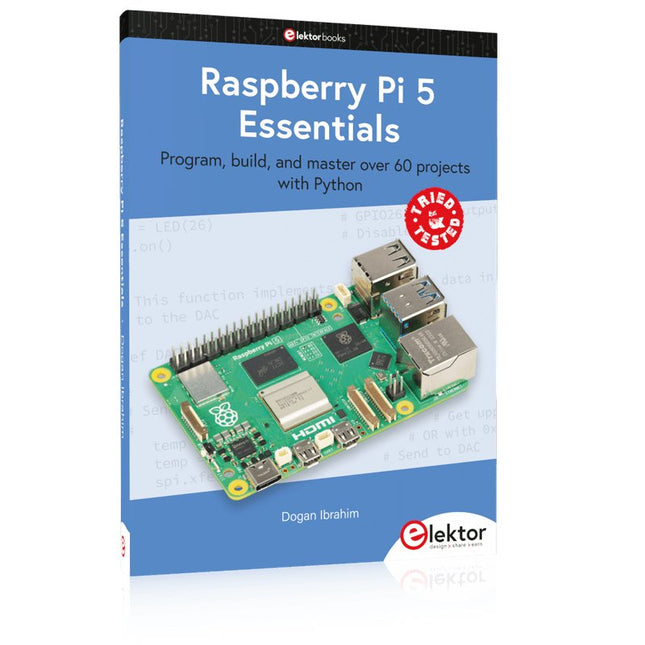
Elektor Publishing Raspberry Pi 5 Essentials
Program, build, and master over 60 projects with Python The Raspberry Pi 5 is the latest single-board computer from the Raspberry Pi Foundation. It can be used in many applications, such as in audio and video media centers, as a desktop computer, in industrial controllers, robotics, and in many domestic and commercial applications. In addition to the well-established features found in other Raspberry Pi computers, the Raspberry Pi 5 offers Wi-Fi and Bluetooth (classic and BLE), which makes it a perfect match for IoT as well as in remote and Internet-based control and monitoring applications. It is now possible to develop many real-time projects such as audio digital signal processing, real-time digital filtering, real-time digital control and monitoring, and many other real-time operations using this tiny powerhouse. The book starts with an introduction to the Raspberry Pi 5 computer and covers the important topics of accessing the computer locally and remotely. Use of the console language commands as well as accessing and using the desktop GUI are described with working examples. The remaining parts of the book cover many Raspberry Pi 5-based hardware projects using components and devices such as LEDs and buzzers LCDs Ultrasonic sensors Temperature and atmospheric pressure sensors The Sense HAT Camera modules Example projects are given using Wi-Fi and Bluetooth modules to send and receive data from smartphones and PCs, and sending real-time temperature and atmospheric pressure data to the cloud. All projects given in the book have been fully tested for correct operation. Only basic programming and electronics experience are required to follow the projects. Brief descriptions, block diagrams, detailed circuit diagrams, and full Python program listings are given for all projects described.
€ 39,95
Leden: € 35,96
-

Elektor Digital Mikrocontroller-Technik (PDF)
Mikrocontroller haben sich in den letzten Jahren in praktisch allen Bereichen der modernen Technik etabliert. In zunehmendem Maße dringen sie auch in die Gebiete der Künstlichen Intelligenz und der Robotertechnik vor. Das vorliegende Buch gibt eine umfassende Einführung in die Welt der Controller-Technik mit all ihren Facetten, von der einfachen Steuerung über die Sensor-Technik bis hin zur Datenübertragung in das Internet. Als Basis dafür dient das von Elektor entwickelte AVR-Playground-Board. Das Board kann mit Controllern der ATmega-Familie bestückt werden und ist mit dem bekannten Arduino-System kompatibel, so dass auch die verschiedenen Arduino-Hardware-Erweiterungen verwendet werden können. Für die Programmierung kommt die Sprache „C“ zum Einsatz. Auch hier wird im Buch auf das Arduino-System zurückgegriffen. Die frei verfügbare Arduino-Entwicklungsumgebung erlaubt den leichten Einstieg, ohne dass später Einschränkungen in Kauf genommen werden müssen. Die Hardware-nahe Programmierung steht dabei besonders im Fokus. Nach der Erläuterung von grundlegenden Anwendungen wird auf die anspruchsvolleren Themen wie Interrupts, Timer und Counter, Pulsweitenmodulation und Analog-Digital-Wandlung eingegangen. Praktische Anwendungen können sowohl mit einem Arduino als auch mit dem AVR-Playground-Board durchgeführt werden. Da das AVR-Playground-Board bereits über eine Vielzahl von Peripherie-Einheiten verfügt, sind nur noch wenige externe Bauteile erforderlich. Das Board kann im Elektor-Shop hier bezogen werden.
€ 32,80
Leden: € 29,52


