Elektor GREEN en GOLD leden kunnen deze uitgave hier downloaden.Nog geen lid? Klik hier om een lidmaatschap af te sluiten.
Voor ogen en oren
Video-output met microcontrollers (1)Composiet Video
electronica 2022nieuws van 's werelds grootste elektronicabeurs
ESP32-camerazo simpel – heeft niet eens WiFi
ATX-voeding voor Raspberry Pi
32 Ω KoptelefoonversterkerEenvoudige maar hoogwaardige 3-chip oplossing
SDR-radioklokkenvijf tijdsignalen, zes displays
Alle begin......zet een streep onder de diode
Uit het leven gegrepenover de kwaliteit der dingen
Reverse-engineering van een Bluetooth Low Energy LED-badgeeen BLE-apparaat besturen met een Python-script
MakePython ESP32 Development KitAlles in een doosje
THD-meting met een oscilloscoop en FFTgemakkelijke berekening van de vervormingsfactor
Allesziende machinesde technologie achter moderne industrële visionsystemen
Infographics
De evolutie van spraak- en audiogestuurde elektronische apparaten
WEEF 2022 terugblik
FFWD elektronica 2022 terugblikde vernieuwers hebben niet nagelaten indruk te maken
The Tubeeen ongebruikelijke buizenversterker
Biomateriaal in elektronica: klaar of niet
De Opera Cake antenne switch voor HackRF OneSluit tot acht antennes aan op uw SDR
Engineering met de Arduino, en meerEen interview met auteur Ashwin Pajankar
LiDAR-precisiemetermeet tot 12 meter
Audiosignalen en de ESP32De ESP-ADF-omgeving in de praktijk
Elektor Fortissimo-100 einversterker-kit
Lichtgestuurde geluidseffectenSpanningsgestuurd 24 dB/oct synthesizerfilter (VCF) met LDR's
De kilo-watter van Elektuurmeer volume gaat niet!
Oost West Lab Besteen volumetrisch display in Canada
Project 2.0Correcties, Updates en Brieven van lezers
Hexadoku
Elektor GREEN and GOLD members can download their digital edition here.
Not a member yet? Click here.
Digital Load for High-Current TestingFrom Necessity to Innovation
Vocal RemoverInstant Karaoke Circuit
Audio A/B Selector With Gain ControlSwitches from Microphone to Line Inputs
Better Charging for the LIR2032Be Kind to Your Coin Cells
Touch Sensing Made SimpleA DIY Guide for Any Microcontroller
Universal Infrared Remote SwitchA New Life for Old Remotes
Microcontroller-Powered Moo BoxMaking Playful Sounds With a Microcontroller
USB Battery Interface
Powering Low-Draw Devices With Power BanksA “Stay Alive” Solution
Small Class-A Audio Amplifier With Current OutputDrive Speakers with Current Instead of Voltage
Pseudo-Balanced ModuleHigh CMRR with Unbalanced Audio Links
Ni-MH Cells Automatic ChargerRefill All Your Battery Packs in One Go!
Thyristor-Based Power Supply Protection
Fingerprint Sensor SwitchA Useful Proof-of-Identity Device
DC-DC 3-A Power ConverterUpgrade Your Fixed-Voltage Sources
Remote Water Heater MonitorVoltage and Current Detection for AC Lines
Attenuators for Audio Signals (1)Adjustable Via Jumpers
Pimp My Car Battery Charger (Part 1)Don’t Throw It Away, Mod It!
A Board for the Blue OnePCB for Alps Motorized Potentiometer with Feedback
50-Hz Reference from 60-Hz Mains VoltageHow to Use 50-Hz Electronics in 60-Hz Environments
Digital IsolatorsRealizing Galvanic Isolation Easily
Compact 12-W Hi-Fi Mono AmplifierSmall But Powerful
LM386 Ramp Generator
Three-Phase GeneratorWith Raspberry Pi Pico
Door Opener for the Musically Talented
Elektor Classic: Surf SynthesizerOcean Watersports Background Sound Generator (OWBSG)
Pimp my Car Battery Charger (Part 2)Don’t Throw It Away, Mod It!
Lamp Current MonitorWith a Raspberry Pi Pico
Infrared Telegraphy
Fnirsi SWM-10Repair Battery Packs With This Portable Intelligent Spot Welding Machine
Stereo Audio Codec for the ESP32 and Co.No Need to Be Afraid of Audio Measurement Technology
Tin Soldering TechniquesMake Them Well Right Away!
Attenuators for Audio Signals (2)Switching Via Relays
USB-C PowerDrawing Power from USB-C Power Adapters
Three Circuits with Two and Three Counter ICs4017 ICs Working Together
Active Components – The Diode
A Timer For Ultra-Long DelaysSet It, and Forget It!
Jack In and Jack OutA Useful Insert Option for Audio Circuits
Power an ESP32 from a Single Li-ion Cell
Hexadoku
Elektor GREEN en GOLD leden kunnen deze uitgave hier downloaden.
Nog geen lid? Klik hier om een lidmaatschap af te sluiten.
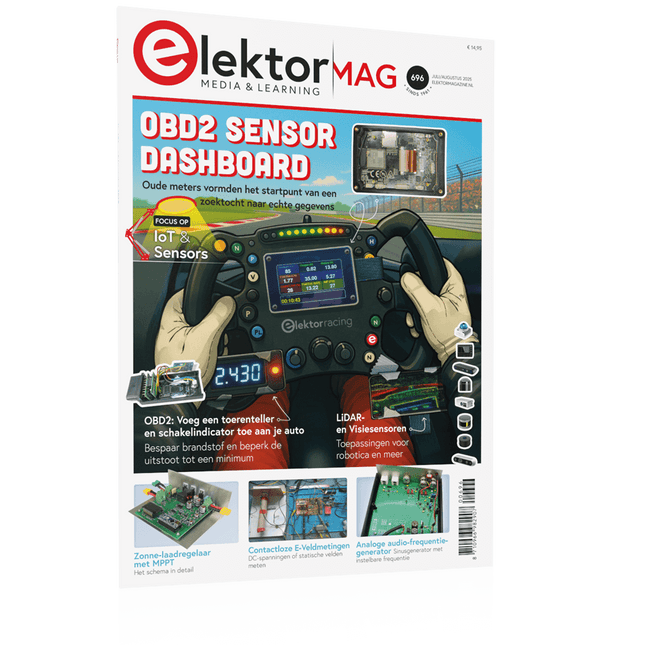
OBD2-sensordashboardOude meters vormden het startpunt van een zoektocht naar echte gegevens
OBD2: voeg een toerenteller en schakelindicator toe aan je autoRetro, maar uiterst nuttig
LiDAR- en Visiesensoren voor Robotica
Sensor+Test 2025 en PCIM 2025
Contactloze E-Veldmetingen (1)Een Trillende Membraan voor het Detecteren van Gelijkspanningen of Statische Elektrische Velden
Draadloze brievenbusmeldervan optische sensoren tot radar: enkele mogelijkheden
Elektor Mini-Wheelieeen zelfbalancerende robot
ZonnecellenVreemde onderdelen, de serie
Aan de slag met een moderne radarsensorStaat een nauwkeurige meting op uw radar?
Uit het leven gegrepenpapierfabriek
CybersecurityZware tijden voor hackers
Infographics: IoT en sensoren 2025
Bluetooth 6.0 brengt verbeterde toepassingen voor afstandsbepalingNieuwe versie biedt betere apparaatpositionerings- en -locatieservices
Draadloze communicatie verkennen met BeagleY-AI
Err-lectronicsCorrecties, updates en lezerspost
Alle begin......sluit het thema opamps af
Een krachtige AI-codeerassistentsneller ontwikkelen met Continue en Visual Studio Code
Zonne-laadregelaar met MPPT (2)Het schema
Ultrasone obstakeldetectoreen eenvoudig project om slechtzienden te helpen
2025: Een AI-odysseeHalfjaaroverzicht
Raspberry Pi Standalone MIDI-synthesizer (3)Het slimmer maken en een gebruikersinterface toevoegen
Meshtastic: een demonstratieprojectEen slim netwerk van LoRa-radio's
Analoge audio-frequentiegeneratorHoogwaardige sinusgenerator met instelbare frequentie
Recently, the development of a tiny chip called the ESP8266 has made it possible to interface any type of microcontroller to a Wi-Fi AP. The ESP8266 is a low-cost tiny Wi-Fi chip having fully built-in TCP/IP stack and a 32-bit microcontroller unit. This chip, produced by Shanghai based Chinese manufacturer Espressif System, is IEEE 802.11 b/g/n Wi-Fi compatible with on-chip program and data memory, and general purpose input-output ports. Several manufacturers have incorporated the ESP8266 chip in their hardware products (e.g. ESP-xx, NodeMCU etc) and offer these products as a means of connecting a microcontroller system such as the Android, PIC microcontroller or others to a Wi-Fi. The ESP8266 is a low-power chip and costs only a few Dollars.
ESP8266 and MicroPython – Coding Cool Stuff is an introduction to the ESP8266 chip and describes the features of this chip and shows how various firmware and programming languages such as the MicroPython can be uploaded to the chip. The main aim of the book is to teach the readers how to use the MicroPython programming language on ESP8266 based hardware, especially on the NodeMCU.
Several interesting and useful projects are given in the e-book (pdf) to show how to use the MicroPython in NodeMCU type ESP8266 hardware:
Project “What shall I wear today?”: You will be developing a weather information system using a NodeMCU development board together with a Text-to-Speech processor module.
Project “The Temperature and Humidity on the Cloud”: You will be developing a system that will get the ambient temperature and humidity using a sensor and then store this data on the cloud so that it can be accessed from anywhere.
Project “Remote Web Based Control”: You will be developing a system that will remotely control two LEDs connected to a NodeMCU development board using an HTTP Web Server application.
ARM Cortex-M Embedded Design from 0 to 1
Hobbyists can mash together amazing functional systems using platforms like Arduino or Raspberry Pi, but it is imperative that engineers and product designers understand the foundational knowledge of embedded design. There are very few resources available that describe the thinking, strategies, and processes to take an idea through hardware design and low-level driver development, and successfully build a complete embedded system. Many engineers end up learning the hard way, or never really learn at all.
ARM processors are essentially ubiquitous in embedded systems. Design engineers building novel devices must understand the fundamentals of these systems and be able to break down large, complicated ideas into manageable pieces. Successful product development means traversing a huge amount of documentation to understand how to accomplish what you need, then put everything together to create a robust system that will reliably operate and be maintainable for years to come.
This book is a case study in embedded design including discussion of the hardware, processor initialization, low‑level driver development, and application interface design for a product. Though we describe this through a specific application of a Cortex-M3 development board, our mission is to help the reader build foundational skills critical to being an excellent product developer. The completed development board is available to maximize the impact of this book, and the working platform that you create can then be used as a base for further development and learning.
The Embedded in Embedded program is about teaching fundamental skill sets to help engineers build a solid foundation of knowledge that can be applied in any design environment. With nearly 20 years of experience in the industry, the author communicates the critical skill development that is demanded by companies and essential to successful design. This book is as much about building a great design process, critical thinking, and even social considerations important to developers as it is about technical hardware and firmware design.
Downloads
EiE Software Archive (200 MB)
IAR ARM 8.10.1 (Recommended IDE version to use) (1.2 GB)
IAR ARM 7.20.1 (Optional IDE version to use) (600 MB)
De OWON ADS900A-serie is een compacte 12-bits digitale oscilloscoop met een snelheid tot 2 GSa/s, een geheugen van 100 Mpts en een bandbreedte van 125/250 MHz. Met zijn 7-inch multi-touch display, FFT, protocoldecodering en geïntegreerde logic analyzer levert hij nauwkeurige signaalanalyse voor toepassingen in het laboratorium, de werkplaats en in het veld.
Specificaties
ADS914A
ADS924A
Bandwidth (-3 dB)
125 MHz
250 MHz
Channels
4
Max. sample rate
2 GSa/s (single-channel) 1 GSa/s (dual-channel) 500 MSa/s (full-channel)
DC Gain Accuracy
3% (≤1 mV)
2% (≥2 mV)
Max memory depth
100M
Vertical resolution
12 bits
Relay time accuracy
±25 ppm (typical)
Input Impedance
1 MΩ±2%, parallel with20 pF±5 pF
Probe Attenuation Coefficient
1.00μX-1M.00X,step by 1-2-5, support custom
Trigger type
Edge, Video, Pulse, Slope, Runt, Windows, Timeout, Nth, Logic, RS232/UART, I²C, SPI CAN, LIN
Bus decoding
RS232/UART, I²C, SPI, CAN, LIN
Auto measurement
Period, Frequency, +Width, -Width, Rise Time, Fall Time, Scr Duty, +Duty,-Duty, Vavg, Vpp, VRMS, Overshoot, Vmax, Vmin, Vtop, CycRms, Vbase, Vamp, Preshoot, Std Dev, +Pulse Cnt, -Pulse Cnt, Rise Cnt, Fall Cnt, Area, Cyc Area, Delay(A↑-B↑), Delay(A↑-B↓), Delay(A↓-B↑), Delay(A↓-B↓), Phase(A↑-B↑)
Phase(A↑-B↓), Phase(A↓-B↑), Phase(A↓-B↓), FRR(A↑-B↑), FRF(A↑-B↓)
FFR(A↓-B↑), FFF(A↓-B↓), LRR(A↑-B↑), LRF(A↑-B↓), LFR(A↓-B↑), LFF(A↓-B↓)
Waveform Math
+, -, *, /, &&, ||, ^, !, Intg, Diff, Sqrt, Function operation (Lg / Ln / Exp / Abs / Sine / Cosine / Tan), FFT, FFT rms, User Defined, digital filter (low pass, high pass, band pass, band reject)
Frequency counter
6-digit frequency counter
Maximum frequency: maximum analog bandwidth of oscilloscope
Voltmeter
Support DC, AC+DCrms, ACrms, Resolution: 4 digits (ACV/DCV)
Logical Analyzer Specifications
Number of channels
16 input channels (D0-D15) (D0 to D7, D8 to D15)
Max. input voltage
±40V peak CAT I, transient overvoltage 800Vpk
Input Impedance
100kΩ, 8 pF
Vertical resolution
1 bit
Other
Communication Interface
HDMI, USB device, USB Host, Trig Out (P/F), LAN
Display
7 inch (1024x600), capacitive multi-touch screen
Power supply interface
USB-C
Dimensions
260 x 160 x 78 mm
Weight
1.5 kg
Inbegrepen
1x OWON ADS924A Oscilloscoop
1x Voedingsadapter
1x Netsnoer
1x USB-kabel
1x Probe
1x Quick Guide
Downloads
Manual
Quick Guide
PC Software
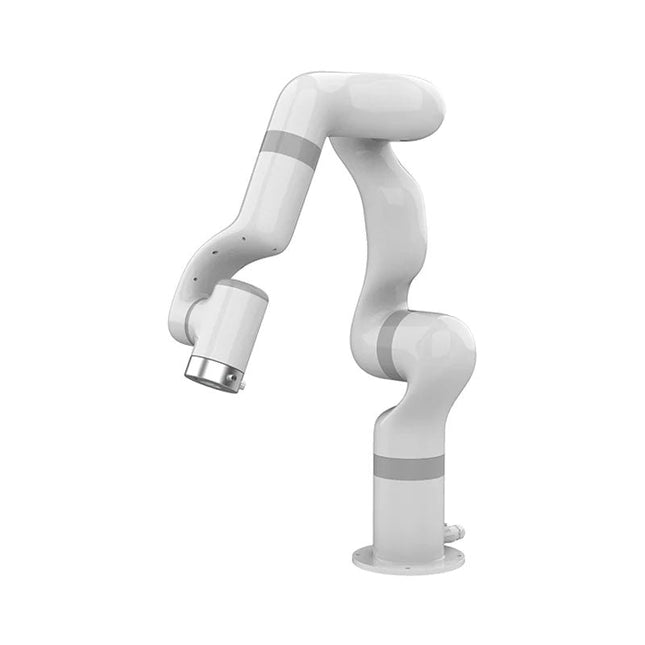
UFactory 850 is the most powerful robot with industrial grade performance.
Features
6DoF
Payload: 5 kg
Reach: 850 mm
Repeatability: 0.02 mm
Weight: 20 kg
Applications
Glambot
Welding
Screwdriving
Robot Vision
Industrial Production
Designed for both mobile platforms and your workbench
The AC control box contains an AC-DC adapter inside, 100-240 V AC is all ready to go.
The DC control box supports 48-72 V wide inputs, it perfectly fits the battery system on your mobile platform.
Flexible Deployment With Safe Feature
Hand teaching, space-saving and easy to re-deploy to multiple applications without changing your production layout. Perfectly for recurrent tasks.
Collision detection is available for all of our cobots. Your safety is always the top priority.
Graphical Interface For Beginner-Friendly Programming
Compatible with various operation systems, including macOS and Windows.
Web-based technology compatible with all major browsers.
Drag and drop to create your code in minutes.
Powerful And Open Source SDK At Your Fingertips
Fully functional open-source Python/C++ SDK provides more flexible programming.
ROS/ROS2 packages are ready-to-go.
Example codes help you to deploy the robotic arm smoothly.
Specifications
UFactory 850
xArm 5
xArm 6
xArm 7
Payload
5 kg
3 kg
5 kg
3.5 kg
Reach
850 mm
700 mm
700 mm
700 mm
Degrees of freedom
6
5
6
7
Repeatability
±0.02 mm
±0.1 mm
±0.1 mm
±0.1 mm
Maximum Speed
1 m/s
1 m/s
1 m/s
1 m/s
Weight (robot arm only)
20 kg
11.2 kg
12.2 kg
13.7 kg
Maximum Speed
180°/s
180°/s
180°/s
180°/s
Joint 1
±360°
±360°
±360°
±360°
Joint 2
-132°?132°
-118°?120°
-118°?120°
-118°?120°
Joint 3
-242°~3.5°
-225°~11°
-225°~11°
±360°
Joint 4
±360°
-97°~180°
±360°
-11°?225°
Joint 5
-124°~124°
±360°
-97°~180°
±360°
Joint 6
±360°
±360°
-97°~180°
Joint 7
±360°
Hardware
Ambient Temperature Range
0-50°C
Power Consumption
Typical 240 W, max 1000 W
Input Power Supply
48 V DC, 20.8 A
Footprint
Ø 190 mm
Materials
Aluminum, Carbon Fiber
Base Connector Type
M8x4
ISO Class Cleanroom
5
Robot Mounting
Any
End Effector Communication Protocol
Modbus RTU
End Effector I/O
2x DI / 2x DO / 2x AI / 1x RS485
Communication Mode
Ethernet
Included
1x UFactory 850 robotic arm
1x AC control box
1x Control box power cable
The OWON SPE6103 is a 1-channel DC power supply (300 W) in a small body with features like over voltage and over current protection. It has a high resolution of 10 mV/1 mA. The 2.8' LCD displays the following information (constant voltage output, constant current output, cumulative running time, actual output power, channel output status, actual voltage output, actual current output).Features
Small body for easy carry
High resolution: 10 mV/1 mA
List waveform editing output, editable 10 groups of timing output function
Low ripple/noise
Over voltage / over current protection
Output voltage and current curve monitoring function
Intelligent temperature control fan cooling
2.8-inch TFT LCD display
USB communication interface, support SCPI
Specifications
Model
SPE6102
SPE6103
Rated Output (0-40°C)
Voltage
0-60 V
0-60 V
Current
10 A
10 A
Output Power
200 W
300 W
USB Output
5 V/1 A (SPE Series) or suppout QC2.0, QC3.0, BC1.2, Apple, Huawei, Samsung fast charging protocols (optional)
Load Regulation
Voltage
?30 mV
Current
?20 mA
Power Regulation
Voltage
?30 mV
Current
?20 mA
Setting Resolution
Voltage
10 mV
Current
1 mA
Readback Resolution
Voltage
10 mV
Current
1 mA
Value Resolution (within 12 months) (25 ±5°C)
Voltage
?0.1% ±30 mV
?0.1% ±30 mV
Current
?0.05% ±10 mA
Readback Value Resolution (25 ±5°C)
Voltage
?0.1% ±30 mV
?0.1% ±30 mV
Current
Ripple/Noise
Voltage (Vp-p)
?50mVp-p
?50mVp-p
Voltage (rms)
?5mVrms
?5mVrms
Current (rms)
?30mAp-p
Output temperature coefficient (0-40°C)
Voltage
100ppm/°C
Current
200ppm/°C
Readback temperature coefficient
Voltage
100ppm/°C
Current
200ppm/°C
Response Time (50-100% rated load)
?1.0ms
Storage
4 groups of data
Working Temperature
0-40°C
Included
1x OWON SPE6102
1x Power Cord
1x Quick Guide
1x USB Cable
1x Fuse
Downloads
User Manual
Programming Manual
Software
Physical Computing met het Arduino-platform
Dit leerboek over het Arduino-platform is uniek en brengt u stap voor stap van beginner tot gevorderde Arduino-gebruiker. Er wordt duidelijk in uitgelegd waarom en waardoor toepassingen werken, ondersteund door gedetailleerde afbeeldingen in kleur. Er is slechts een geringe elektronische basiskennis vereist, omdat de benodigde hardware uitgebreid wordt besproken. Het laatste gedeelte van dit boek bevat een degelijke theoretische verdieping, zodat u een krachtig naslagwerk achter de hand houdt.
Er bestond in het Nederlands nog geen lesboek over dit platform. De didactische opbouw is zodanig dat de vereiste abstracte kennis wordt uitgelegd aan de hand van toepasbare en actuele praktijkvoorbeelden. De meeste toepassingen zijn gericht op ‘physical computing’, dat is de interactie tussen sensoren, actoren, elektronica en software. Hierdoor is het boek ook geschikt voor technisch beroepsonderwijs, o.a. voor de richting mechatronica.
De opbouw van het boek is als volgt:
Algemene introductie microcontrollers.
Informatie over het Arduino-platform.
Oefeningen met uitleg aan de hand van 21 voorbeelden.
Praktijkvoorbeelden met uitleg aan de hand van 5 voorbeelden.
Theoretische verdieping van de software en hardware.
Praktische elektronicaschema´s.
Alle software-voorbeelden in het boek zijn als download beschikbaar.
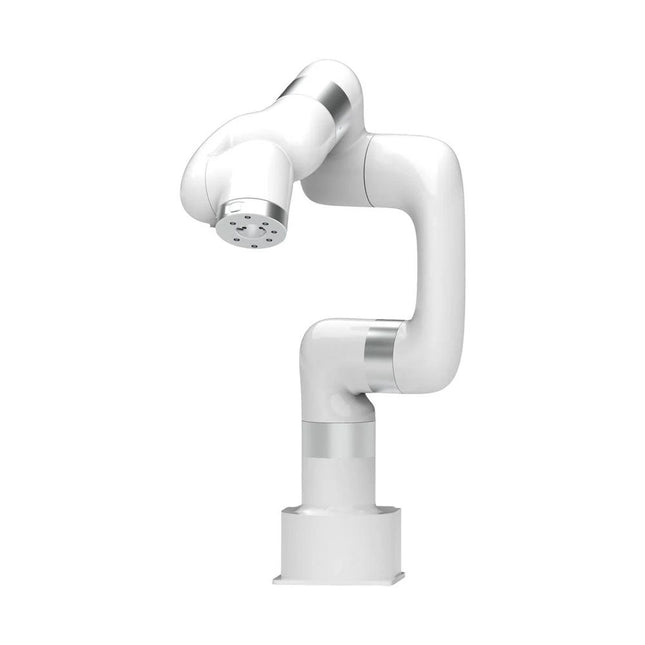
This multi-axis robot perfectly balances power and size.
Features
5 Axis
Payload: 3 kg
Reach: 700 mm
Repeatability: 0.1 mm
Max Speed 1000 mm/s
Applications
Machine Tending
Bin Picking
Mobile platform
Lab Automation
Robotic Research
Durable Collaborative robots for your automation
Industrial-grade harmonic drive and servomotors guarantee 24/7 working without stop.
Crafted from Carbon fiber, 15 kg weight makes it possible for easier deployment.
Flexible deployment with safe feature
Hand teaching, lightweight, space-saving and easy to re-deploy to multiple applications without changing your production layout. Perfectly for recurrent tasks.
Collision detection is available for all of our cobots. Your safety is always the top priority.
Graphical interface for beginner-friendly programming
Compatible with various of operation systems, including macOS and Windows.
Web-based technology compatible with all major browsers.
Drag and drop to create your code in minutes.
Powerful and open source SDK at your fingertips
Fully functional open-source Python/C++ SDK provides more flexible programming.
ROS/ROS2 packages are ready-to-go.
Example codes help you to deploy the robotic arm smoothly.
Specifications
UFactory 850
xArm 5
xArm 6
xArm 7
Payload
5 kg
3 kg
5 kg
3.5 kg
Reach
850 mm
700 mm
700 mm
700 mm
Degrees of freedom
6
5
6
7
Repeatability
±0.02 mm
±0.1 mm
±0.1 mm
±0.1 mm
Maximum Speed
1 m/s
1 m/s
1 m/s
1 m/s
Weight (robot arm only)
20 kg
11.2 kg
12.2 kg
13.7 kg
Maximum Speed
180°/s
180°/s
180°/s
180°/s
Joint 1
±360°
±360°
±360°
±360°
Joint 2
-132°?132°
-118°?120°
-118°?120°
-118°?120°
Joint 3
-242°~3.5°
-225°~11°
-225°~11°
±360°
Joint 4
±360°
-97°~180°
±360°
-11°?225°
Joint 5
-124°~124°
±360°
-97°~180°
±360°
Joint 6
±360°
±360°
-97°~180°
Joint 7
±360°
Hardware
Ambient Temperature Range
0-50°C
Power Consumption
Min 8.4 W, Typical 200 W, max 400 W
Input Power Supply
24 V DC, 16.5 A
Footprint
Ø 126 mm
Materials
Aluminum, Carbon Fiber
Base Connector Type
M5x5
ISO Class Cleanroom
5
Robot Mounting
Any
End Effector Communication Protocol
Modbus RTU(rs485)
End Effector I/O
2x DI/2x DO/2x AI/1x RS485
Communication Mode
Ethernet
Included
1x xArm 5 robotic arm
1x AC control box
1x Robotic arm power cable
1x Robotic arm end effector adapter cable
1x Robotic arm signal cable
1x Control box power cable
1x Network cable
1x Mounting tool
1x Quick start guide
De SDRplay RSPdx-R2 is een breedbandige, volledig uitgeruste 14-bit SDR-ontvanger met één tuner die het volledige RF-spectrum van 1 kHz tot 2 GHz bestrijkt, met een spectrumbereik tot 10 MHz. Hij bevat drie antennepoorten, waarvan er twee SMA-connectoren gebruiken en werken over het volledige bereik van 1 kHz tot 2 GHz, en de derde een BNC-connector heeft die werkt tot 200 MHz.
De RSPdx-R2 is een verbeterde versie van de RSPdx met verdere ontwerpverbeteringen voor gebruik bij frequenties lager dan 2 MHz. De RSPdx-R2 is gehuisvest in een stevige stalen behuizing en biedt, naast de functionaliteit van de RSP1B, drie softwarematig selecteerbare antenne-ingangen en een externe klokingang. Hij biedt uitstekende prestaties op HF- en VHF-frequenties tot wel 2 GHz. De RSPdx-R2 ondersteunt ook een "HDR-modus" die geoptimaliseerd is voor de veeleisende radio-ontvangstomstandigheden onder de 2 MHz.
De RSPdx-R2 introduceert, in combinatie met de eigen software van SDRplay, een speciale HDR-modus (High Dynamic Range) voor ontvangst binnen geselecteerde banden onder de 2 MHz. De HDR-modus levert verbeterde intermodulatieprestaties en minder storende signalen voor die uitdagende banden.
Kenmerken
Bestrijkt alle frequenties van 1 kHz via VLF, LF, MW, HF, VHF, UHF en L-band tot 2 GHz, zonder onderbrekingen
Ontvang, bewaak en neem tot 10 MHz spectrum tegelijk op
Aanzienlijk verbeterde ruisprestaties onder 1 MHz (d.w.z. voor sommige MF, LF en lager)
Verbeterd dynamisch bereik onder 2 MHz, zowel in tunermodus als HDR-modus
HDR-modus onder 2 MHz biedt voordelen op het gebied van algemeen dynamisch bereik en selectiviteit
Softwarematig selecteerbare keuze uit 3 antennepoorten
Externe klokingang voor synchronisatiedoeleinden, of aansluiting op GPS-referentieklok voor extra frequentienauwkeurigheid
Uitstekend dynamisch bereik voor uitdagende ontvangstomstandigheden
Gratis gebruik van Windows-gebaseerde SDRuno-software (raadpleeg de website voor ondersteunde versies)
Gratis gebruik van SDRconnect SDR- en serversoftware voor Windows, MacOS en Linux (raadpleeg de website voor ondersteunde versies)
Ondersteuning voor multiplatform drivers en API's, waaronder Windows, Linux, Mac en Raspberry Pi 4/5
Sterk en groeiend softwareondersteuningsnetwerk
Gekalibreerde S-meter/RF-vermogens- en signaal-ruisverhoudingsmeting met SDRuno (inclusief datalogging naar .CSV-bestanden)
Gedocumenteerde API beschikbaar voor demodulator- of applicatieontwikkeling op meerdere platforms
Toepassingen (Amateur)
Luisteren naar kortegolfradio
Uitzending DX (AM/FM/TV)
Panadaptor
Vliegtuigen (ADS-B en ATC)
Slow Scan TV
Monitoring van multi-amateurbanden
WSPR & digitale modi
Weerfax (HF en satelliet)
Satellietmonitoring
Geostationaire omgevingssatellieten
Trunked radio
Monitoring van nutsbedrijven en hulpdiensten
Snelle en effectieve antennevergelijking
Toepassingen (Industrieel)
Spectrum Analyser
Bewaking
Draadloze microfoonbewaking
RF-meting
IoT-ontvangerketen
Signaalregistratie
RFI/EMC-detectie
Bewaking van de uitzendintegriteit
Spectrumbewaking
Vermogensmeting
Toepassingen (Educatief/Wetenschappelijk)
Onderwijs
Ontwerp van ontvangers
Radioastronomie
Passieve radar
Ionosonde
Spectrumanalysator
Ontvanger voor IoT-sensorprojecten
Antenneonderzoek
Specificaties
Frequentiebereik
1 kHz – 2 GHz
Antenne-aansluiting
SMA
Antenne-impedantie
50 ohm
Stroomverbruik (typisch)
190 mA bij >60 MHz (excl. Bias-T)120 mA bij <60 MHz (excl. Bias-T)
USB-aansluiting
USB-B
Maximaal ingangsvermogen
+0 dBm Continu+10 dBm korte duur
ADC-samplefrequenties
2-10,66 MSPS
ADC-aantal bits
14 bit 2-6,048 MSPS12 bit 6,048-8,064 MSPS10 bit 8,064-9,216 MSPS8 bit >9,216 MSPS
Bias-T
4,7 V100 mA gegarandeerd
Referentie
0,5 ppm 24 MHz TCXOFrequentiefout trimbaar tot 0,01 ppm in het veld
Bedrijfstemperatuur
−10˚C tot +60˚C
Afmetingen
113 x 94 x 35 mm
Gewicht
315 g
Downloads
Datasheet
Software
RSPdx-R2 vs RSPduo
RSPdx-R2
RSPduo
Continue dekking van 1 kHz tot 2 GHz
✓
✓
Tot 10 MHz zichtbare bandbreedte
✓
✓
14-bits ADC siliciumtechnologie plus meerdere krachtige ingangsfilters
✓
✓
Softwarematig selecteerbare AM/FM & DAB broadcast band notch filters
✓
✓
4,7 V Bias-T voor voeding van externe antenneversterker
✓
✓
Voedt de USB-kabel met een eenvoudige aansluiting type B
✓
✓
50Ω SMA-antenne-ingang(en) voor werking van 1 kHz tot 2 GHz (softwarematig instelbaar)
2
2
Extra softwarematig selecteerbare Hi-Z ingang voor werking tot 30 MHz
✓
Extra softwarematig selecteerbare 50Ω BNC-ingang voor werking tot 200 MHz
✓
Extra LF/VLF-filter voor onder 500 kHz
✓
24 MHz referentieklokingang (+ uitgang op RSPduo)
✓
✓
Dubbele tuners voor ontvangst op 2 totaal onafhankelijke 2 MHz-bereiken
✓
Dubbele tuners voor diversiteitsontvangst met SDRuno
✓
Robuuste zwartgelakte stalen behuizing
✓
✓
Algemene prestaties onder 2 MHz voor MW en LF
++
+
Meerdere gelijktijdige toepassingen
+
++
Prestaties in uitdagende fading-omstandigheden (*met gebruik van diversiteitsafstemming)
+
*++
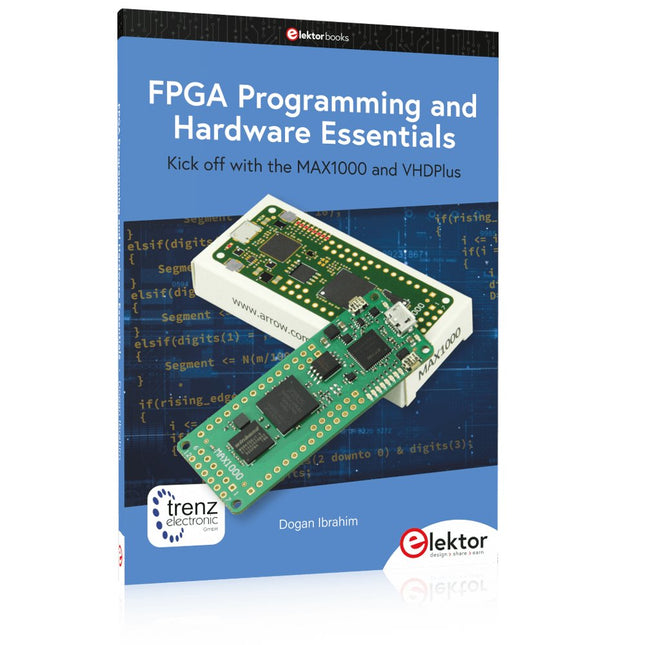
Kick off with the MAX1000 and VHDPlus
Ready to Master FPGA Programming? In this guide, we’re diving into the world of Field Programmable Gate Arrays (FPGAs) – a configurable integrated circuit that can be programmed after manufacturing. Imagine bringing your ideas to life, from simple projects to complete microcontroller systems!
Meet the MAX1000: a compact and budget-friendly FPGA development board packed with features like memory, user LEDs, push-buttons, and flexible I/O ports. It’s the ideal starting point for anyone wanting to learn about FPGAs and Hardware Description Languages (HDLs).
In this book, you’ll get hands-on with the VHDPlus programming language – a simpler version of VHDL. We’ll work on practical projects using the MAX1000, helping you gain the skills and confidence to unleash your creativity.
Get ready for an exciting journey! You’ll explore a variety of projects that highlight the true power of FPGAs. Let’s turn your ideas into reality and embark on your FPGA adventure – your journey starts now!
Exciting Projects You’ll Find in This Book
Arduino-Driven BCD to 7-Segment Display Decoder
Use an Arduino Uno R4 to supply BCD data to the decoder, counting from 0 to 9 with a one-second delay
Multiplexed 4-Digit Event Counter
Create an event counter that displays the total count on a 4-digit display, incrementing with each button press
PWM Waveform with Fixed Duty Cycle
Generate a PWM waveform at 1 kHz with a fixed duty cycle of 50%
Ultrasonic Distance Measurement
Measure distances using an ultrasonic sensor, displaying the results on a 4-digit 7-segment LED
Electronic Lock
Build a simple electronic lock using combinational logic gates with push buttons and an LED output
Temperature Sensor
Monitor ambient temperature with a TMP36 sensor and display the readings on a 7-segment LED
Downloads
Software