
Zoekresultaten voor "raspberry OR pi OR 400 OR buffer OR board"
-

Elektor Digital Machine Learning mit Python für PC, Raspberry Pi und Maixduino (PDF)
Nahezu alle Menschen werden zunehmend mit den Anwendungen der „Künstlichen Intelligenz“ (KI oder AI für engl. Artificial Intelligence) konfrontiert. Musik- oder Videoempfehlungen, Navigationssysteme, Einkaufsvorschläge etc. basieren auf Verfahren, die diesem Bereich zugeordnet werden können. Der Begriff „Künstliche Intelligenz“ wurde 1956 auf einer internationalen Konferenz, dem Dartmouth Summer Research Project geprägt. Eine grundlegende Idee war dabei, die Funktionsweise des menschlichen Gehirns zu modellieren und darauf basierend fortschrittliche Computersysteme zu konstruieren. Bald sollte klar sein, wie der menschliche Verstand funktioniert. Die Übertragung auf eine Maschine wurde nur noch als ein kleiner Schritt angesehen. Diese Vorstellung erwies sich als etwas zu optimistisch. Dennoch sind die Fortschritte der modernen KI, beziehungsweise ihrem Teilgebiet dem sogenannten „Machine Learning“, nicht mehr zu übersehen. Um die Methoden des Machine Learnings näher kennenzulernen, sollen in diesem Buch mehrere verschiedene Systeme zum Einsatz kommen. Neben dem PC werden sowohl der Raspberry Pi als auch der „Maixduino“ in den einzelnen Projekten ihre Fähigkeiten beweisen. Zusätzlich zu Anwendungen wie Objekt- und Gesichtserkennung entstehen dabei auch praktisch einsetzbare Systeme wie etwa Flaschendetektoren, Personenzähler oder ein „Sprechendes Auge“. Letzteres ist in der Lage, automatisch erkannte Objekte oder Gesichter akustisch zu beschreiben. Befindet sich beispielsweise ein Fahrzeug im Sichtfeld der angeschlossenen Kamera, so wird die Information „I see a car!“ über elektronisch erzeugte Sprache ausgegeben. Derartige Geräte sind hochinteressante Beispiele dafür, wie etwa auch blinde oder stark sehbehinderte Menschen von KI-Systemen profitieren können.
€ 32,80
Leden: € 29,52
-
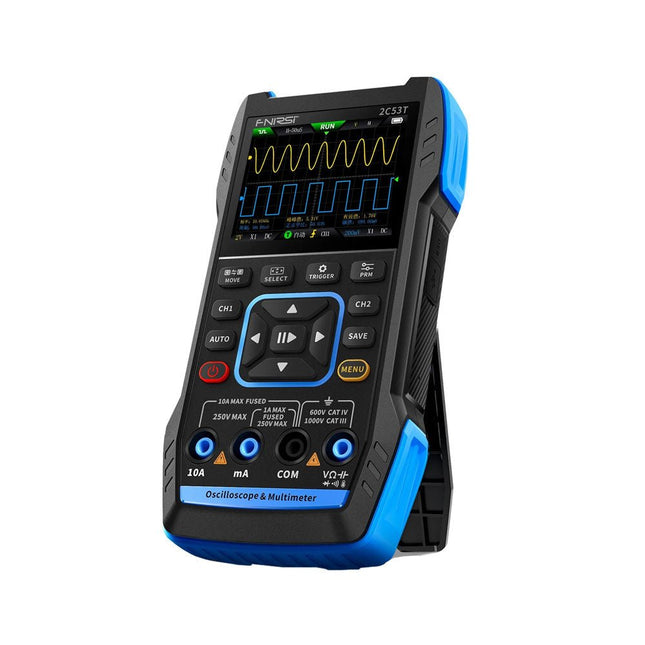
FNIRSI FNIRSI 2C53T (3-in-1) 2-kanaals Oscilloscoop (50 MHz) + Multimeter + Signaalgenerator
De FNIRSI 2C53T, een verbeterde versie van zijn 10 MHz voorganger, is een compact en veelzijdig 3-in-1 apparaat. Het combineert een tweekanaals 50 MHz-oscilloscoop, een 4,5-cijferige True RMS-multimeter en een signaalgenerator met 13 golfvormtypen, waardoor het een essentieel hulpmiddel is voor onderhouds- en onderzoeksprofessionals. Oscilloscoop: beschikt over een bandbreedte van 50 MHz, een bemonsteringssnelheid van 250 MS/s, ±400 V-bescherming, FPGA + ARM + ADC-architectuur en opslag van golfvormen voor analyse. Multimeter: 4,5-cijferig True RMS met 19999 counts, ondersteunt AC/DC-spannings-, stroom-, capaciteits-, weerstands-, diode- en continuïteitsmetingen. Signaalgenerator: voert 13 signaaltypen uit tot 50 kHz, met instelbare frequentie, amplitude en werkcyclus. Met een 2,8-inch LCD-scherm, een batterij van 3000 mAh (6 uur looptijd) en een draagbaar ontwerp biedt hij krachtige functionaliteit in een gebruiksvriendelijk pakket. Specificaties Oscilloscoop Kanalen 2 Analoge bandbreedte 50 MHz Realtime sampling rate 250 MS/s Opslagdiepte 1 Kpts Impedantie 1 MΩ Tijdbasisbereik 10ns-20s Verticale gevoeligheid 10 mV/div-10 V/div (x1) Maximum gemeten spanning ±400 V Triggermodus Auto/Normal/Single Triggertype Rising edge, Falling edge Weergavemodus Y-T/Rolling/X-Y Koppelingsmethode AC/DC Persistentie UIT, 500ms, 1s, ∞ Wiskunde 8 Basisbewerkingen + FFT Ondersteund Screenshot golfvorm opslaan, golfvormafbeelding exporteren, cursormeting, oneindig nagloeien Multimeter Gelijkspanning 1.9999V/19.999V/199.99V/1000V ±(0.5%+3) AC-spanning 1.9999V/19.999V/199.99V/750.0V ±(1%+3) Gelijkstroom 19.999mA/199.99mA/1.9999A/9.999A ±(1.2%+3) AC-stroom 19.999mA/199.99mA/1.9999A/9.999A ±(1.5%+3) Weerstand 19.999MΩ/1.9999MΩ/199.99KΩ/19.999KΩ ±(0.5%+3) 1.9999KΩ/199.99Ω ±(2.0%+3) Capaciteit 999.9uF/99.99uF/9.999uF/999.9nF/99.99nF/9.999nF ±(2.0%+5) 9.999mF/99.99mF ±(5.0%+20) Temperatuur −55~1300°C ±(2.5%+5) Continuïteitstest Ja Diode Ja Signaalgenerator 13 signaalgolfvormen Sinusgolf, rechthoekige golf, zaagtandgolf, halve golf, volledige golf, positieve stapgolf, omgekeerde stapgolf, exponentiële stijging, exponentiële daling, DC, multi-audio, zinkloodpuls, Lorentz-golf Uitgangsfrequentie 0-50 KHz Uitgangsamplitude 0-3 V Uitgangscyclus 0-100% Algemeen Weergave 2,8" HD-kleurenscherm Resolutie 320 x 240 Opladen USB-C (5 V/1 A) Batterij 3000 mAh lithiumbatterij Stand-by tijd 6 uur Talen Engels, Chinees Afmetingen 167 x 89 x 35 mm Gewicht 300 g Verschillen nieuwe versus oude versie Model 2C53T Upgrade 2C53T Voorganger Bandbreedte 50 MHz 10 MHz Weergavemodus Y-T/Rolling/X-Y Y-T/Rolling Wiskunde 8 basisbewerkingen + FFT N.v.t. Cursorfunctie Ja N.v.t. XY Lissau-grafiek Ja N.v.t. Nagloeifunctie Ja N.v.t. Multimeter-nauwkeurigheid 19999 Counts 9999 Counts Signaalgenerator 50 KHz 2 MHz Inbegrepen 1x FNIRSI 2C53T Oscilloscoop (50 MHz) 2x P6100-oscilloscoopsondes (10X) 1x Multimetersonde 1x Krokodillenklemsonde 1x USB-C-oplaadkabel 1x Opbergtas 1x Manual Downloads Manual Firmware V1.2.0
€ 119,95€ 94,95Beste prijs
-

Elektor Digital Sprachsteuerung von IoT-Projekten mit Amazon Alexa (PDF)
Sprachsteuerung von IoT-Projekten mit Amazon Alexa gibt dem Leser einen tiefen Einblick in die Technik der Sprachsteuerung am Beispiel von Amazon Alexa. Es erklärt detailliert Schritt für Schritt, wie man Raspberry Pi, ESP8266/32 und Arduino mit einem Sprachassistenten verbindet und steuert. Dieses geschieht anhand von Projekten aus den Bereichen Hausautomation und Robotik. Der Leser erfährt, wie man Heizkessel, Roboter und Gartenhäuser mit dieser modernen Mensch-Maschine-Schnittstelle kommandieren kann. Der Autor Walter Trojan führt dabei den Leser in die vielschichtige Welt der Amazon Web Services ein, wo er neben dem Alexa Skills Kit weitere Module wie AWS Lambda und IoT Core kennenlernt. Das erwartet den Leser: Kapitel 1: Sprachassistenten setzen sich durch Kapitel 2: Alexa intern Kapitel 3: Der erste Alexa Skill Kapitel 4: Alexa Skills für Fortgeschrittene Kapitel 5: Erster Hardware-Skill auf Raspberry Pi Kapitel 6: Auch Alexa liebt die Arduino-IDE Kapitel 7: Hacks mit Schaltern Kapitel 8: Alexa steuert ein Gartenhaus Kapitel 9: Auch Roboter gehorchen Alexa Kapitel 10: Alexa geht fremd
€ 32,80
Leden: € 29,52
-

Elektor Digital Python 3 Programming and GUIs (E-book)
This is the second edition of a book aimed at engineers, scientists, and hobbyists who want to interface PCs with hardware projects using graphical user interfaces. Desktop and web-based applications are covered. The programming language used is Python 3, which is one of the most popular languages around: speed of programming being a key feature. The book has been revised and updated with an emphasis on getting the user to produce practical designs with ease – a text editor is all that is required to produce Python programs. Hardware interfacing is achieved using an Arduino Uno as a remote slave. A full description and source code of the communication interface is given in the book. The slave provides digital and analog input and outputs. Multiple Unos can be included in one project with all control code written in Python and running on a PC One project involves a PIC microcontroller with the code provided that can be loaded into the PIC using the Uno. The web applications and server are all implemented in Python, allowing you to access your electronic hardware over the Internet. The Raspberry Pi computer can be used as your web server. An introductory chapter is provided to get you started with using Linux. The book is written for use with Debian or variations including Mint or Ubuntu. All of the programs in the book are freely available, ready to use and experiment with by way of a download from Elektor.
€ 29,95
Leden: € 26,96
-
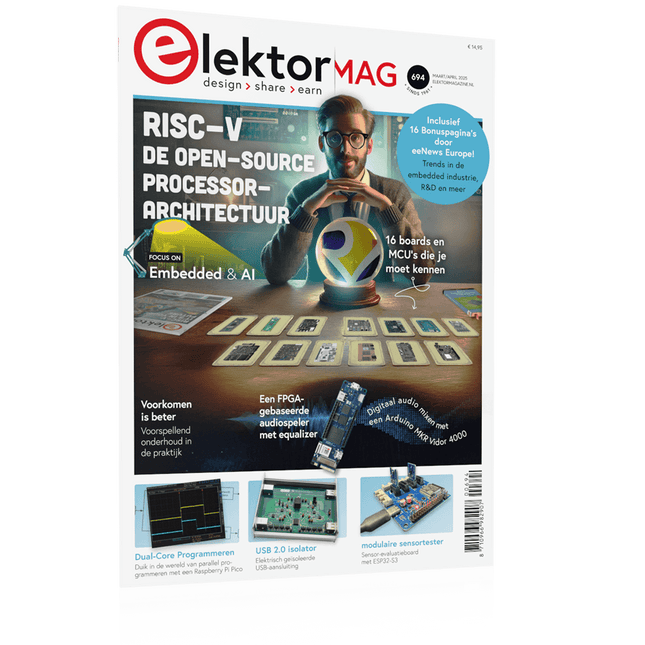
Elektor Maart/April 2025 (NL)
Elektor GREEN en GOLD leden kunnen deze uitgave hier downloaden. Nog geen lid? Klik hier om een lidmaatschap af te sluiten. De open-source processorarchitectuur RISC-V16 boards en MCU's die je moet kennen Een FPGA-gebaseerde audiospeler met equalizer (1)Digitaal audio mixen met een Arduino MKR Vidor 4000 Laserkop voor pico-gebaseerde zandklokTekenen met licht Doe mee aan de STM32 Edge AI Contest Een multi-sensor plantenmonitor-systeemdraadloze meting van watertoevoer en lichtomstandigheden Maixduino AI-gestuurde automatische portiergezichtsdetectie met een camera Embedded Electronics 2024AI gaat de industrie opnieuw vormgeven Lading-gebaseerde in-Memory computing bij EnCharge AI AI-Inferentie met 10 Keer Lager Energieverbruik en 20 Keer Lagere Kosten Click board ondersteunt het ontwikkelen en trainen van ML-modellen voor trillingsanalyse De Elektor Mini-WheelieEen kit voor een zelfbalancerende robot MCU, ik zie jeMCUViewer: open-source multiplatform debugging-tool USB 2.0-isolatorelektrisch geïsoleerde USB-aansluiting Voorkomen is betervoorspellend onderhoud in de praktijk SPoE – Elektromagnetische compatibiliteitSingle pair met Power-over-Ethernet door de ogen van EMC Retro techEen nieuwe wereld met kleurentelevisie ECG-monitorimplementatie met Hexabitz-modules en een STM32CubeMonitor De strijd om AI aan de edge Met HaLow Wi-Fi is een record afstand bereikt van 16 km op 900 MHz Eerste CHERI RISC-V Embedded Chip en Early Access programma Derde generatie bosbranddetectie maakt gebruik van satellietverbindingen Uit het leven gegrepenkeuzestress Alle begin......filtert verder en regelt tonen Quasi-analoog uurwerkwedergeboorte van een Elektor-klassieker Een modulaire sensortesterSensor-evaluatieboard met ESP32-S3 2025: Een AI-OdysseeDe opkomst van foundation modellen en hun rol in het democratiseren van AI Raspberry Pi standalone MIDI-synthesizer (1)voorbereiding van een platform voor enkele edge-AI-experimenten Err-lectronicsCorrecties, updates en brieven van lezers Universele AI RISC-V processor doet ze allemaal - CPU, GPU, DSP, FPGA Interview met de CEO: Ventiva's dunne en coole technologie Dual-core programmeren met een Raspberry Pi Picoduik in de wereld van parallel programmeren
€ 14,95
-
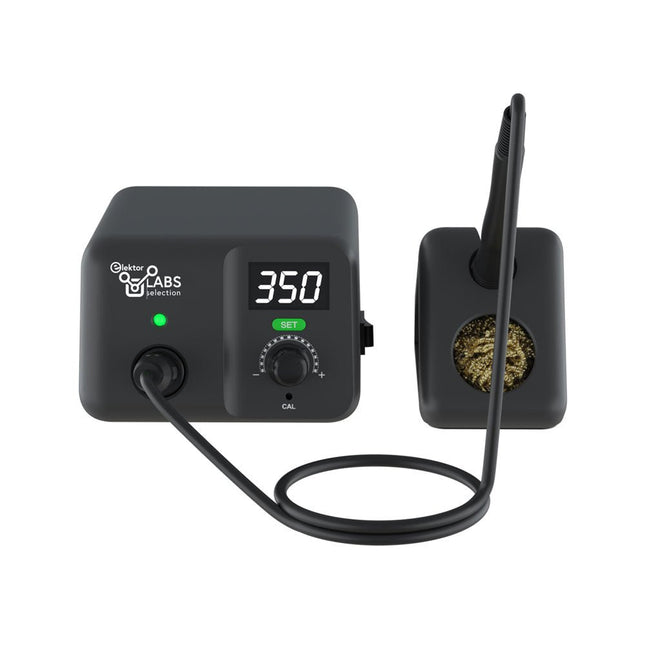
Eleshop AE970D Soldeerstation (80 W)
Soldeerstation voor precisiesolderen met actief verwarmde soldeerstift Het AE970D soldeerstation is een krachtig 80 W apparaat om te kunnen solderen met een snelle opwarming. Het brede temperatuurbereik van 150-550°C zorgt ervoor dat hij aan al uw soldeerwensen kan voldoen. Dankzij de krachtige plug-and-play geïntegreerde actieve soldeerstift kan de AE970D binnen 9 seconden het smeltpunt bereiken. Gepatenteerde close-loop automatische en constante temperatuurregeling zorgt ervoor dat er gesoldeerd kan worden met veel stabiliteit, uitstekende prestaties en een hoge nauwkeurigheid. Kenmerken Een vermogen van 80 W voor een snelle opwarming. Breed temperatuurbereik van 150-550°C (302-1022°F) om aan al uw soldeerwensen te kunnen voldoen. Hoogwaardige plug-and-play geïntegreerde actieve soldeerstift, kan het smeltpunt binnen 9 seconden bereiken. Gepatenteerde close-loop automatische en constante temperatuurregeling, wat veel stabiliteit, uitstekende prestaties en een hoge nauwkeurigheid garandeert. Specificaties Vermogen 80 W Voedingsspanning 110 VAC / 230 VAC Uitgangsspanning 25 VAC Temperatuurbereik 150-550°C (302-1022°F) Verwarmingselement Geïntegreerde actieve verwarming uit de T80-serie Temperatuurstabiliteit ±1°C/±1.8°F (bij temperatuur > 200°C/400°F) Weerstand van stift naar aarde < 2 Ω Spanning van stift naar aarde < 2 mV Lengte netsnoer 1 m Kabellengte naar soldeerbout 1,2 m Afmetingen 148 x 120 x 85 mm Gewicht (basis unit) 1,33 kg Inbegrepen Basis unit Soldeerbout incl. soldeerstift T80-D12 IJzeren standaard Messing wolbedje Handleiding
€ 95,00
-

Elektor Publishing Experimenting with Red Pitaya STEMlab Gen 2
Practical Projects and Programs With Experimenting with Red Pitaya STEMlab Gen 2, Red Pitaya goes beyond a versatile board. It becomes a powerful laboratory instrument for precision measurement, analysis, and control. From the fundamentals of electronic project development, monitoring, control, and design to testing, this book walks you step-by-step through everything you need to know to harness the full potential of Red Pitaya hardware and software. The book presents real-time, FPGA-based projects that are developed on a PC using the Vivado environment, then transferred to the Red Pitaya for execution and testing. You will learn about enhanced performance, expanded I/O capabilities, improved FPGA features, and advanced connectivity options that open up new frontiers for precision measurement, monitoring, and control in your embedded applications. Inside the book you will discover: A deep dive into Red Pitaya architecture and hardware design Electronic experiments using Red Pitaya for measurement and monitoring Hands-on projects using the Python programming language Practical guidance for FPGA programming using Red Pitaya Red Pitaya FPGA projects using the Verilog HDL under Vivado IDE Practical design of electronic projects including measurement and testing Step-by-step examples that bridge theory and real-world implementation Whether you are designing your own electronic circuits, developing signal analysis tools, or creating real-time control or monitoring systems, this book provides you the knowledge and confidence you need to fully learn and customize the Red Pitaya platform.
€ 39,95€ 32,95Beste prijs
-

Elektor Digital Elektor November/December 2023 (PDF)
Elektor GREEN and GOLD members can download their digital edition here. Not a member yet? Click here. The Raspberry Pi 5A Huge Improvement From Its Predecessor AI in the Electronics LabGoogle Bard and Flux Copilot Put to the Test Arduino Nano Waveform GeneratorNano + Code = Function Generator Solar-Powered Christmas GarlandAn Eco-Friendly Solution for Garnishing Your Balcony USB Killer DetectorBetter Safe Than Sorry A Simple CNCed EnclosureWith Autodesk Fusion 360 for Personal Use Low-Volume Board ProductionWith and without Assembly IoT Simulation Simplified with WokwiDeveloper Uri Shaked on Design, Software, and More A Bare-Metal Programming Guide (Part 3)CMSIS Headers, Automatic Testing, and a Web Server LoRa, a Swiss Army Knife (2)The Hardware and Software MEMS Microphone Design and Construction Tools to Try Before You SolderSimulation and 3D Modeling Tools That Can Be Used for Free New Tools From Microchip!PICkit 5 and MPLAB ICD 5 Available Now! Rapid Prototyping of Flexible, Stretchable ElectronicsHow the Voltera NOVA Speeds Up Innovation in Wearable Electronic Systems Galvanic IsolationUsing Phototransistor Optocouplers Successfully The Complex Solution or the Anybus Solution?Embedded Industrial Ethernet in 2 Days Rather Than Many Months Your Essential DFM ChecklistHow to Start Designing for Manufacture 3D Printing FilamentsTypes, Features and Use in Prototyping Specialists for Effective Signal Analysis from ELF to EHF BandAaronia’s latest real-time SPECTRAN® V6 series spectrum analyzers Challenges of DFM Analysis for Flex and Rigid-Flex Design Setting Up an SMT Line The Right Combination for a Reliable Assembly Revolutionizing IndustriesThe Rise of Autonomous Mobile Robots (AMRs) Evolved for More ChallengesRohde & Schwarz Adds Eight-Channel R&S MXO 5 to Next-Generation Oscilloscopes Starting Out in Electronics……Amplifying Differences Mini Reflow PlateFor Assembling or Repairing Small SMD Circuits Don’t Start with a Prototype – Start with a Pretotype!Check That a Market Exists for Your Product Before Warming Your Soldering Iron 2023: An AI OdysseyGetting Help Designing a Physical Project Brussels Is InnovatingSupport for Deep Tech
€ 7,50
-
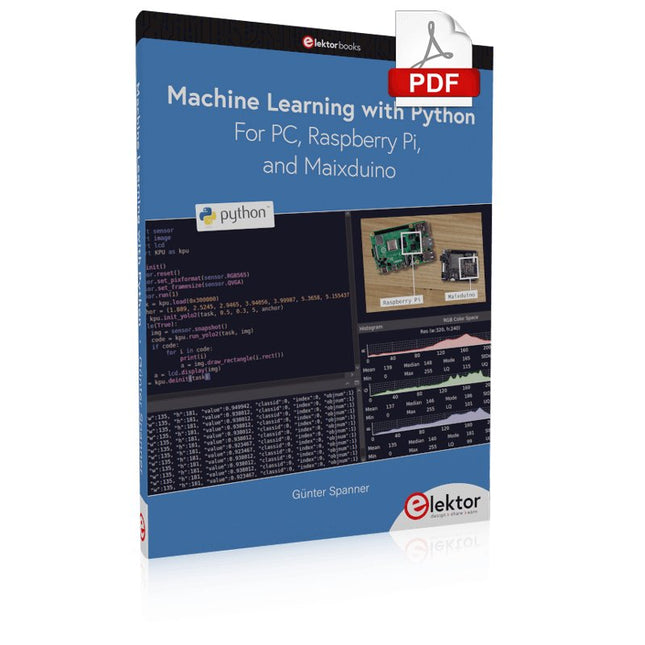
Elektor Digital Machine Learning with Python for PC, Raspberry Pi, and Maixduino (E-book)
Most people are increasingly confronted with the applications of Artificial Intelligence (AI). Music or video ratings, navigation systems, shopping advice, etc. are based on methods that can be attributed to this field. The term Artificial Intelligence was coined in 1956 at an international conference known as the Dartmouth Summer Research Project. One basic approach was to model the functioning of the human brain and to construct advanced computer systems based on this. Soon it should be clear how the human mind works. Transferring it to a machine was considered only a small step. This notion proved to be a bit too optimistic. Nevertheless, the progress of modern AI, or rather its subspecialty called Machine Learning (ML), can no longer be denied. In this book, several different systems will be used to get to know the methods of machine learning in more detail. In addition to the PC, both the Raspberry Pi and the Maixduino will demonstrate their capabilities in the individual projects. In addition to applications such as object and facial recognition, practical systems such as bottle detectors, person counters, or a “talking eye” will also be created. The latter is capable of acoustically describing objects or faces that are detected automatically. For example, if a vehicle is in the field of view of the connected camera, the information 'I see a car!' is output via electronically generated speech. Such devices are highly interesting examples of how, for example, blind or severely visually impaired people can also benefit from AI systems.
€ 32,95
Leden: € 29,66
-

Elektor Digital Elektor September/October 2022 (PDF)
Elektor GREEN and GOLD members can download their digital edition here. Not a member yet? Click here. electronica fast forward 2022 Start- & Scale-Up AwardsPreparations Speeding Up! Bluetooth Low Energy with ESP32-C3 and ESP32You Don’t Always Need to Choose Wi-Fi! Bluetooth Low Energy SnifferHacking a makerdiary nRF52840 MDK USB Dongle Magic RGB LED CubeHardware Design Around an RP2040 Auto On/Off for Solder Paste Compressor Elektor Video ContentLivestreams, Webinars, and Courses for Engineers and Pro Makers Bicycle ElectrificationHands-On with an E-Bike Retrofit Kit Starting Out in ElectronicsMultiplying Voltages From Life’s ExperienceSidelines Teensy 4.0Why Is This Board So Fast? Audio Power Amplifier Simulation with TINAThe Try-Before-You-Build Approach Develop and Operate Your LoRaWAN IoT NodesSample Chapter: Dragino LHT65, LDS01, and LDS02 LoRaWAN Modules Err-lectronicsCorrections, Updates and Readers’ Letters 5G Just for MeGaining Complete Control of 5G Deployments with Private Cellular Networks Infographics 7-8/2022 How Does My Device Learn to Transmit?Applications with Wi-Fi Interfaces Smartphones are the Heart of the IoT Audio Spectrum Analyzer with DekatronsA New Way to Use Vintage Tubes Sending Data to TelegramGet It Done with an ESP32 and a Few Parts A Fliege Notch Filter for Audio MeasurementsMake Better Measurements with a Notch Filter CO2 Meter TeardownIs It Hackable for Your Projects? PUT-ting It All TogetherThe Programmable Unijunction Transistor Explained Round Touchscreen for Raspberry PiHyperPixel 2.1 Round from Pimoroni Remote Sensing with Connection Loss DetectionUsing nRF24L01+ Modules Digital FM Receiver with Arduino and TEA5767Stayed Tuned with an Arduino Nano Changing an OLED Interface from SPI to I²C HomeLab ToursA Hobby Does Not Retire A Decade of Ethics in ElectronicsTessel Renzenbrink Reflects on the Digital Society and More HexadokuThe Original Elektorized Sudoku
€ 7,50
-

Elektor Digital Elektor Mars/Avril 2023 (PDF)
Le chargeur intégré est disponible pour nos clients OR et VERT sur le site d'Elektor Magazine ! Pas encore membre ? Cliquez ici . Horloge 2.0 le réveil-matin de vos rêves PIO du RP2040 en pratique expérimentation des programmables E/S du RP2040 ChipTweaker du pauvre homme Nous avons des moyens (abordables) de vous faire parler générateur d'équipement externe avec interface USB deux PICs pour le prix d'un AVR vitamines audio pour micro ramollo Comment gonfler soi-même le levé de sortie d'un microphone FFT avec Maixduino Acquisition des spectres de fréquences sur le vif sans raison apparente pilote de moteurs pas à pas UCN5804 drôle de composant, la série simulation du circuit avec Micro-Cap Les premiers ministres transmettent un problème mondial Prix PAUL 2022 les jeunes talents de la technologie et des solutions créatives Mon première radio définie par logiciel réalisé, dans les 15 minutes la documentation des microcontrôleurs sans peine (1) la structure d'une fiche technique et pour l'IA et les systèmes d'embarquement ? outils, plaques et remplacement des éditeurs numériser une ferme verticale Infographie : embarqué et l'ia d'aujourd'hui et demain Présentation du TinyML Étude de cas KwickPOS Hautes performances pour tous Normes Ordinateur sur module démarrer en électronique Actifs des composants communication I²C avec Node.js et Raspberry Pi affiche des données de vos capteurs dans un navigateur sortie vidéo sur les microcontrôleurs (2) sorties VGA et DVI le système d'exploitation temps réel Metronom un RTOS pour les processeurs AVR DVI sur le RP2040 Entrées de Luke Wren, développeur compositeur avec Raspberry Pi L?afficher HAT Mini Aperçus d'affiches avec Raspberry Pi ! WEEF Awards 2022 : célébrez les bonnes choses Hexadoku
€ 10,95
-

Elektor Digital Elektor 01-02/2025 (PDF) DE
Diese Ausgabe steht allen GOLD- und GREEN-Mitgliedern auf der ElektorMagazine-Website zum Download bereit! Sie sind noch kein Mitglied? Hier klicken! DIY-SolarakkusÜber den Selbstbau von Energiespeichern für Solaranlagen Solarmodul-SimulatorFür Test und Optimierung von MPP-Trackern und Invertern Der STM32-Edge-KI-WettbewerbEntdecken Sie den neuen STM32N6 und nehmen Sie am Wettbewerb um 5.000 € teil! Erweiterung der BandlückeWarum gibt es so viel Interesse an SiC und GaN? Power-Bank für NotebooksVerlängern Sie das Leben Ihres alten Laptops! Medizinische RoboterÜberwindung technischer und regulatorischer Hürden Frostwächter für ObstpflanzenMit Temperatur-Datenlogger Das analoge DingDer Arduino des Analog-Computings? Sparsames NetzrelaisMit über 90% Leistungsreduzierung Verbesserung der DC-Last ET5410A+Keep cool and be quiet! electronica 2024 im Rückblick Elektromagnetische VerträglichkeitEMV kurz und bündig! Aller Anfang......muss nicht schwer sein: Aktive Filter Verlustleistung reduzieren mit AbleitkondensatorenEin cleverer Einsatz von kapazitiver Reaktanz Preiswerter 12-Bit-Digital-Analog-Wandler MCP4725Mit EEPROM-Feature für sicheres Einschaltverhalten Fnirsi LCR-ST1, die intelligente LCR-SMD-Pinzette Test- und Messlabor mit Raspberry PiDas Wichtigste zuerst: Der ADC Elektronischer LastwiderstandEin Projekt aus der Kiste 2025: Eine Odyssee in die KIEinige Projekte für das neue Jahr Projekt-Update: Modulares DC-Leistungsmessgerät AmpVolt v2.0100 Ampere und mehr! Projekt 2.0 Ethische Transparenz sichtbar gemachtErgebnisse der Umfrage 2024 von Ethics in Electronics Elektor Audio-DSP FX-Prozessor-BoardTeil 2: Anwendungen erstellen
€ 11,90


