
Zoekresultaten voor "joy OR it OR um25c OR usb OR measuring OR device"
-

Elektor Digital Getting Started with ESPHome (E-book)
Develop your own custom home automation devices Espressif's ESP8266 and ESP32 microcontrollers have brought DIY home automation to the masses. However, not everyone is fluent in programming these microcontrollers with Espressif's C/C++ SDK, the Arduino core, or MicroPython. This is where ESPHome comes into its own: with this project, you don’t program your microcontroller but configure it. This book demonstrates how to create your own home automation devices with ESPHome on an ESP32 microcontroller board. You’ll learn how to combine all kinds of electronic components and automate complex behaviours. Your devices can work completely autonomously, and connect over Wi-Fi to your home automation gateways such as Home Assistant or MQTT broker. By the end of this book, you will be able to create your own custom home automation devices the way you want. Thanks to ESPHome and the ESP32, this is within everyone’s grasp. Set up an ESPHome development environment and create maintainable configurations Use buttons and LEDs Sound a buzzer and play melodies Read measurements from various types of sensors Communicate over a short distance with NFC, infrared light, and Bluetooth Low Energy Show information on various types of displays Downloads Software
€ 29,95
Leden: € 26,96
-

Elektor Digital Elektor July/August 2021 (PDF) EN
LoRa with the Raspberry Pi PicoFun with MicroPython What Is RISC-V?And Why the Industry Is So Excited About a New Processing Core! Elektor @ 60Circuits of Summer Past Versatile Power Supply for BreadboardsPositive and Negative Voltages Out of 5 V from USB Raspberry Pi Pico EssentialsSample Chapter: Wi-Fi with the Raspberry Pi Pico Magnetic Levitation the Easy Way Hands On the Parallax Propeller 2Part 3: Smart Pins and Serial Data (UART) Nucleo Boards Programming with the STM32CubeIDESample Chapter: FreeRTOS for the STM32 MCU Developer's ZoneTips & Tricks, Best Practices and Other Useful Information Miniware DT71 Digital Tweezers Wearable Wi-Fi Gadget: ESPHome Does the Job Again Starting out in ElectronicsEasier Than Imagined! This Concludes the Subject of “Capacitors” Simple Sketches Using the Qwiic Ecosystem Java on the Raspberry Pi (Part 2)Controlling GPIOs with a Spring REST Service Raspberry Pi Compute Module 4A Raspberry Pi for Industry Portable, Stand-Alone Air Quality Display for 2.5 µm ParticlesKeep(s) an Eye on Your Health From Life’s ExperienceThe Future Was Better in the Past MicroPython for the ESP32 and FriendsPart 1: Installation and Our First Programs Charge-Coupled Devices in OscilloscopesPeculiar Parts, the series ESD – The Invisible DestroyerComponents Trashed by a Bolt from the Blue Solar Power for Mowing RobotsEcological, Inexpensive, Simple! Europe’s Efforts to Tame Big Tech HexadokuThe Original Elektorized Sudoku
€ 7,50
-
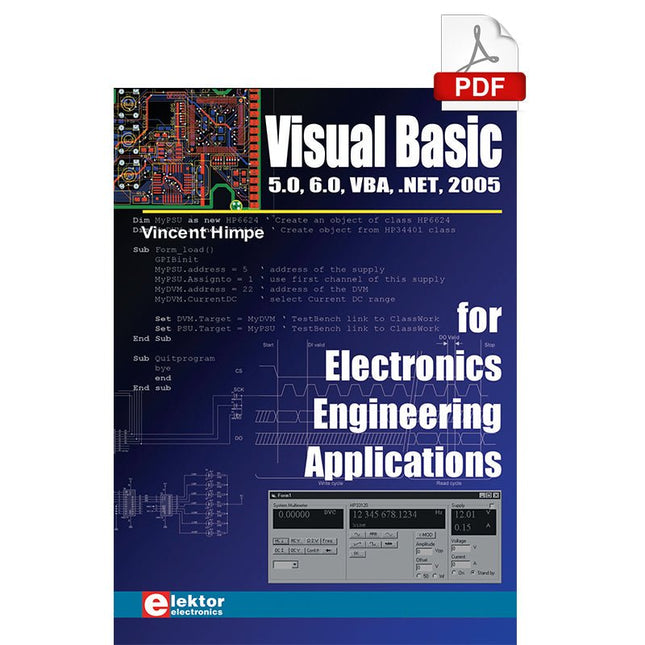
Elektor Digital Visual Basic for Electronics Engineering Applications (E-book)
The PC has long-time outgrown its function as a pure computer and has become an all-purpose machine. This book is targeted towards those people that want to control existing or self-built hardware from their computer. Using Visual Basic as Rapid Application Development tool we will take you on a journey to unlock the world beyond the connectors of the PC. After familiarising yourself with Visual Basic, its development environment and the toolset it offers, items such as serial communications, printer ports, bit-banging, protocol emulation, ISA, USB and Ethernet interfacing and the remote control of test-equipment over the GPIB bus, are covered in extent. Each topic is accompanied by clear, ready to run code, and where necessary, schematics are provided that will get your projects up to speed in no time. This book will show you advanced things like: using tools like Debug to find hardware addresses, setting up remote communication using TCP/IP and UDP sockets and even writing your own internet servers. Or how about connecting your own block of hardware over USB or Ethernet and controlling it from Visual Basic. Other things like internet-program communication, DDE and the new graphics interface of Windows XP are covered as well. All examples are ready to compile using Visual Basic 5.0, 6.0, NET or 2005. Extensive coverage is given on the differences between what could be called Visual Basic Classic and Visual basic .NET / 2005.
€ 39,95
Leden: € 35,96
-

Elektor Digital Elektor Circuit Special 2024 (PDF)
Elektor GREEN en GOLD leden kunnen deze uitgave hier downloaden. Nog geen lid? Klik hier om een lidmaatschap af te sluiten. Digitale belasting voor grote stromenvan noodzaak tot innovatie Stemmenroverinstant karaoke-schakeling Audio A/B-keuzeschakelaar met versterkingsregelingschakelt tussen microfoon- en lijningangen Beter laden voor de LIR2032wees lief voor uw knoopcellen Simpele aanraaksensorenmaak ze zelf – voor elke microcontroller Universele infraroodschakelaartweede leven voor oude afstandsbedieningen Microcontroller-gestuurde loeidoosspeelse geluiden met een microcontroller USB-accu-interface Low-power apparaten voeden met een powerbankanti-afschakel-schakeling Kleine klasse-A audioversterker met stroomuitgangstuur luidsprekers aan met stroom in plaats van spanning Pseudo-symmetrische modulehoge CMRR met asymmetrische audioverbindingen Automatische NiMH-laderlaad al uw accu’s in één keer! Thyristorgebaseerde voedingsbeveiliging Schakelaar met vingerafdruk-sensornuttige identiteitscontrole DC/DC-converter voor 3 Aeen upgrade voor vaste-spanningsbronnen Bewaking voor een boilerspannings- en stroomdetectie voor AC-kabels Verzwakkers voor audiosignalen (1)instelbaar met jumpers Poets uw acculader op (1)niet weggooien maar ombouwen! Een print voor ‘de Blauwe’print voor Alps-motorpotmeter met terugkoppeling 50Hz-referentie uit 60Hz-netspanningzo gebruikt u 50Hz-elektronica in 60Hz-landen Digitale isolatoreneenvoudige realisatie van galvanische isolatie Compacte 12W-hifi-monoversterkerklein maar krachtig Zaagtandgenerator met LM386 Driefasen-generatormet Raspberry Pi Pico Deuropener voor muzikaal getalenteerden Elektor-klassieker: Surf Synthesizerzeewatersportachtergrondgeluidgenerator (zwsaggg) Poets uw acculader op (2)niet weggooien maar ombouwen! Lampstroom-monitormet Raspberry Pi Pico Infrarood-telegrafie Fnirsi SWM-10repareer zelf uw accupacks met dit intelligent draagbaar puntlasapparaat Stereo audio-codec voor ESP32 en co.geen angst voor audio-meettechnologie Soldeertechniekendoe het meteen goed! Verzwakkers voor audiosignalen (2)geschakeld met relais USB-C voedingstroom uit USB-C voedingsadapters Drie schakelingen met twee en drie teller-IC’s4017’s werken samen Actieve componenten – de diode Timer voor extreem lange tijdeninstellen en vergeten! Jack in en jack uiteen handige insert-optie voor audioschakelingen ESP32 met één Li-ion-cel Hexadoku
€ 9,95
-

Elektor Digital Elektor January/February 2021 (PDF) EN
DIY LiPo Supercharger BundleGreatScott and Elektor's LiPo Charger, Booster, and Protector MTheCamA Simple Mini Thermal Camera Weller WE 1010Soldering Station electronica Fast Forward 2020 Winners I2S Test Signal Generator with AVR Microcontroller32-Bit 1-kHz Digital Sine, fs 192 kHz, Level Adjustable from 0 to -110 dB Control Your Home with Raspberry PiRPi snoops on 433.92 MHz Simulate Circuits Online From Life's ExperienceThe Fine Line Between Order and Chaos Starting Out in ElectronicsEasier Than imagined! Homebrew CPUsThe Discrete Microcontroller Connect Your Thermostat with ESPHomeAn Attempt at Doing Home Automation the Right Way Developer’s ZoneTips & Tricks, Best Practices and Other Useful Information Small Circuits RevivalFrom the Elektor suggestions box Raspberry Pi Full StackRPi and RF24 at the heart of a sensor network Practical ESP32 Multitasking (6)Event Groups Multi-Channel Power Analyzer: Up to 3 Channels, with Graphic and Alphanumeric Display Analogue Filter Design (Part 3)Passive Filters JOY-iT VAX-1030Wireless Measurement Module New LCR Meter 50 Hz - 2 MHz Part 2Operation, Calibration, and Firmware Programming Error AnalysisTips on Voltage Regular Circuits, PCB Design, and More The Open Hardware ObservatoryCommunity-Based Open Source Hardware Assessment Java on the Raspberry PiAn Interview with Frank Delporte Data Analysis and Artificial Intelligence in PythonInterpreting Real Data with NumPy, pandas and scikit-learn Project 2.0Corrections, Updates and Readers’ letters Getting to Know the Parallax Propeller 2 (Part 1)An Introduction Hexadoku
€ 7,50
-

SDRplay SDRplay RSPdx-R2 Single-Tuner 14-bit SDR-ontvanger (1 kHz tot 2 GHz)
De SDRplay RSPdx-R2 is een breedbandige, volledig uitgeruste 14-bit SDR-ontvanger met één tuner die het volledige RF-spectrum van 1 kHz tot 2 GHz bestrijkt, met een spectrumbereik tot 10 MHz. Hij bevat drie antennepoorten, waarvan er twee SMA-connectoren gebruiken en werken over het volledige bereik van 1 kHz tot 2 GHz, en de derde een BNC-connector heeft die werkt tot 200 MHz. De RSPdx-R2 is een verbeterde versie van de RSPdx met verdere ontwerpverbeteringen voor gebruik bij frequenties lager dan 2 MHz. De RSPdx-R2 is gehuisvest in een stevige stalen behuizing en biedt, naast de functionaliteit van de RSP1B, drie softwarematig selecteerbare antenne-ingangen en een externe klokingang. Hij biedt uitstekende prestaties op HF- en VHF-frequenties tot wel 2 GHz. De RSPdx-R2 ondersteunt ook een "HDR-modus" die geoptimaliseerd is voor de veeleisende radio-ontvangstomstandigheden onder de 2 MHz. De RSPdx-R2 introduceert, in combinatie met de eigen software van SDRplay, een speciale HDR-modus (High Dynamic Range) voor ontvangst binnen geselecteerde banden onder de 2 MHz. De HDR-modus levert verbeterde intermodulatieprestaties en minder storende signalen voor die uitdagende banden. Kenmerken Bestrijkt alle frequenties van 1 kHz via VLF, LF, MW, HF, VHF, UHF en L-band tot 2 GHz, zonder onderbrekingen Ontvang, bewaak en neem tot 10 MHz spectrum tegelijk op Aanzienlijk verbeterde ruisprestaties onder 1 MHz (d.w.z. voor sommige MF, LF en lager) Verbeterd dynamisch bereik onder 2 MHz, zowel in tunermodus als HDR-modus HDR-modus onder 2 MHz biedt voordelen op het gebied van algemeen dynamisch bereik en selectiviteit Softwarematig selecteerbare keuze uit 3 antennepoorten Externe klokingang voor synchronisatiedoeleinden, of aansluiting op GPS-referentieklok voor extra frequentienauwkeurigheid Uitstekend dynamisch bereik voor uitdagende ontvangstomstandigheden Gratis gebruik van Windows-gebaseerde SDRuno-software (raadpleeg de website voor ondersteunde versies) Gratis gebruik van SDRconnect SDR- en serversoftware voor Windows, MacOS en Linux (raadpleeg de website voor ondersteunde versies) Ondersteuning voor multiplatform drivers en API's, waaronder Windows, Linux, Mac en Raspberry Pi 4/5 Sterk en groeiend softwareondersteuningsnetwerk Gekalibreerde S-meter/RF-vermogens- en signaal-ruisverhoudingsmeting met SDRuno (inclusief datalogging naar .CSV-bestanden) Gedocumenteerde API beschikbaar voor demodulator- of applicatieontwikkeling op meerdere platforms Toepassingen (Amateur) Luisteren naar kortegolfradio Uitzending DX (AM/FM/TV) Panadaptor Vliegtuigen (ADS-B en ATC) Slow Scan TV Monitoring van multi-amateurbanden WSPR & digitale modi Weerfax (HF en satelliet) Satellietmonitoring Geostationaire omgevingssatellieten Trunked radio Monitoring van nutsbedrijven en hulpdiensten Snelle en effectieve antennevergelijking Toepassingen (Industrieel) Spectrum Analyser Bewaking Draadloze microfoonbewaking RF-meting IoT-ontvangerketen Signaalregistratie RFI/EMC-detectie Bewaking van de uitzendintegriteit Spectrumbewaking Vermogensmeting Toepassingen (Educatief/Wetenschappelijk) Onderwijs Ontwerp van ontvangers Radioastronomie Passieve radar Ionosonde Spectrumanalysator Ontvanger voor IoT-sensorprojecten Antenneonderzoek Specificaties Frequentiebereik 1 kHz – 2 GHz Antenne-aansluiting SMA Antenne-impedantie 50 ohm Stroomverbruik (typisch) 190 mA bij >60 MHz (excl. Bias-T)120 mA bij <60 MHz (excl. Bias-T) USB-aansluiting USB-B Maximaal ingangsvermogen +0 dBm Continu+10 dBm korte duur ADC-samplefrequenties 2-10,66 MSPS ADC-aantal bits 14 bit 2-6,048 MSPS12 bit 6,048-8,064 MSPS10 bit 8,064-9,216 MSPS8 bit >9,216 MSPS Bias-T 4,7 V100 mA gegarandeerd Referentie 0,5 ppm 24 MHz TCXOFrequentiefout trimbaar tot 0,01 ppm in het veld Bedrijfstemperatuur −10˚C tot +60˚C Afmetingen 113 x 94 x 35 mm Gewicht 315 g Downloads Datasheet Software RSPdx-R2 vs RSPduo RSPdx-R2 RSPduo Continue dekking van 1 kHz tot 2 GHz ✓ ✓ Tot 10 MHz zichtbare bandbreedte ✓ ✓ 14-bits ADC siliciumtechnologie plus meerdere krachtige ingangsfilters ✓ ✓ Softwarematig selecteerbare AM/FM & DAB broadcast band notch filters ✓ ✓ 4,7 V Bias-T voor voeding van externe antenneversterker ✓ ✓ Voedt de USB-kabel met een eenvoudige aansluiting type B ✓ ✓ 50Ω SMA-antenne-ingang(en) voor werking van 1 kHz tot 2 GHz (softwarematig instelbaar) 2 2 Extra softwarematig selecteerbare Hi-Z ingang voor werking tot 30 MHz ✓ Extra softwarematig selecteerbare 50Ω BNC-ingang voor werking tot 200 MHz ✓ Extra LF/VLF-filter voor onder 500 kHz ✓ 24 MHz referentieklokingang (+ uitgang op RSPduo) ✓ ✓ Dubbele tuners voor ontvangst op 2 totaal onafhankelijke 2 MHz-bereiken ✓ Dubbele tuners voor diversiteitsontvangst met SDRuno ✓ Robuuste zwartgelakte stalen behuizing ✓ ✓ Algemene prestaties onder 2 MHz voor MW en LF ++ + Meerdere gelijktijdige toepassingen + ++ Prestaties in uitdagende fading-omstandigheden (*met gebruik van diversiteitsafstemming) + *++
€ 263,00
-

Elektor Digital Elektor Mars/Avril 2023 (PDF)
Le chargeur intégré est disponible pour nos clients OR et VERT sur le site d'Elektor Magazine ! Pas encore membre ? Cliquez ici . Horloge 2.0 le réveil-matin de vos rêves PIO du RP2040 en pratique expérimentation des programmables E/S du RP2040 ChipTweaker du pauvre homme Nous avons des moyens (abordables) de vous faire parler générateur d'équipement externe avec interface USB deux PICs pour le prix d'un AVR vitamines audio pour micro ramollo Comment gonfler soi-même le levé de sortie d'un microphone FFT avec Maixduino Acquisition des spectres de fréquences sur le vif sans raison apparente pilote de moteurs pas à pas UCN5804 drôle de composant, la série simulation du circuit avec Micro-Cap Les premiers ministres transmettent un problème mondial Prix PAUL 2022 les jeunes talents de la technologie et des solutions créatives Mon première radio définie par logiciel réalisé, dans les 15 minutes la documentation des microcontrôleurs sans peine (1) la structure d'une fiche technique et pour l'IA et les systèmes d'embarquement ? outils, plaques et remplacement des éditeurs numériser une ferme verticale Infographie : embarqué et l'ia d'aujourd'hui et demain Présentation du TinyML Étude de cas KwickPOS Hautes performances pour tous Normes Ordinateur sur module démarrer en électronique Actifs des composants communication I²C avec Node.js et Raspberry Pi affiche des données de vos capteurs dans un navigateur sortie vidéo sur les microcontrôleurs (2) sorties VGA et DVI le système d'exploitation temps réel Metronom un RTOS pour les processeurs AVR DVI sur le RP2040 Entrées de Luke Wren, développeur compositeur avec Raspberry Pi L?afficher HAT Mini Aperçus d'affiches avec Raspberry Pi ! WEEF Awards 2022 : célébrez les bonnes choses Hexadoku
€ 10,95
-

SDRplay SDRplay nRSP-ST Netwerkradio-ontvanger (1 kHz tot 2 GHz)
De nRSP-ST is een op een netwerk aangesloten radio-ontvanger met algemene dekking voor frequenties van 1 kHz tot 2 GHz met een spectrumzichtbaarheid tot 10 MHz. De nRSP-ST is uw eigen persoonlijke, op afstand toegankelijke SDR die u ook kunt delen met een klein aantal vertrouwde vrienden of collega's. De nRSP-ST komt tegemoet aan de behoeften van radioliefhebbers die een 'plug-and-play'-oplossing willen voor ontvangst op afstand. Naast dat we dit hebben bereikt, hebben we typische internetbandbreedtebeperkingen aangepakt door een nieuwe IQ Lite-modus te creëren, die op efficiënte wijze kanalen met IQ-gegevens levert. We introduceren ook de mogelijkheid om IQ-opnames op een externe locatie te beheren en op te slaan. De nRSP-ST is ideaal voor iedereen die een breedbandontvanger op afstand wil zonder computervaardigheden en urenlange insteltijd en doorlopend onderhoud op de externe locatie. Kenmerken "Plug and play" geïntegreerde, op een netwerk aangesloten ontvanger met algemene dekking: Combineert een ontvanger, een hostcomputer en nog veel meer – alles in één doos! Sluit de stroom aan en maak verbinding met internet (Ethernet of Wi-Fi) en de nRSP-ST is automatisch overal toegankelijk Multi-platform SDRconnect-software ondersteunt lokale bediening of externe toegang op Windows-, MacOS- of Linux-platforms De nRSP-ST & SDRconnect kan worden geconfigureerd voor de beschikbare netwerkbandbreedte: In de Full IQ-modus biedt de nRSP-ST IQ-gegevensoverdracht van de zichtbare spectrumbandbreedte (bijvoorbeeld voor hogesnelheids-LAN of supersnelle internetverbinding) In de IQ Lite-modus levert de nRSP-ST IQ-gegevens van kanalen tot 192 kHz breed (bijvoorbeeld voor digitale decodering door de klant) In de Compact modus levert de nRSP-ST gecomprimeerde audio (ideaal voor langzamere internetverbindingen) Ondersteunt meerdere clientverbindingen met een gelijktijdige combinatie van verbindingsmodi. Met een beheerderstool kunt u gebruikersnamen en time-outs toewijzen aan vertrouwde vrienden of collega's. Alle modi ondersteunen visualisatie van een spectrumbandbreedte tot 10 MHz Twee opties voor externe verbinding: Gebruik een externe SDRconnect-client of Gebruik de ingebouwde webserver voor externe toegang vanaf elk apparaat dat geschikt is voor internetten, inclusief Android-/iOS-tablets en -telefoons De nRSP-ST biedt de mogelijkheid om IQ- en audiobestanden op te nemen op een NAS-apparaat (Network Attached Storage), indien beschikbaar op het LAN. De 14-bits ADC volledig uitgeruste breedband SDR-ontvanger bestrijkt alle frequenties van 1 kHz via VLF, LF, MW, HF, VHF, UHF en L-band tot 2 GHz, zonder onderbrekingen Bewaak op afstand tot 10 MHz spectrum per keer via een keuze uit 3 antennes Flash kan worden geüpgraded voor toekomstige functieverbeteringen Inbegrepen 1x nRSP-ST ontvanger 1x WLAN-antenne 1x Voeding 1x Manual Downloads Release notes Software
€ 554,18
-

Elektor Digital Elektor 01-02/2024 (PDF)
Diese Ausgabe steht allen GOLD- und GREEN-Mitgliedern auf der ElektorMagazine-Website zum Download bereit! Sie sind noch kein Mitglied? Hier klicken! Projekt-Update: Energiemessgerät mit ESP32Nächste Schritte beim Prototyping Balkonkraftwerke optimierenÜberlegungen, Wissenswertes und Kalkulationen Für Balkonkraftwerke: ESP32 mit OpenDTUDaten kleiner Wechselrichter per µC auslesen Variables lineares Stromversorgungs-Ensemble0...50 V / 0...2 A + Doppelsymmetrische Versorgung Energiespeicherung heute und morgenEin Interview mit Simon Engelke 2024: Eine Odyssee in die KIWeiter, immer weiter... Bluetooth LE auf dem STM32Auf dem Weg zum fernabgelesenen Messgerät Intelligentes KücheninventarsystemMehr als eine Küchenwaage MAUI: Programmieren für PC, Tablet und SmartphoneDas neue Framework in Theorie und Praxis ChatMagLevDer KI-Weg der Levitation Einfacher PV-Energieregler für InselanlagenBauen Sie ein voll funktionsfähiges PV-Energiemanagement-System KaltkathodenröhrenBemerkenswerte Bauteile Aus dem Leben gegriffenNostalgie Aller Anfang ...... muss nicht schwer sein: Vom FET zum Opamp CAN-Bus-Tutorial für den Arduino UNO R4Zwei UNO R4 nehmen den Bus! Infografik: Strom und Energie Umfangreiche Unterstützung bei Design und EntwicklungArrow Engineering Services Leistungsdichte vs. Wirkungsgrad Aluminium-ElektrolytkondensatorenStörpotential in der Audiotechnik? USB-Tester FNB58 von Fnirsi Pixel Pump Das Pick-and-Place ToolVereinfachung der manuellen SMD-Bestückung HomeLab-ToursVor nicht allzu langer Zeit in einem weit entfernten Land... „In der Welt der Ethik in der Elektronik können auch kleine Schritte eine große Wirkung haben.“ Ethik in der ElektronikDie OECD-Leitsätze und das deutsche Lieferkettengesetz Intelligentes Ni-MH-Ladegerät/EntladegerätDas Leserprojekt „Chadèche“ in Kürze Projekt 2.0Korrekturen, Updates und Leserbriefe
€ 11,90
-

Robotis Robotis TurtleBot3 Waffle Pi (incl. Raspberry Pi 4)
World’s Most Popular ROS PlatformTurtleBot is the most popular open source robot for education and research. The new generation TurtleBot3 is a small, low cost, fully programmable, ROS based mobile robot. It is intended to be used for education, research, hobby and product prototyping.Affordable CostTurtleBot was developed to meet the cost-conscious needs of schools, laboratories and companies. TurtleBot3 is the most affordable robot among the SLAM-able mobile robots equipped with a 360° Laser Distance Sensor LDS-01.ROS StandardThe TurtleBot brand is managed by Open Robotics, which develops and maintains ROS. Nowadays, ROS has become the go-to platform for all the roboticists around the world. TurtleBot can be integrated with existing ROS-based robot components, but TurtleBot3 can be an affordable platform for whom want to get started learning ROS.ExtensibilityTurtleBot3 encourages users to customize its mechanical structure with some alternative options: open source embedded board (as a control board), computer and sensors. TurtleBot3 Waffle Pi is a two-wheeled differential drive type platform but it is able to be structurally and mechanically customized in many ways: Cars, Bikes, Trailers and so on. Extend your ideas beyond imagination with various SBC, sensors and motors on a scalable structure.Modular Actuator for Mobile RobotTurtleBot3 is able to get a precise spatial data by using 2 DYNAMIXEL’s in the wheel joints. DYNAMIXEL XM series can be operated by one of 6 operating modes (XL series: 4 operating modes): Velocity control mode for wheels, Torque control mode or Position control mode for joint, etc. DYNAMIXEL can be used even to make a mobile manipulator which is light but can be precisely controlled with velocity, torque and position control. DYNAMIXEL is a core component that makes TurtleBot3 perfect. It is easy to assemble, maintain, replace and reconfigure.Open Control Board for ROSThe control board is open-sourced in hardware wise and in software wise for ROS communication. The open source control board OpenCR1.0 is powerful enough to control not only DYNAMIXEL’s but also ROBOTIS sensors that are frequently being used for basic recognition tasks in cost effective way. Various sensors such as Touch sensor, Infrared sensor, Color sensor and a handful more are available. The OpenCR1.0 has an IMU sensor inside the board so that it can enhance precise control for countless applications. The board has 3.3 V, 5 V, 12 V power supplies to reinforce the available computer device lineups.Open SourceThe hardware, firmware and software of TurtleBot3 are open source which means that users are welcomed to download, modify and share source codes. All components of TurtleBot3 are manufactured with injection molded plastic to achieve low cost, however, the 3D CAD data is also available for 3D printing.Specifications Maximum translational velocity 0.26 m/s Maximum rotational velocity 1.82 rad/s (104.27 deg/s) Maximum payload 30 kg Size (L x W x H) 281 x 306 x 141 mm Weight (+ SBC + Battery + Sensors) 1.8 kg Threshold of climbing 10 mm or lower Expected operating time 2h Expected charging time 2h 30m SBC (Single Board Computers) Raspberry Pi 4 (2 GB RAM) MCU 32-bit ARM Cortex-M7 with FPU (216 MHz, 462 DMIPS) Remote Controller RC-100B + BT-410 Set (Bluetooth 4, BLE) Actuator XL430-W210 LDS (Laser Distance Sensor) 360 Laser Distance Sensor LDS-01 or LDS-02 Camera Raspberry Pi Camera Module v2.1 IMU Gyroscope 3 AxisAccelerometer 3 Axis Power connectors 3.3 V/800 mA5 V/4 A12 V/1 A Expansion pins GPIO 18 pinsArduino 32 pin Peripheral 3x UART, 1x CAN, 1x SPI, 1x I²C, 5x ADC, 4x 5-pin OLLO DYNAMIXEL ports 3x RS485, 3x TTL Audio Several programmable beep sequences Programmable LEDs 4x User LED Status LEDs 1x Board status LED1x Arduino LED1x Power LED Buttons and Switches 2x Push buttons, 1x Reset button, 2x Dip switch Battery Lithium polymer 11.1 V 1800 mAh / 19.98 Wh 5C PC connection USB Firmware upgrade via USB / via JTAG Power adapter (SMPS) Input: 100-240 VAC 50/60 Hz, 1.5 A @maxOutput: 12 VDC, 5 A Downloads ROS Robot Programming GitHub E-Manual Community
€ 1.879,00
Beste prijs
-

Elektor Digital Visual Basic für Elektroniksteuerungen und Entwicklung (E-book)
Der PC wird schon lange nicht mehr nur als einfacher Computer verwendet, sondern hat sich zu einem Universalwerkzeug entwickelt. Dieses Buch richtet sich an diejenigen, die vorhandene oder selbstgebaute Hardware über den Computer steuern wollen. Der Einsatz von Visual Basic für die schnelle Entwicklung von Elektronikapplikationen öffnet Ihnen eine Welt, die über die Anschlüsse des PCs hinausreicht. Sobald Sie sich mit Visual Basic, seiner Entwicklungsumgebung und den angebotenen Toolsets vertraut gemacht haben, werden Dinge wie die serielle Kommunikation, Druckerports, Bitbanging, Protokoll-Emulation, die ISA-, USB- und Ethernet-Schnittstellen und die Fernsteuerung von Mess- und Testaufbauten über den GPIB-Bus in allen Einzelheiten behandelt. Zu jedem Punkt gibt es einen übersichtlichen und lauffähigen Programmcode und wo nötig existieren Schaltpläne, mit denen Sie Ihr Projekt in kurzer Zeit einsatzfähig machen können. Darüber hinausgehend erläutert dieses Buch den Umgang mit Debug-Tools bei der Suche nach Hardware-Adressen, den Aufbau einer Verbindung über TCP/IP- und UDP-Sockets und Sie lernen sogar eigene Internetserver zu programmieren. Oder wollen Sie Ihre Hardware über USB oder Ethernet anbinden und mit Visual Basic steuern? Auch die Kommunikation zwischen Programmen, DDE und das neue Grafik-Interface von Windows XP werden behandelt. Alle Programmbeispiele lassen sich mit Visual Basic 5.0, 6.0, .NET oder 2005 kompilieren. Auch die Unterschiede zwischen Visual Basic Classic und Visual Basic NET/2005 sind ausführlich erläutert.
€ 39,80
Leden: € 35,82
-

Elektor Digital C# 2010 Programmierung und PC-Anbindung (E-book)
C# 2010 Programmierung und PC-Anbindung (E-book)
€ 39,80
Leden: € 35,82


