
Zoekresultaten voor "official OR micro OR usb OR power OR supply OR for OR raspberry OR pi OR black"
-

Elektor Digital PID-basierte digitale Regelungstechnik mit Raspberry Pi und Arduino Uno (PDF)
Der Arduino Uno ist ein Open-Source-Mikrocontroller-Entwicklungssystem, das Hardware, eine integrierte Entwicklungsumgebung (IDE) und eine Vielzahl von Bibliotheken umfasst. Es wird von einer riesigen Gemeinschaft von Programmierern, Elektronikern, Enthusiasten und Akademikern unterstützt. Insbesondere die Bibliotheken erleichtern die Programmierarbeit und reduzieren die Entwicklungszeiten, da sie das Erstellen von Programmen erheblich erleichtern. Der Raspberry Pi 4 kann in vielen Projekten wie Audio- und Videoanwendungen, aber auch in Industriesteuerungen, Robotik, Spielen usw. eingesetzt werden. Dazu bietet er auch WiFi- und Bluetooth-Fähigkeiten, wodurch er sich zudem hervorragend für internetbasierte Steuerungs- und Überwachungsanwendungen eignet. In diesem Buch werden sowohl der Raspberry Pi 4 als auch der Arduino Uno in PID-basierten automatischen Steuerungsanwendungen eingesetzt. Nach einer grundlegenden Theorie der Regelsysteme werden funktionierende und getestete Projekte zur Steuerung realer Systeme mit PID-Reglern vorgestellt. Die Open-Loop-Eigenschaften, die Abstimmung der PID-Parameter und das Closed-Loop-Zeitverhalten der Systeme werden zusammen mit Blockdiagrammen, Schaltplänen und PID-Regelalgorithmen ausführlich diskutiert. Vollständige Programme für den Raspberry Pi und den Arduino Uno runden die im Buch vorgestellten Projekte ab. Die Regelsysteme können problemlos auch auf andere Projekte angewendet werden und die für den Raspberry Pi 4 angegebenen Programme sollten auch mit anderen Modellen der Raspberry Pi-Familie reibungslos funktionieren. Das Buch behandelt folgende Themen: Steuer- und Regelsysteme Analoge und digitale Sensoren Übertragungsfunktionen und zeitkontinuierliche Systeme Systemantwortfunktionen erster und zweiter Ordnung Zeitdiskrete digitale Systeme Zeitkontinuierliche PID-Regler Zeitdiskrete PID-Regler Zweipunkt-Temperaturregelung mit Raspberry Pi und Arduino Uno PID-basierte Temperaturregelung mit Raspberry Pi und Arduino Uno Motorsteuerung mit Raspberry Pi und Arduino Uno Wasserstandsregelung mit Raspberry Pi und Arduino Uno PID-basierte LED-Helligkeitsregelung mit Raspberry Pi und Arduino Uno
€ 32,80
Leden: € 29,52
-

FNIRSI FNIRSI TDM-120P Warmtebeeldmultimeter
De FNIRSI TDM-120P is een multimeter met warmtebeeldtechnologie die thermische beeldvorming combineert met traditionele multimeterfuncties. Hierdoor levert het apparaat uitgebreidere en intuïtievere testresultaten voor elektrische tests en aanverwante toepassingen. Het wordt veelvuldig gebruikt in sectoren zoals elektrotechniek, industriële productie, de bouw en beveiligingsmonitoring. De TDM-120P biedt betrouwbare technische ondersteuning bij het testen van apparatuur, het opsporen van defecten en onderhoudsbeheer, en draagt zo bij aan een hogere productie-efficiëntie, betere productkwaliteit en meer veiligheid. Kenmerken 2-in-1: Warmtebeeldcamera + True RMS-multimeter (19.999 counts) 120 x 90 HD-beeldkwaliteit | Hoge thermische gevoeligheid <60 mK Temperatuurbereik -20°C tot 400°C | Instelbare emissiviteit 0,01–1,00 2,8-inch LCD-touchscreen | 7 kleurenpaletten | Opslaan met één druk op de knop & USB-export Volledige multimeterfuncties: AC/DC-spanning, weerstand en capaciteit Brede inzetbaarheid: HVAC, lekdetectie, elektrotechniek en autoreparatie Specificaties 7 kleurenpaletten Arctic / Hot Iron / Iron Red / Rainbow / Lava / Black Hot / White Hot Detectortype Vanadiumoxide Gezichtsveld 50° Scherm 2,8-inch LCD-touchscreen Beeldsnelheid ≤25 Hz Infraroodresolutie 120 x 90 Temperatuurweergave Middelpunt, automatische detectie van hoogste/laagste temperatuur Temperatuurbereik -20°C ~ 400°C (-4°F ~ 752°F) Temperatuureenheid °C / °F Nauwkeurigheid ±2°C of ±2% (hoogste gemeten waarde) Alarm voor hoge/lage temperatuur Ja Emissiviteit Instelbaar van 0,01 tot 1 Talen Engels, Chinees Gelijkspanning (DC) Bereik: 1,9999 V / 19,999 V / 199,99 V / 1000 V Nauwkeurigheid: ±(0,5% +3) Wisselspanning (AC) Bereik: 1,9999 V / 19,999 V / 199,99 V / 750,0 V Nauwkeurigheid: ±(1% +3) Weerstand Bereik: 19,999 MΩ / 1,9999 MΩ / 199,99 kΩ / 19,999 kΩ Nauwkeurigheid: ±(0,5% +3) Bereik: 1,9999 kΩ / 199,99 Ω Nauwkeurigheid: ±(2,0% +3) Capaciteit Bereik: 999,9 μF / 99,99 μF / 9,999 μF / 999,9 nF / 99,99 nF / 9,999 nF Nauwkeurigheid: ±(2,0% +5) Bereik: 9,999 mF / 99,99 mF Nauwkeurigheid: ±(5,0% +20) Diode Ja Continuïteit Ja Inbegrepen 1x FNIRSI TDM-120P warmtebeeldmultimeter 2x Multimeter-meetsnoeren 1x Opbergtas 1x USB-kabel 1x Manual Downloads Manual Firmware v1.2.6
€ 179,95
Beste prijs
-
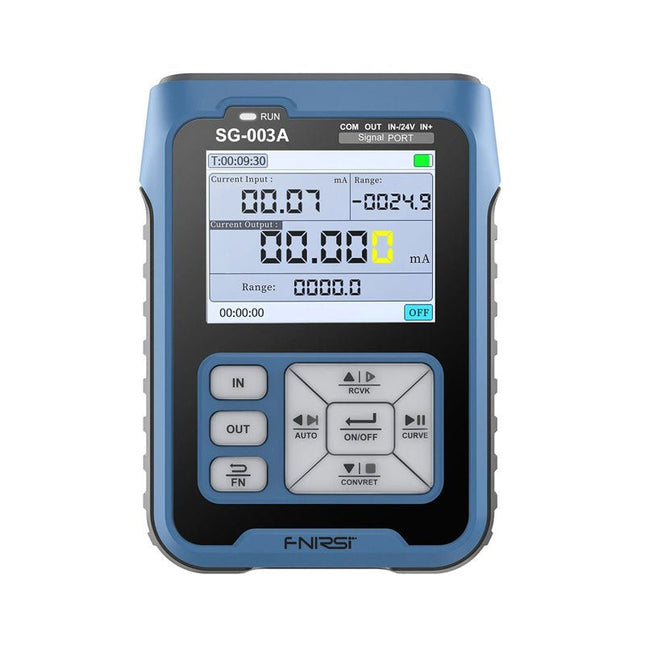
FNIRSI FNIRSI SG-003A Signaalgenerator
De FNIRSI SG-003A multifunctionele signaalgenerator, ook bekend als procesmeter/kalibrator, is een zeer nauwkeurige spanning-/stroomgenerator en -meter. De SG-003A levert zeer nauwkeurige referentiespanningen of -stromen voor het testen en kalibreren van andere meetinstrumenten, zoals multimeters en oscilloscopen. Naast spanningen en stromen genereert de SG-003A ook rechthoekige puls signalen met nauwkeurig programmeerbare frequenties en inschakelduur. De convertor modus verandert de SG-003A in een nauwkeurige spanning gestuurde stroombron, of stroom gestuurde spanningsbron, en zelfs in een spanning- of stroom gestuurde frequentiegenerator. De SG-003A is een zeer handig hulpmiddel voor het controleren van de nauwkeurigheid en precisie van uw multimeter, en voor het testen van bijvoorbeeld LED's. Kenmerken Nauwkeurigheid (spanning/stroom) 0,1% ± 0,005 Resolutie (huidig) 0,01 mA Frequentie 0-10 kHz Resolutie 5 cijfers Uitgangsspanning 24 V Scherm 2,4" TFT LCD-scherm (320 x 240) Afmetingen 92 x 72 x 30 mm Gewicht 165 g Specificaties Signaal Bereik Precisie Resolutie Max belasting Externe voeding Actieve stroomuitgang 0~24 mA ±(0,1% + 0,005) 0,01 mA 750 Ω Passieve stroomuitgang (XMT) 0~24 mA ±(0,1% + 0,005) 0,01 mA 0~30 V Uitgangsspanning 0~24 V ±(0,1% + 0,005) 0,01 V 24 V loop 0~24 mA ±(0,1% + 0,005) 0,01 mA Frequentie uitgang 0~9999 Hz ±2% 5 cijfers Stroom ingang 0~24 mA ±(0,1% + 0,005) 0,01 mA Spanning ingang 0~3 0V ±(0,1% + 0,005) 0,01 V Inbegrepen 1x FNIRSI SG-003A signaalgenerator 4x Testclips 1x USB oplader 1x USB-C kabel 1x Handleiding Downloads Manual Firmware V4.3
€ 69,95
-
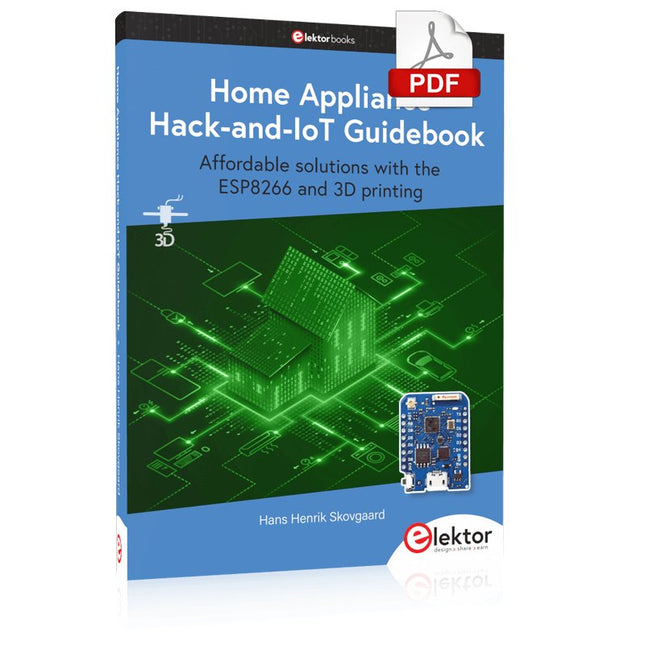
Elektor Digital Home Appliance Hack-and-IoT Guidebook (E-book)
Affordable solutions with the ESP8266 and 3D printing If you are looking for a small yet powerful IoT device, you are likely to come across the ESP8266 and compatible products on the market today. One of these, the Wemos/Lolin D1 Mini Pro board strikes a remarkable balance between cost and performance. A small and very affordable prototype board, the D1 Mini Pro stands out with its WiFi functionality and a 16-Mbytes flash memory for easy creation of a flash file system. In addition, there are sufficient input and output pins (only one analog input though) to support PWM, I²C, and One-Wire systems to mention but a few. The book describes the operation, modding, construction, and programming of home appliances including a colorful smart home accessory, a refrigerator/greenhouse controller, an AC powerline monitor, a door lock monitor, and an IKEA Trådfri controller. As a benefit, all firmware developed for these DIY, "IoT-ized" devices can be updated over-the-air (OTA). For most of the designs in the book, a small printed circuit board (PCB) and an enclosure are presented so readers can have a finished and attractive-looking product. Readers having – or with access to! – a 3D printer can "print" the suggested enclosures at home or in a shop. Some of the constructions benefit from a Raspberry Pi configured as a gateway or cms server. This is also described in detail with all the necessary configuring. You don’t need to be an expert but the prerequisites to successful replication of the projects include basic skills with PC software including the ability to surf the Internet. In terms of hardware, you should be comfortable with soldering and generally assembling the PCBs presented in the book. All custom software written for the IoT devices, the PCB layouts, and 3D print files described in the book are available for free downloading.
€ 34,95
Leden: € 31,46
-

Elektor Digital Raspberry Pi Select (PDF) NL
61 pagina's met de beste Raspberry Pi artikelen en projecten uit Elektor Magazine: Windows op de Raspberry Pi (1) Windows op de Raspberry Pi (2) Windows op de Raspberry Pi (3) Raspberry Pi wobbulator Raspberry-Pi-emulator Raspberry-Pi-voltmeter Raspberry Pi prototyping-board Visual Basic op de Raspberry Pi RPi meet energieverbruik Voor Linux-board en Raspberry Pi Maak uw eigen I2C-device voor de Raspberry Pi SD-kaart-upgrade voor RPi model 2 Mini-workshop GestIC & 3D-touchpad (2) Surfen op de golven van de RPi ATmega op het web (1) ATmega op het web (2)
€ 9,50
Leden: € 8,55
-

Elektor Digital Practical Electronics Crash Course (E-book)
Learning circuit design the fun way Welcome to the world of electronics! Getting started in electronics is not as difficult as you may think. Using this book, you will explore and learn the most important electrical and electronics engineering concepts in a fun way by doing various experiments and by simulating circuits. It will teach you electronics practically without getting into complex technical jargon and long calculations. As a result, you will be creating your own projects soon. No prior knowledge of electronics is required, only some basic algebra is used in a few simple calculations. Many tested and working projects and simulations are presented to familiarise yourself with the construction of electronic circuits. Circuit simulation is introduced at an early stage to enable you to experiment with circuits easily without breaking anything. You will learn: The concepts of voltage, current, and power AC and DC Basic lamp circuits with switches Passive components: resistors, capacitors & inductors RC & RCL circuits Electromagnetism Loudspeakers, relays, buzzers, and transformers Active components: diodes & LEDs, bipolar transistors & MOSFETs Transistor-based switching circuits Optocoupler circuits Astable & monostable multivibrators Using the 555 timer IC The operational amplifier Digital logic Advanced examples: amplifiers, oscillators, filters, and sensors Test and measurement tools Microcontrollers: Arduino UNO, ESP32, Raspberry Pi Pico, and Raspberry Pi Reading datasheets and best practices for selecting components EMC & EMI and norms & regulations
€ 32,95
Leden: € 29,66
-

Elektor May/June 2025 (EN)
Elektor GREEN and GOLD members can download their digital edition here. Not a member yet? Click here. PbMonitor v1.0A Battery-Monitoring System for UPS and Energy Storage Applications Solar Charge Controller with MPPT (1)Basic Principles of a Solar Controller for Stand-Alone Systems B-Field Integration Magnetometer With Home-Made Sensors Precise or Accurate?Your Instruments Need to Be Both! AD7124 A Precision ADC in PracticeFeatures for Sensor Signal Conditioning PID Control ToolOptimize Your Parameters Easily embedded world 2025 Starting Out in Electronics……Continues with Tone Control Academy Pro BoxBook + Online Course + Hardware Milliohmmeter AdapterUses the Precision of Your Multimeter The Next Leap in SemiconductorsOnward Toward 1.4 nm Through-Hole Technology ConnectorsThe Best of Two Worlds: THR Frequency CounterPortable and Auto-Calibrating Via GPS Analog MetersPeculiar Parts, the Series Stand-Alone Crystal TesterHow Accurate Is Your Clock Source? Low-Cost I²C TesterConnect I²C Devices Directly to Your PC From Life’s ExperienceWho Doesn’t Honor the Small Things? 2025: An AI OdysseyThe Transformative Impact on Software Development Err-lectronicsCorrections, Updates, and Readers’ Letters Raspberry Pi Standalone MIDI Synthesizer (2)Enhancing Our Setup with Intelligence Nortonized Wien Bridge OscillatorSmall Changes Yield Significant Improvements Putting a $0.10 Controller to the TestThe CH32V003 RISC-V Microcontroller and MounRiver Studio in Practice An FPGA-Based Audio Player with Equalizer (2)Adding Volume Control, Advanced Mixing, and a Web Interface
€ 10,95
-

Elektor Publishing Das offizielle Raspberry Pi Handbuch
Von den Machern von MagPi, dem offiziellen Raspberry Pi Magazin Starten Sie jetzt mit dem Raspberry Pi 5, dem neuesten und besten Minicomputer von Raspberry Pi – und lernen Sie, mit diesem unglaublichen Computer zu programmieren und Projekte zu erstellen. In diesem Buch finden Sie außerdem jede Menge kreative Ideen und Tipps, die Sie mit dem Raspberry Pi 4, dem Raspberry Pi Zero 2 W und dem Raspberry Pi Pico W umsetzen können. Mit den neuesten Reviews, Tutorials, Projekten, Anleitungen und mehr ist dies Ihre ultimative Ressource für den Raspberry Pi! 228 Seiten über Raspberry Pi Alles, was Sie über den Raspberry Pi 5 wissen müssen Erste Schritte für jeden Raspberry Pi Viel Spaß mit Elektronik und dem Pico W Inspirierende Projekte für Ihre nächste Bauidee Lernen Sie MicroPython, indem Sie ein Handheld bauen Erste Schritte mit dem Raspberry Pi Camera Modul Künstliche Intelligenz: Bauen Sie Ihren eigenen GPT Chatbot
€ 34,80
Beste prijs
-
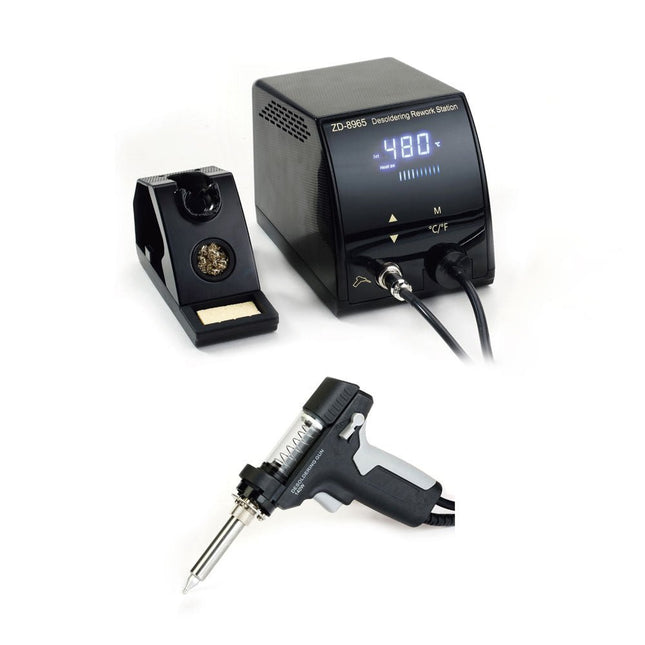
Zhongdi ZD-8965 Desoldeerstation
De ZD-8965 is een digitaal temperatuurgecontroleerd desoldeerstation uitgerust met aardingsbeveiliging en een LCD-display voor temperatuurweergave. Ondanks het compacte en robuuste ontwerp is dit krachtige desoldeerstation eenvoudig met één hand te bedienen. De ZD-8965 is voorzien van een soldeerpistool met een geïntegreerd filter dat al het geëxtraheerde materiaal opvangt, waardoor continu gebruik mogelijk is door simpelweg de filters te vervangen. Bovendien is er een temperatuursensor in de punt ingebed, waardoor een snelle reactie op temperatuurschommelingen mogelijk is, voor consistente prestaties. Kenmerken Pas de temperatuur moeiteloos aan tussen 160°C en 480°C met de handige omhoog/omlaag-knoppen op het voorpaneel. LED-display om de temperatuur in °C/°F aan te geven Beschikt over een ergonomische pistoolgreep met een trekker voor snelle en efficiënte verwijdering van soldeerafval. Het verbeterde soldeerpistool is voorzien van een trigger aan de achterkant, waardoor het uitzonderlijk handig is om componenten te vervangen en te reinigen. Wordt geleverd met een hoogwaardig soldeerpistool en een stevige houder. Uitgerust met een krachtige verwarming die keer op keer zorgt voor optimale desoldeerprestaties. Specificaties Station Spanningsvoorziening 220-240 V Stroomverbrui 140 W Vakumdruk 600 mm HG Desoldeerpistool Stroomverbruik 140 W (18 V DC)Opwarmvermogen: 140 W Temperatuur 160-480°C Verwarmingselement Keramische verwarming Inbegrepen 1x ZD-8965 Desoldeerstation 2x Reserve soldeerpunten 3x Reinigingsnaalden voor desoldeertips 3x Reservefilter voor desoldeerpistool 1x Reservefilter voor desoldeerstation 1x Manual
€ 99,00
-

Elektor Digital The ESP32 Cheap Yellow Display Book (PDF)
Projects Using Arduino IDE and the LVGL Graphics Library The ESP32 is probably one of the most popular microcontrollers used by many people, including students, hobbyists, and professional engineers. Its low cost, coupled with rich features makes it a popular device to use in many projects. Recently, a board called the ESP32 Cheap Yellow Display (CYD for short) is available from its manufacturers. The board includes a standard ESP32 microcontroller together with a 320x240 pixel TFT display. Additionally, the board provides several connectors for interfaces such as GPIO, serial port (TX/RX), power and Ground. The inclusion of a TFT display is a real advantage as it enables users to design complex graphics-based projects without resorting to an external LCD or graphics displays. The book describes the basic hardware of the ESP32 CYD board and provides details of its on-board connectors. Many basic, simple, and intermediate-level projects are given in the book based on the ESP32 CYD, using the highly popular Arduino IDE 2.0 integrated development environment. The use of both the basic graphics functions and the use of the popular LVGL graphics library are discussed in the book and projects are given that use both types of approaches. All the projects given in the book have been tested and are working. The block diagram, circuit diagram, and the complete program listings and program descriptions of all the projects are given with explanations. Readers can use the LVGL graphics library to design highly popular eye-catching full-color graphics projects using widgets such as buttons, labels, calendars, keypads, keyboards, message boxes, spinboxes, sliders, charts, tables, menus, bars, switches, drop-down lists, animations, and many more widgets.
€ 29,95
Leden: € 26,96
-

Elektor Digital Elektor 09-10/2023 (PDF)
Diese Ausgabe steht allen GOLD- und GREEN-Mitgliedern auf der ElektorMagazine-Website zum Download bereit! Sie sind noch kein Mitglied? Hier klicken! Raspberry Pi Pico als Spektrum-AnalyserFFTs auf preiswerter Hardware-Basis ±40 V Linearer SpannungsreglerEine alternative Stromversorgung für die Fortissimo-100-Endstufe... und andere! Drahtlose MCU-Kommunikation flexibel gemachtEEPROM eröffnet Netzwerk-Perspektiven für drahtlose MCUs 5.000 € zu gewinnen!Machen Sie mit beim STM32 Wireless Innovation Design Contest! 2023: Odyssee in der KILoslegen mit dem Code-Interpreter von ChatGPT LoRa, ein Schweizer TaschenmesserTeil 1: Das LoRa-Protokoll und seine Vorteile Einstellbare Stromsenke mit integriertem TaktgeberZum Testen von Netzteilen, Spannungswandlern und Batterien Zwei neue Arduino UNO R4 Boards: Minima und WiFi Logarithmische PotentiometerSie sind exponentiell! Motortreiber-Breakout-BoardEin BoB für einen 5-A-Treiber für DC-Motoren mit einer Größe von 3×3 mm Aus dem Leben gegriffenGefährliche Elektronik Ist Mobilfunk die energiesparendste Option für das IoT?LTE-M und NB-IoT: Energieanforderungen in LPWAN-Implementierungen Kabellose Kommunikation in IoT-Systemen mit Modulen MKR von ArduinoKommunikationsstandards der Arduino-Module für IoT AC-Verluste in magnetischen BauteilenVermeiden Sie heiße Induktivitäten! Messungen für eine optimale Cloud-Implementierung Matter-Implementierung: Was braucht es, um Matter-Geräte einzusetzen? Neue 2,4 GHz-Funkeinheiten von Circuit DesignPrädestiniert für Fernsteuerung und Überwachung PIC o’Clock – am Puls der ZeitDesign eines SDR-Zeitzeichen-Empfängers Due Diligence DirectiveBusiness as Usual Will Not Do Aller Anfang...Ist gar nicht schwer: Spannungsverstärkung Infraschall-Rekorder mit dem Arduino Pro MiniEin Beispielprojekt aus dem Elektor-Buch „Arduino & Co.“ Cloud-basierter EnergiezählerMit ESP32-Modul und PZEM-004T-Spannungs-/ Stromsensor Eine Anleitung zur Bare-Metal-ProgrammierungTeil 2: Exaktes Timing, UART und Debugging
€ 11,90
-

Elektor Digital Elektor July/August 2021 (PDF) EN
LoRa with the Raspberry Pi PicoFun with MicroPython What Is RISC-V?And Why the Industry Is So Excited About a New Processing Core! Elektor @ 60Circuits of Summer Past Versatile Power Supply for BreadboardsPositive and Negative Voltages Out of 5 V from USB Raspberry Pi Pico EssentialsSample Chapter: Wi-Fi with the Raspberry Pi Pico Magnetic Levitation the Easy Way Hands On the Parallax Propeller 2Part 3: Smart Pins and Serial Data (UART) Nucleo Boards Programming with the STM32CubeIDESample Chapter: FreeRTOS for the STM32 MCU Developer's ZoneTips & Tricks, Best Practices and Other Useful Information Miniware DT71 Digital Tweezers Wearable Wi-Fi Gadget: ESPHome Does the Job Again Starting out in ElectronicsEasier Than Imagined! This Concludes the Subject of “Capacitors” Simple Sketches Using the Qwiic Ecosystem Java on the Raspberry Pi (Part 2)Controlling GPIOs with a Spring REST Service Raspberry Pi Compute Module 4A Raspberry Pi for Industry Portable, Stand-Alone Air Quality Display for 2.5 µm ParticlesKeep(s) an Eye on Your Health From Life’s ExperienceThe Future Was Better in the Past MicroPython for the ESP32 and FriendsPart 1: Installation and Our First Programs Charge-Coupled Devices in OscilloscopesPeculiar Parts, the series ESD – The Invisible DestroyerComponents Trashed by a Bolt from the Blue Solar Power for Mowing RobotsEcological, Inexpensive, Simple! Europe’s Efforts to Tame Big Tech HexadokuThe Original Elektorized Sudoku
€ 7,50


