
Zoekresultaten voor "official or case or for or raspberry or pi or black or grey"
-

Elektor Edge Impulse Guest Edition 2025 (EN)
Elektor GREEN and GOLD members can download their digital edition here. Not a member yet? Click here. What to expect This Elektor edition guest-edited by Edge Impulse explores the edge AI workflow, from data collection and model training to deployment and optimization: End-to-End Edge AIA hands-on object detection series that walks through the complete machine learning pipeline on embedded hardware. High-Resolution, High-Speed Object Counting (Nvidia Jetson Nano, TensorRT)Pushing inference speed and precision for visual counting applications. PCB Defect Detection with Computer Vision (Raspberry Pi)Smarter manufacturing through embedded vision. Smart Building Ventilation with Sensor FusionAI-powered environmental optimization for energy efficiency. Analog Meter Reading (Arduino Nicla Vision)A TinyML approach to automating analog infrastructure. Smart Appliance Control Using Voice Commands (Nordic Thingy:53)Speech recognition at the edge. Liquid Classification with TinyML (Seeed Wio Terminal + TDS Sensor)Combining IoT sensing and embedded ML for fluid analysis. Surgery Inventory Object DetectionApplying real-time vision to healthcare logistics. Plus, the magazine includes exclusive interviews with: Edge Impulse co-founders Zach Shelby and Jan Jongboom; Qualcomm Technologies VP of product management Manny Singh; and EDGE AI FOUNDATION CEO Pete Bernard. Also included are a Tech the Future essay titled "AI at the Edge: Powering the Next Generation of Devices," an Industry Case Study on GlobalSense, and more. Contents What the Heck Is Edge AI Anyway?Bringing Intelligence to the Device Meet Edge Impulse StudioEasily Build and Deploy Edge AI Models Keyword Spotting with Edge ImpulseCollect, Train, and Deploy Smart Appliance Control Using Voice Commands with the Nordic Thingy:53 Key Terms for Understanding Edge AI and Machine Learning Crash Course: Getting Started with Edge ImpulseLearn to Collect, Train, and Deploy an ML Model with the Arduino Nano 33 BLE Sense A New Chapter for ArduinoFrom Hobby Board to Edge Computing Powerhouse Getting Started with Object Detection on Edge Devices PCB Defect DetectionComputer Vision with Raspberry Pi Scaling AI to the Smallest Devices Optimizing Power Efficiency in Battery-Driven Edge AI Devices AI ToasterWhen Edge AI Meets Breakfast Thundercomm Rubik Pi 3Raspberry Pi Familiarity Meets Edge AI Leadership, Embedded ML, and the Edge Revolution Vision Language Models for the EdgeCascading Models for Better Reliability Get to Know Edge ImpulseQuestions from the Elektor Community Project Update #5: ESP32-Based Energy MeterUsing Edge AI to Recognize Household Loads Motion Recognition with Anomaly DetectionAn End-to-End Tutorial Smart Ventilation System: Fusing Sound and Environmental DataA Dual-MCU Machine Learning Approach for Automated Window and Louver Control Bringing Voice Control to Earbuds and Headsets AI at the Edge: Powering the Next Generation of Devices
€ 14,90
-

Elektor Digital Elektor Mars/Avril 2024 PDF (FR)
Le téléchargement intégral de ce numéro est disponible pour nos membres GOLD et GREEN sur le site Elektor Magazine ! Pas encore membre ? Cliquez ici. CaptureCountdétecteur et compteur d'objets basé sur le Raspberry Pi 5 référence de tension avec Arduino Pro Minilinéariser et calibrer les entrées analogiques FPGA pour les débutantsThe Path From MCU to FPGA Programming mise à jour : STM32 Wireless Innovation Design Contest 2024 Bluetooth LE avec MAUIControl Apps for Android & Co. carte d'extension de portsaugmentez le nombre d'E/S de votre carte de développement carte spéciale IAapprentissage automatique avec le Jetson Nano 2024 : l'Odyssée de l'IApremiers essais avec TensorFlow 262 144 façons de jouer au Jeu de la Vieun projet de lecteur en bref sur le vifle souffle du dragon sur mon cou faites tourner votre moteur CCSample Projects from the Elektor Motor Control Development Bundle Adaptateur ESP32-RS-232A Wireless Link for Classic Test Equipment démarrer en électronique…en savoir plus sur les ampli-op bibliothèques ESP recommandées composants piézoélectriques compteur d'objets intelligentreconnaissance d'images simplifiée avec Edge Impulse des solutions à vos problèmes de développement de systèmes embarqués les plus délicats Terminal ESP32un appareil portable avec un écran tactile commencer avec le RTOS Zephyraussi puissant que difficile à maîtriser Award-Winning EthicsDialogue avec Alexander Gerfer, Directeur Technique chez Würth Elektronik eiSos sur la promotion du comportement respectueux et innovant projet 2.0corrections, mises à jour et courrier des lecteurs
€ 10,95
-

Elektor Publishing Robotik und Künstliche Intelligenz
Robotik und Künstliche Intelligenz
€ 39,80
Beste prijs
-
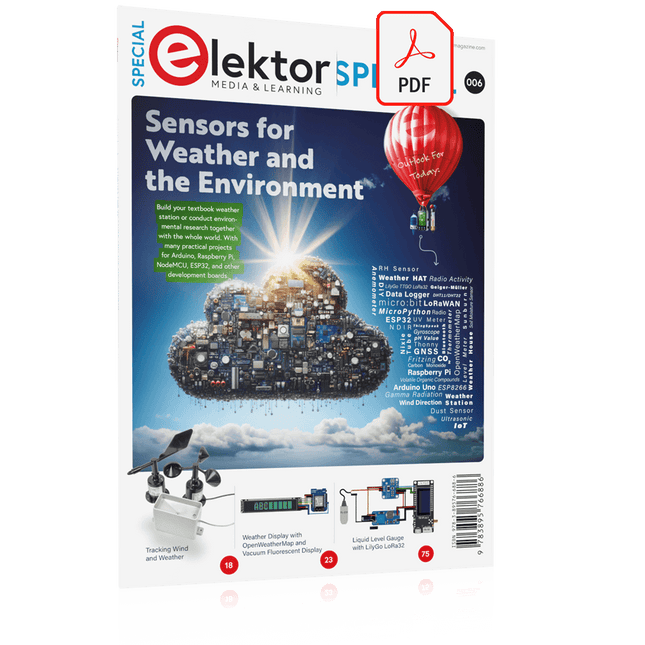
Elektor Digital Elektor Special: Sensors for Weather and the Environment (PDF)
Build your textbook weather station or conduct environmental research together with the whole world. With many practical projects for Arduino, Raspberry Pi, NodeMCU, ESP32, and other development boards. Weather stations have enjoyed great popularity for decades. Every current and even every long discontinued electronics magazine has regularly featured articles on building your own weather station. Over the years, they have become increasingly sophisticated and can now be fully integrated into an automated home — although this often requires loyalty to an (expensive) brand manufacturer across all components. With your own weather and environmental data, you can keep up and measure things that no commercial station can. It’s also fun: expand your knowledge of electronics, current microcontroller development boards and programming languages in a fun and meaningful way. For less than 10 euros you can get started and record your first environmental data — with time and growing interest, you will continue to expand your system. In this Edition Which Microcontroller Fits My Project? The Right Development Environment Tracking Wind and Weather Weather Display with OpenWeatherMap and Vacuum Fluorescent Display Volatile Organic Compounds in the Air We Breathe Working with MQ Sensors: Measuring Carbon Monoxide — Odorless but Toxic CO2 Traffic Light with ThingSpeak IoT Connection An Automatic Plant Watering System Good Indoor Climate: Temperature and Humidity are Important criteria Classy Thermometer with Vintage Tube Technology Nostalgic Weather House for the Whole Family Measuring Air Pressure and Temperature Accurately Sunburn Warning Device DIY Sensor for Sunshine Duration Simple Smartphone Says: Fog or Clear View? Identifying Earthquakes Liquid Level Measurement for Vessels and Reservoirs Water pH Value Measurement Detecting Radioactive Radiation GPS: Sensor Location Service Across the Globe Saving and Timestamping Log Files on SD Cards LoRaWAN, The Things Network, and ThingSpeak Operating a LoRaWAN Gateway for TTN Defying "Wind and Weather" Mega Display with Weather Forecasz
€ 14,95
Leden: € 13,46
-

Elektor Digital Python 3 Programming and GUIs (E-book)
This is the second edition of a book aimed at engineers, scientists, and hobbyists who want to interface PCs with hardware projects using graphical user interfaces. Desktop and web-based applications are covered. The programming language used is Python 3, which is one of the most popular languages around: speed of programming being a key feature. The book has been revised and updated with an emphasis on getting the user to produce practical designs with ease – a text editor is all that is required to produce Python programs. Hardware interfacing is achieved using an Arduino Uno as a remote slave. A full description and source code of the communication interface is given in the book. The slave provides digital and analog input and outputs. Multiple Unos can be included in one project with all control code written in Python and running on a PC One project involves a PIC microcontroller with the code provided that can be loaded into the PIC using the Uno. The web applications and server are all implemented in Python, allowing you to access your electronic hardware over the Internet. The Raspberry Pi computer can be used as your web server. An introductory chapter is provided to get you started with using Linux. The book is written for use with Debian or variations including Mint or Ubuntu. All of the programs in the book are freely available, ready to use and experiment with by way of a download from Elektor.
€ 29,95
Leden: € 26,96
-

Elektor Digital Sprachsteuerung von IoT-Projekten mit Amazon Alexa (PDF)
Sprachsteuerung von IoT-Projekten mit Amazon Alexa gibt dem Leser einen tiefen Einblick in die Technik der Sprachsteuerung am Beispiel von Amazon Alexa. Es erklärt detailliert Schritt für Schritt, wie man Raspberry Pi, ESP8266/32 und Arduino mit einem Sprachassistenten verbindet und steuert. Dieses geschieht anhand von Projekten aus den Bereichen Hausautomation und Robotik. Der Leser erfährt, wie man Heizkessel, Roboter und Gartenhäuser mit dieser modernen Mensch-Maschine-Schnittstelle kommandieren kann. Der Autor Walter Trojan führt dabei den Leser in die vielschichtige Welt der Amazon Web Services ein, wo er neben dem Alexa Skills Kit weitere Module wie AWS Lambda und IoT Core kennenlernt. Das erwartet den Leser: Kapitel 1: Sprachassistenten setzen sich durch Kapitel 2: Alexa intern Kapitel 3: Der erste Alexa Skill Kapitel 4: Alexa Skills für Fortgeschrittene Kapitel 5: Erster Hardware-Skill auf Raspberry Pi Kapitel 6: Auch Alexa liebt die Arduino-IDE Kapitel 7: Hacks mit Schaltern Kapitel 8: Alexa steuert ein Gartenhaus Kapitel 9: Auch Roboter gehorchen Alexa Kapitel 10: Alexa geht fremd
€ 32,80
Leden: € 29,52
-
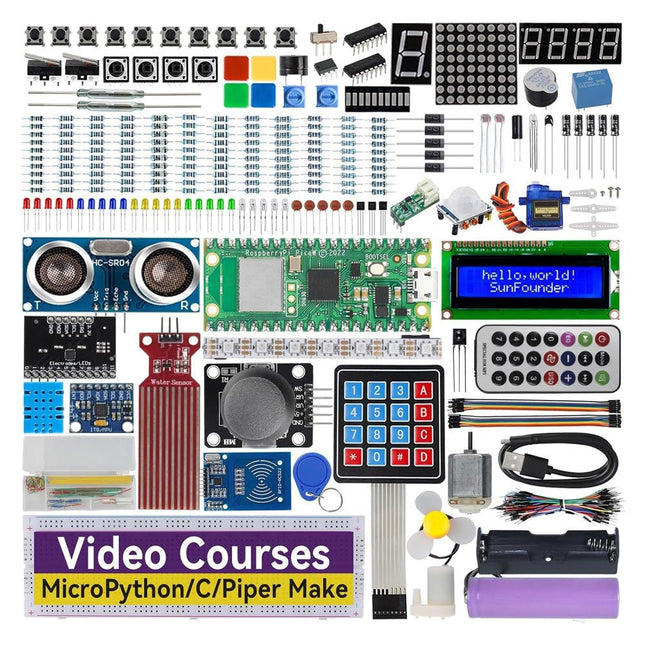
SunFounder SunFounder Kepler Kit (Ultimate Starter Kit voor Raspberry Pi Pico W)
Uw toegangspoort tot IoT en programmeren met microcontrollers Met 450+ componenten en 117 online projecten, stimuleert deze uitgebreide kit uw creativiteit. De tutorials van Paul McWhorter maken leren leuk voor beginners en gevorderde gebruikers. Deze kit ondersteunt MicroPython, C/C++ en Piper Make, en biedt diverse programmeeropties. Ontdek sensoren, actuatoren, LED's en LCD's voor eindeloze projectmogelijkheden. Van huisautomatisering tot robotica, deze kit versterkt uw technische reis. Kenmerken IoT Starter Kit voor beginners: Deze kit biedt een rijke IoT-leerervaring voor beginners. Met 450+ componenten, 117 projecten en door experts geleide videolessen, maakt deze kit het leren van microcontrollerprogrammering en IoT boeiend en toegankelijk. Door experts geleide videolessen: De kit bevat 27 videotutorials van de bekende docent Paul McWhorter. Zijn boeiende stijl vereenvoudigt complexe concepten, wat zorgt voor een effectieve leerervaring in microcontrollerprogrammering. Breed scala aan hardware: De kit bevat een divers scala aan componenten zoals sensoren, actuatoren, LED's, LCD's en meer, waardoor u kunt experimenteren en verschillende projecten kunt maken met de Raspberry Pi Pico W. Ondersteunt meerdere talen: De kit biedt veelzijdigheid met ondersteuning voor drie programmeertalen – MicroPython, C/C++ en Piper Make, wat zorgt voor een gevarieerde programmeerleerervaring. Toegewijde ondersteuning: Profiteer van onze voortdurende assistentie, inclusief een communityforum en tijdige technische hulp voor een naadloze leerervaring. Inbegrepen Raspberry Pi Pico W Breadboard Jumper Wires Weerstand Transistor Condensator Diode Li-po-oplaadmodule 74HC595 TA6586 – Motordriverchip LED RGB-LED LED-staafdiagram Weergave met 7 segmenten 4-cijferige 7-segmentweergave LED-dotmatrix I²C LCD1602 WS2812 RGB-strip met 8 LED's Zoemer DC-motor Servo DC-water Pomp Relais Knop Microschakelaar Schuifschakelaar Potentiometer Infraroodontvanger Joystickmodule 4x4 toetsenbord MPR121-module MFRC522-module Fotoweerstand Thermistor Kantelschakelaar Reedschakelaar PIR-bewegingssensormodule Waterniveausensormodule Ultrasone module DHT11-vochtigheidssensor MPU6050-module Documentatie Online tutorials in 3 talen (EN, DE en JP)
-
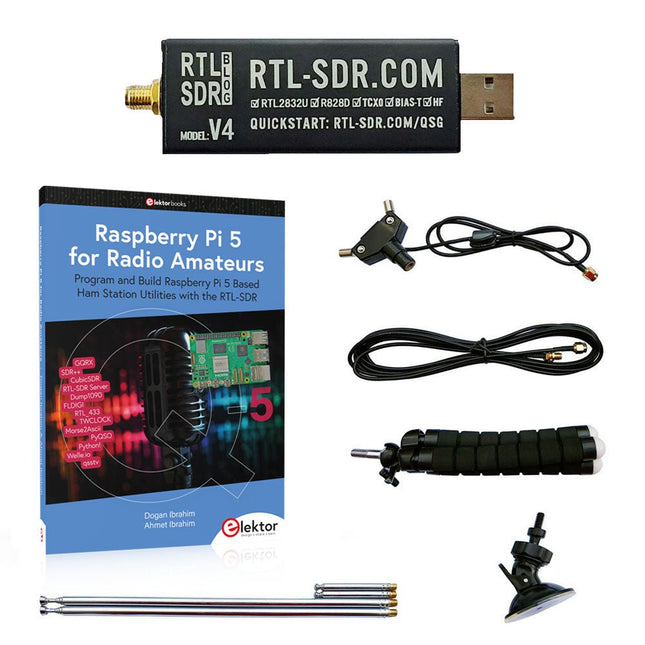
Elektor Bundles Raspberry Pi 5 RTL-SDR V4 (Bundel)
Programmeer en bouw op Raspberry Pi-gebaseerde hulpprogramma's, tools en instrumenten voor hamstations Met de verbeterde RTL-SDR V4 kunt u radiosignalen ontvangen tussen 500 kHz en 1,75 GHz van stations die verschillende banden gebruiken, waaronder MW/SW/LW-uitzendingen, hamradio, nutsvoorzieningen, luchtverkeersleiding, PMR, SRD, ISM, CB, weersatelliet en radioastronomie. Het boek Raspberry Pi 5 for Radio Amateurs geeft uitgebreide dekking voor het inzetten van de RTL-SDR-kit via het gebruik van een Raspberry Pi 5. Deze bundel bevat: RTL-SDR V4 (incl. Dipool Antenne Kit) (normale prijs: € 75) Raspberry Pi 5 for Radio Amateurs (normale prijs: € 40) RTL-SDR V4 (Software Defined Radio) met Dipole Antenne Kit De RTL-SDR is een betaalbare dongle die kan worden gebruikt als een computer-ondersteunde radioscanner voor het ontvangen van live radiosignalen tussen 500 kHz en 1,75 GHz bij u in de buurt. Deze RTL-SDR V4 heeft verschillende verbeteringen waaronder het gebruik van de R828D tunerchip, een triplex ingangsfilter, een notchfilter, verbeterde componenttoleranties, een 1 PPM temperatuur-gecompenseerde oscillator (TCXO), een SMA F-connector, aluminium behuizing met passieve koeling, bias T-circuit, verbeterde voeding en een ingebouwde HF upconverter. RTL-SDR V4 wordt geleverd met een draagbare dipool antennekit. Het is een geweldig apparaat voor beginners omdat hij terrestrial en satellietontvangst mogelijk maakt, gemakkelijk buitenshuis kan worden gemonteerd, en geschikt is voor draagbaar en tijdelijk gebruik onderweg. Kenmerken Verbeterde HF-ontvangst: De V4 maakt gebruik van een ingebouwde upconverter in plaats van een direct sampling circuit. Dit betekent dat er geen gebruik meer hoeft te worden gemaakt wordt van de Nyquist-frequentie van rond de 14,4 MHz, wat een verbeterde gevoeligheid en een instelbare versterking op HF mogelijk maakt. Net als bij de V3 blijft het laagste afstembereik 500 kHz en kan bij een zeer sterk ontvangstsignaal nog steeds front-end verzwakking/filtering nodig zijn. Verbeterde filtering: De V4 maakt gebruik van de R828D tunerchip die drie ingangen heeft. De SMA ingang is drievoudig uitgevoerd voor 3 banden: HF, VHF en UHF. Dit zorgt voor enige isolatie tussen de 3 banden, wat betekent dat out-of-band interferentie van sterke zenders minder snel verminderde gevoeligheid of spiegelsignalen kan veroorzaken. Verbeterde filtering x2: Naast de triplex ingang kan ook de open drain pin op de R828D worden gebruikt. Hierop kunnen eenvoudige notch-filters worden aangesloten voor bekende banden qua interferentie, zoals de AM en FM omroepbanden en de DAB-banden. Deze dempen slechts met een paar dB maar kunnen nog steeds van nut zijn. Verminderde faseruis op sterke signalen: Door een verbeterd ontwerp van de voeding is de faseruis als gevolg van ruis uit de voeding aanzienlijk verminderd. Minder warmte: Een ander voordeel van de verbeterde voeding is een lager stroomverbruik en minder warmteontwikkeling in vergelijking met de V3. Inbegrepen 1x RTL-SDR V4-dongle (R828D RTL2832U 1PPM TCXO SMA) 2x 23 cm tot 1 m telescoop antenne 2x 5 cm tot 13 cm telescoop antenne 1x Dipool antennevoet met 60 cm RG174 1x 3 m RG174 verlengkabel 1x Flexibele statiefbevestiging 1x Zuignapbevestiging Downloads Datasheet Gebruikershandleiding Quick Start Guide SDR# Gebruikershandleiding Dipole Antenne Guide Boek: Raspberry Pi 5 for Radio Amateurs De RTL-SDR-apparaten (V3 en V4) hebben aan populariteit gewonnen onder radioamateurs vanwege hun zeer lage kosten en uitgebreide mogelijkheden. Een basissysteem kan bestaan uit een USB-gebaseerd RTL-SDR apparaat (dongle) met een geschikte antenne, een Raspberry Pi 5 computer, een USB-gebaseerde externe audio input-output adapter en software geïnstalleerd op de Raspberry Pi 5 computer. Met zo'n bescheiden opstelling is het mogelijk signalen te ontvangen van ongeveer 24 MHz tot meer dan 1,7 GHz. Dit boek is bedoeld voor liefhebbers van radioamateurs en studenten elektrotechniek, maar ook voor iedereen die de Raspberry Pi 5 wil leren gebruiken om elektronische projecten te bouwen. Het boek is geschikt voor zowel beginners als ervaren lezers. Enige kennis van de programmeertaal Python is vereist om de projecten in het boek te begrijpen en eventueel aan te passen. Voor elk project wordt een blokschema, een schakelschema en een complete programmatabel in Python gegeven, naast een uitgebreide beschrijving. De volgende populaire RTL-SDR-programma's worden in detail besproken, geholpen door stap-voor-stap installatiegidsen voor praktisch gebruik op een Raspberry Pi 5: SimpleFM GQRX SDR++ CubicSDR RTL-SDR Server Dump1090 FLDIGI Quick RTL_433 aldo xcwcp GPredict TWCLOCK CQRLOG klog Morse2Ascii PyQSO Welle.io Ham Clock CHIRP xastir qsstv flrig XyGrib FreeDV Qtel (EchoLink) XDX (DX-Cluster) WSJT-X De toepassing van de programmeertaal Python op het nieuwste Raspberry Pi 5-platform sluit uit dat de programma's in het boek werken op oudere versies van Raspberry Pi-computers.


