Elektor GREEN and GOLD members can download their digital edition here.
Not a member yet? Click here.
Audio DSP FX Processor BoardPart 1: Features and Design
50 Years of Elektor in English
KiCad 8Top New and Updated Features
Elektor MultiCalculator KitAn Arduino-Based Calculator Kit for Electronic Purposes
Low-Cost GNSS RTK SystemsWith Centimeter-Level Degree of Accuracy
PCB Layout and SafetyHints for a Safe, Long-Life Design of Your Boards
Opamp TesterFor Audio and Other Applications
Project Update #4: ESP32-Based Energy MeterEnergy Monitoring with MQTT
Real-Time Spectrum Analyzer with Waveguide Technology and Multi-Interface PCsAaronia Establishes New Product Segment and Presents First Prototypes at Electronica in Munich
Applications of Ynvisible’s E-paper DisplaysTransform Businesses and Shape the Future
SMT InductorsCoils and Ferrites — Selection Made Easy
Arrow Electronics to Showcase Innovative Technologies at electronica 2024
Using EMI Shielding to Achieve Electromagnetic Compatibility Compliance
The Ultimate Tool for Every Electronics EnthusiastUnlock Endless Possibilities with Red Pitaya and 1,000+ Click Boards™
V-LD1 Distance Radar Module
Siglent Presents Its New Vector Network Analyzer Platform SNA6000A
HDI in the MiddleA New Cost-Effective PCB Pooling Service for Tiny BGAs
Remote Access IoT LabOne and Only Solution for Remote Learning and Development in Embedded Industry
Challenges of DFM Analysis for Flex and Rigid-Flex Design
From Life's ExperienceMicrotechnophobia
3D Christmas TreeA 3D PCB with a Low-Cost, 32-bit Microcontroller
Starting Out in Electronics……Continues with the Opamp!
An Autonomous Sensor Node (Project Update #1)Reducing Idle Power Consumption with External RTC and Power Switch
2024: An AI OdysseyA Look Back at the Future
LED Displays with the MAX7219A Hands-On Approach to a Great Chip
Err-lectronicsCorrections, Updates, and Readers’ Letters
VibroTactile GlovesA Breakthrough for Parkinson’s Patients
Elektor GREEN and GOLD members can download their digital edition here.
Not a member yet? Click here.
MultiRF Dev BoardA Platform for Evaluating Short- and Long-Range Wireless Protocols
Elektor at 65Disrupting Electronics Since 1961
Wi-Fi-Based Person Detection on an ESP32When Your Router Becomes a Motion Sensor
Wireless ScalesFour Small Scales = One Big Scale
Walter, the Compact IoT ModuleESP32-S3 SoC, LTE-M/NB-IoT 5G Modem, and GNSS Receiver
3- and 4-Wire RTD Sensors ConditioningWith Full-Scale Adjustment and Cable Compensation
3-in-1 2-Channel Oscilloscope/Generator/MultimeterA Review of The Fnirsi 2D15P
electronica Fast Forward 2026 Invites Startups and Industry Partners
EcologgingA Modular Environmental IoT Station for Field Research
Wireless Connectivity in Medical ApplicationsAlways on the Pulse with Bluetooth LE
AudiotronicsHum Reduction
Increasing Agricultural Efficiency with AI Modeling and SensorsBoosting Agricultural Productivity
OPC UA — An OverviewPlatform-Independent Data Exchange
Redox Meter
Instrumentation Amplifier for Physics and Engineering Experiments
Active Differential Audio FiltersFor Professional Crossovers and More
Elektor Community Perspectives on IoT & Sensors
Telegram-Controlled Water Heater Interface ModuleA Solution Based on an ESP32 and Arduino Software
2026: An AI OdysseyWhatever Happened to Fuzzy Logic?
Err-lectronics
Alarm Signal Injector Plus PowerTools for Finding Broken Wires
Your First Steps with an ESP32-C3 and the IoTA Wi-Fi Button and Relay IoT Cloud a la Arduino
Dual Geiger-Müller Tube Arduino ShieldA High Sensitivity, Very Low-Power Radiation Sensor
CO2 GuardA DIY Approach to Monitoring Air Quality
MonkMakes Air Quality Kit for Raspberry PiMeasures Temperature and eCO2
Starting Out in ElectronicsWelcome to the Diode
Tips & Tricks for Testing ComponentsNo Expensive Equipment Required
Reducing the Power Consumption of Your Mole RepellerAn ATtiny13 Replaces a 555
Light Switch DeLuxA Solution for High-Precision Light-Controlled Switching
The Challenges in Bringing IoT Solutions to MarketWorries Around Security, Scalability, and Competition Infographics 5-6/2022
Preferably Wired After AllTips for Developing a 1 Gbit/s Interface in an Industrial Environment Bringing Real-Time Object Detection to MCUs with Edge Impulse FOMO
Traveling-Wave TubesPeculiar Parts, the Series
Narrowband Internet of ThingsStandards, Coverage, Agreements, and Modules
Dragino LPS8 Indoor GatewaySpeedy LoRaWAN Gateway Setup
Explore ATtiny Microcontrollers Using C and Assembly LanguageSample Chapter: ATtiny I/O Ports
Err-lectronicsCorrections, Updates and Readers’ Letters
LoRa GPS Tracker UpdateReceive and Show Location Using a Raspberry Pi
Circuit Simulation with TINA Design Suite & TINACloudSample Chapter: Sinusoidal Oscillators
From Life’s ExperienceAssembly Line Work
The WinUI Graphics Framework for Windows AppsA Small Demo Application
GUIs with PythonWorst GUI of the world
Off-Grid Solar SystemsElectrical Energy Independent of the Mains Grid
The 10-Year SmartphoneRenew Your Expectations
HexadokuThe Original Elektorized Sudoku
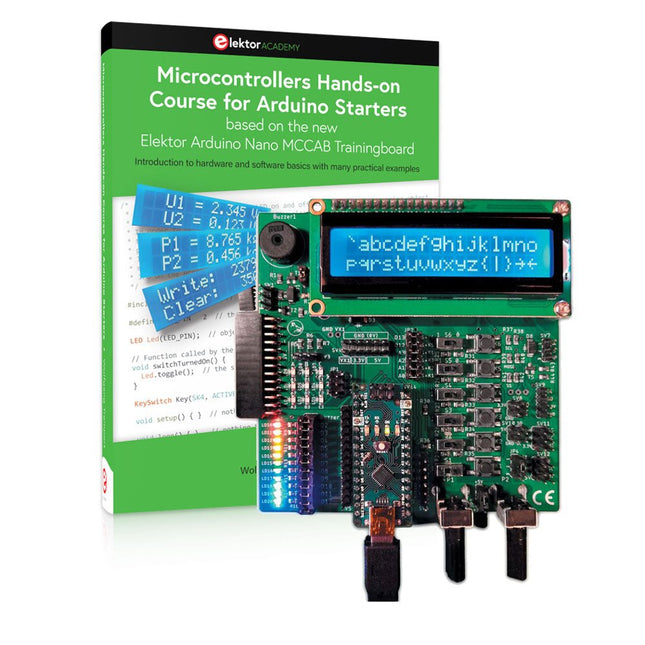
Bouw uw eigen projecten met het Elektor Arduino Nano MCCAB Training Board
De microcontroller is waarschijnlijk het meest fascinerende onderwerp van de moderne elektronica. Door de veelheid aan functies die hij op zijn chip combineert is het een universeel multi-tool voor ontwikkelaars om hun projecten mee te bouwen. Vrijwel elk dagelijks gebruikt apparaat wordt tegenwoordig bestuurd door een microcontroller. Voor een elektronica-leek is het realiseren van de eigen ideeën met een microcontroller echter tot nu toe een utopie gebleven vanwege de complexiteit ervan. Het Arduino-concept heeft het gebruik van microcontrollers sterk vereenvoudigd, zodat zelfs onervaren starters nu hun eigen elektronica ideeën kunnen realiseren met een microcontroller.
Book & Hardware in de bundel: 'Leren door te doen'
Het boek, dat ook in de bundel zit, leert ons hoe je zelfs zonder veel ervaring met elektronica en programmeertalen je eigen projecten met een microcontroller kunt bouwen. Het is een echte hands-on cursus microcontrollers voor starters. Want na een beschrijving van het inwendige van de microcontroller en een introductie in de programmeertaal C, ligt de focus van de cursus op praktische oefeningen. De lezer bouwt de nodige kennis op met 'leren door te doen': in het uitgebreide praktische gedeelte van het boek, met 12 projecten en 46 oefeningen, wordt het geleerde in het voorste deel van het boek met veel voorbeelden onderbouwd. Elke oefening wordt gevolgd door een uitgewerkt voorbeeld met uitleg en toelichting, wat de lezer helpt om de vraagstukken op te lossen en met de eigen oplossing te vergelijken.
Arduino IDE
De Arduino IDE is een software ontwikkelomgeving die gratis op de eigen pc kan worden gedownload, en die alle software bevat die nodig is voor uw eigen microcontroller-projecten. U schrijft de programma's ('apps') met de editor van de IDE in de programmeertaal C. En U vertaalt ze naar bits en bytes die de microcontroller begrijpt met behulp van de ingebouwde compiler van de Arduino IDE. En kunt ze vervolgens via een USB-kabel laden naar het geheugen van de microcontroller op het Elektor Arduino MCAB Nano Training Board.
Externe sensoren, motoren of schakelingen checken of besturen
Naast een Arduino Nano microcontroller module bevat het Elektor Arduino Nano MCCAB Training Board ook alle componenten die nodig zijn voor de oefeningen, zoals LED’s, schakelaars, drukknoppen, buzzer enz. Ook externe sensoren, motoren of modules kunnen worden gecheckt of bestuurd met dit microcontroller-trainingssysteem.
Specificaties (Arduino Nano Training Board MCCAB)
Voeding
Via de USB-aansluiting van de aangesloten pc of een externe voeding (niet inbegrepen)
Spanning
+5 Vcc
Ingangsspanning
Alle ingangen
0 V tot +5 V
VX1 en VX2
+8 V tot +12 V (alleen bij gebruik van een externe voeding)
Hardware
LCD
2x16 karakters
Potentiometer P1 & P2
JP3: Selectie van de werkspanning van P1 & P2
Verdelers
SV4: Verdeler voor de werkspanningenSV5, SV6: Verdelers voor de in-/uitgangen van de microcontroller
Schakelaars en knoppen
RESET knop op de Arduino Nano module; 6x drukknop schakelaars K1 ... K6; 6x Schuifschakelaars S1 ... S6; JP2: Jumper van de schakelaars met de ingangen van de microcontroller
Buzzer
Piezo buzzer ‘Buzzer1’ met jumper op JP6
Indicator LED’s
11 x LED: Status indicator voor de ingangen/uitgangen LED L op de Arduino Nano module, aangesloten op GPIO D13 JP6; Aansluiting van LED's LD10 ... LD20 met GPIO's D2 ... D12
Seriële interfacesSPI & I²C
JP4: Selectie van het signaal op pin X van de SPI-connector SV12 SV9 naar SV12: SPI-interface (3,3 V/5 V) of I²C-interface
Uitgangen voor externe apparaten
SV1, SV7: Geschakelde uitgang (maximaal +24 V/160 mA, extern aangesloten) SV2: 2x13 pinnen voor aansluiting van externe modules
3x3 LED matrix(9 rode LED's)
SV3: Kolommen van de 3x3 LED matrix (uitgangen D6 ... D8) JP1: Verbinding van de rijen met de GPIO's D3 ... D5
Software
MCCABLib library
Controle van hardware componenten (schakelaars, knoppen, LED's, 3x3 LED matrix, buzzer) op het MCCAB Training Board
Werktemperatuur
Tot +40 °C
Afmetingen
100 x 100 x 20 mm
Specificaties (Arduino Nano)
Microcontroller
ATmega328P
Architectuur
AVR
Spanning
5 V
Flash memory
32 KB, waarvan 2 KB gebruikt door de bootloader
SRAM
2 KB
Kloksnelheid
16 MHz
Analoge IN Pinnen
8
EEPROM
1 KB
DC stroom per I/O-pin
40 mA op één I/O-pin, totaal maximaal 200 mA op alle pinnen samen
Ingangsspanning
7-12 V
Digitale I/O-pinnen
22 (waarvan 6 PWM)
PWM Uitgangen
6
Stroomverbruik
19 mA
Afmetingen
18 x 45 mm
Gewicht
7 g
Inbegrepen
Elektor Arduino Nano MCCAB Training Board
Arduino Nano
Boek: Microcontrollers Hands-on Course for Arduino Starters
Elektor GREEN en GOLD leden kunnen deze uitgave hier downloaden.Nog geen lid? Klik hier om een lidmaatschap af te sluiten.
Raspberry Pi Pico als spectrumanalyzerFFT’s met goedkope hardware
±40 V lineaire spanningsregelaaralternatieve voeding voor de Fortissimo-100 eindversterker... en andere!
Flexibele draadloze communicatie met een MCUEEPROM opent netwerkmogelijkheden voor draadloze MCU’s
€ 5000 voor het oprapen!doe mee aan de STM32 Wireless Innovation Design Contest
2023: een AI-odysseeaan de slag met Code Interpreter van ChatGPT
LoRa – een Zwitsers zakmesdeel 1: het LoRa-protocol en zijn voordelen
Instelbare current sink met geïntegreerde klokgeneratortest voedingen, spanningsconverters en accu’s
Twee nieuwe Arduino UNO R4-boards: Minima en WiFi
Logaritmische potentiometersze zijn exponentieel!
Motordriver breakout-boardeen BoB voor een 5 A DC-motordriver van 3×3 mm
Uit het leven gegrepenelektronica periculosa
Biedt cellulair het laagste stroomverbruik voor IoT?energie-eisen van LTE-M en NB-IoT in LPWAN-implementaties
Draadloze communicatie in IoT-systemen met Arduino MKR-moduleshet juiste board voor WiFi, LoRa en andere standaarden
AC-verliezen in magnetische componentenvoorkom hete spoelen!
Meten voor optimale cloud-connectiviteit
Matter implementatie: Wat is er nodig om Matter-devices in te zetten?
YARD Stick Onesub-1 GHz draadloos testtool
Houdrelaisvreemde onderdelen
PIC voor tien – precies op tijdontwerp van een SDR-tijdseinontvanger
Due Diligence DirectiveBusiness as Usual Will Not Do
Alle begin......versterkt spanningen
Infrageluid-recorder met de Arduino Pro Minieen voorbeeldproject uit de Elektor-uitgave “Arduino & Co”
Cloud-gebaseerde energiemetermet een ESP32-module en een PZEM-004T spanning/stroom-sensor
Een gids voor puristisch programmeren (deel 2)nauwkeurige timing, de UART en debugging
Elektor GREEN and GOLD members can download their digital edition here.
Not a member yet? Click here.
The ESP-BLASTA Mini ESP32 Rocket Drone That Flies 100 km/h+
Wireless Workshop (1)Radio Modules Unlocked: 433 MHz CC1101 Sub-GHz Transceiver
AM TransmitterWith Square/Sine Wave Generator on Raspberry Pi Pico
STM32Cube Innovation ChallengeCompete with Your Best STM32C5 Design
CoffeeCallerHow a Long Hallway Led to a Custom Mesh-Networked PCB
AudiotronicsTotal Harmonic Distortion
Elektor at 65Projects from Septembers and Octobers Past
Bluetooth Channel Sounding for Asset TrackingCentimeter-Level Precision Ranging for Next-Generation IoT
2026: An AI OdysseyQuantum Computing Is Not the Next GPU
Protecting the Cloud Demands Security at the Edge
First Experiences with the HackRF ProPractical Tests with the New SDR Hardware
Modem Upgrade from GPRS/2G to LTE/4GUsing a Wireless Alarm Control Panel as an Example
Loop Antenna with RF BricksPart 1: A DIY Shortwave Antenna with Adjustable Directivity
Internet Radio to AM ConverterUsing an ESP32-S3 as Transmitter
Err-lectronics
mioty — An OverviewFraunhofer’s Approach to LPWAN
Workbench WisdomPractical Tips from Experts
Walter, the Compact IoT ModulePart 2: Accessing Weather and Data Services
Measuring Does Not Have to be Expensive
Low-Cost Audio TesterUsing PC-Based Software and a USB Audio Interface
AC Grid Frequency MeterMonitor Mains Frequency and Voltage
A Modest Inductance MeterAn Affordable Solution for Your Workbench
Acoustic Wave HoveringA Look at the Makerfabs Acoustic Levitation Kit
Starting Out in ElectronicsRectifiers E-FFWD: Looking Ahead Again!
Get Started With Your OscilloscopeFind Your Way Through the Knobs and Buttons
Raspberry Pi Pico Makes an MSF-SDRDecode a Time Signal with a Pi Pico SDR
Moisture Sensors for Watering SystemsAutomatic Watering
Disruption in Test and Measurement EquipmentInnovation from the Smaller Players Infographics 7-8/2022
Inspiration, That’s What It’s All AboutInterview with Entrepreneur Walter Arkesteijn, InnoFaith Beauty Sciences Minimizing EMC Interference from Storage Chokes
GUIs with Python (Part 5)Tic-Tac-Toe
Reed RelaysPeculiar Parts, the series Simple Analog ESR Meter With Moving-Coil Meter Precision
Sigfox CO2 Traffic LightNo Wi-Fi Network Needed!
Women in Tech“It's All About Merit Until Merit Has Tits”
Low-Budget Tablet Oscilloscope ADS1013DGood Value for Money?
Smart Plug TeardownWhich Ones Are Hacker-Friendly?
Skin Impedance and Skin CapacitanceSmall Experiments
From Life’s ExperienceNo Local Business
Pokit Meter ReviewA Swiss army knife of test gear
HexadokuThe Original Elektorized Sudoku
Open-Source-Code mit Arduino IDE und PlatformIO
Autonomes Fahren: GPS, Accelerometer, Gyroskop
PS3-Controller
Mikrocontroller wie der Arduino und Einplatinenrechner wie der Raspberry Pi haben sich zu beliebten Komponenten entwickelt. Dritter im Bunde ist der ESP32 der Firma Espressif. Mikrocontroller dieser Baureihe zeichnen sich durch eine Vielzahl implementierter Funktionen aus, die bei einem Arduino konventioneller Prägung mit einem Atmel-AVR-Mikrocontroller erst mit weiterer Hardware möglich sind. Prominentes Beispiel sind hier die WiFi- und Bluetooth-Funktionalitäten. Gegenüber einem Raspberry Pi zeichnen sie sich durch einen deutlich geringeren Preis aus.
Allgemeine Informationen für die Realisierung eines Roboterauto-Projekts mit dem ESP32 sind leicht zu finden. Dabei handelt es sich aber oft nur um Ausführungen zu einem Teilaspekt, ohne inhaltliche oder funktionale Abstimmung. So ist nicht nur die Beschaffung der benötigten Informationen mühselig und zeitaufwändig, sie kann auch außerordentlich fehlerträchtig sein.
Ansatzpunkt dieses Buches ist, diese Lücke zu schließen. Es geht auf verschiedene Möglichkeiten eines Chassis ein, vermittelt nötige Kenntnisse und führt schrittweise von einer einfachen Motorsteuerung zu einem komplexen sensor- und sprachgesteuerten Roboterauto. Hacks rund um GPS und eine PlayStation 3 runden die Sache ab.
Inhalt
Bei der Reihenfolge der Kapitel wurde versucht – beginnend bei der Darstellung von grundlegenden Informationen – über die Lösung einfacher Aufgaben zu etwas anspruchsvolleren Techniken zu führen.
Der Mikrocontroller ESP32
Die Software erstellen
Die Stromversorgung
Rund um die Hardware
Das Chassis
Der Gleichstrommotor
Kabellose Steuerung über WiFi
Mit Sensoren Hindernisse erkennen
Eine eigene Roboterauto-App
Servo und Lichtsensor
GPS
Accelerometer / Gyroskop
PS3-Controller
Roboterauto-App
Hinweis zur Software
Die Dateien haben das Suffix (.cpp). Grund ist die Entwicklung mit PlatformIO. Mit Copy & Paste sollten sie auch in der Arduino-IDE verwendet werden können.
Diese Ausgabe steht allen GOLD- und GREEN-Mitgliedern auf der ElektorMagazine-Website zum Download bereit!
Sie sind noch kein Mitglied? Hier klicken!
High-End aus dem Elektor-Labor
High-End-Verstärker Fortissimo-100Vollsymmetrische Audio-Endstufe mit 100/190 W
Frequenzbestimmung unbekannter Schwingkreise und QuarzeTips & Tricks, Best Practices and Other Useful Information
Platinen entwerfenTipps aus der Praxis
Löten ….na und?Ein etwas genauerer Blick auf die heutige Löttechnik
Bluetooth-Garagentorsteuerung mit niedriger LatenzSteuerung mit kurzen BLE-Nachrichten über ein Smartphone
Ideal Diode Controller„Dioden“ mit geringer Verlustleistung
LED-Girlanden mit ESP32 und FreeRTOSBlinken und variable Helligkeit
Aller Anfang ...... muss nicht schwer sein: Es geht weiter mit den Z-Dioden
UKW/DAB+-EmpfängerDas Beste aus beiden Welten
Aus dem Leben gegriffenElectronica Obscura
Software-Fehlern drahtlos auf der SpurZirkularer Puffer und Webserver auf dem ESP32
Hat Covid einen Innovationsschub im Ingenieurwesen ausgelöst?Innovative Bauteile, Komponenten und Lösungen 2022
Ersa i-CON TRACE – die IoT-Lötstation für Praktiker
Infographics
Was wollen wir mit all diesen Daten machen?
Ansteuerung des E-Paper-Displays von Ynvisible
Immer innovativ mit InnoFaithF&A mit Walter Arkesteijn
Industrielle AutomatisierungEinfache und skalierbare IoT-Nachrüstungen
Das Oszilloskop der nächsten Generation für schnellere EinblickeRohde & Schwarz präsentiert die R&S MXO 4 Serie
Linear-Steckverbinder mit niedrigem Profil lösen Aufgaben im Multi-Signal-Datenmanagement
Smart – Innovativ – KosteneffizientGateMate-FPGAs entwickelt und hergestellt in Deutschland
Vom Layout zum Prototypen an einem Tag4-Lagen-PCBs im Elektronik-Labor
Tools für die kostengünstige Sensorentwicklung
Isolierter Analogausgang für Arduino Uno
Betreten für Unbefugte verboten!Herr Karenovics entdeckt das Theremin
electronica fast forward 2022 - powered by ElektorLine-up und Zeitplan
SenderpeilungVerlorene Funk-Wettersensoren wiederfinden
Das interne Rauschen eines ICs abschätzenMit einer einfachen Methode
Ethik in AktionUnterstützt vom WEEF
Ohne Ethik kein nachhaltiges GeschäftEin Interview mit Professor Stefan Heinemann
Der WEEF-Index 2023
Filter-SoftwareDesign-Tools für analoge Filter
TV-B-Gone!... oder zumindest: B-OFF
RP2040-basierte Luftgütemessung
Kickstart zu Python 3Ein Beispiel-Kapitel: Digitale Bildverarbeitung und Wand-Bibliothek
PolyfusesBemerkenswerte Bauteile
Hexadoku
NIEUWE LCR-METER 50 HZ – 2 MHZautomatische impedantiemeetbrug meet weerstand, capaciteit en zelfinductie van componenten met een impedantie van 10 mΩ tot 100 MΩ
VAN DINGDONG-DEURBEL NAAR IOT-DEURBELintegreer uw deurbel in Home Assistant met ESPHome
ACCUMANAGEMENTwaar u bij het gebruik van (lithium-)accu's op moet letten
ALLE BEGIN......hoeft niet zo moeilijk te zijn
WIE HET KLEINE NIET EERTuit de ideeënbus van Elektor
BREADBOARDEN MET FRITZING
ANALOGE ELEKTRONICA ONTWERPENcase-study #2 – deel 2: actieve filters
OOST WEST LAB BESTeen blik in het allerheiligste, waar interessante projecten worden geboren
DEVELOPER'S ZONEtips & trucs, vakkunstigheden en andere nuttige informatie
REVIEW: RIGOL DS1054Z 4-KANAALS OSCILLOSCOOP
KERSTKAARS...blaas 'm uit!
CONTINU AFSTEMBARE BUIZEN-SINUSGENERATORretro is in...
REVIEW: RIGOL DG2072 GOLFVORMGENERATOR
KICAD PLUGINS EN ADD-ONS
DIFFERENTIËLE STROOMPROBE 2.0 VOOR OSCILLOSCOPENstroom meten met de oscilloscoop
DE HEWLETT-PACKARD INTERFACE LOOPverbind de wereld!
DE TOEKOMST VAN MACHINE LEARNINGvraaggesprek met Daniel Situnayake
MOBIELE APPS VOOR ANDROID EN IOStegelijk geprogrammeerd
UIT HET LEVEN GEGREPENde clash tussen alfa, bèta en gamma
5G: HOE INFRASTRUCTUUR ONZE SAMENLEVING VORMT
MULTITASKING MET DE ESP32 (5)task event-notificaties
HP 10811-OSCILLATORvreemde onderdelen
LORA GPS-TRACKERmet open hard- en software
PROGRAMMEREN VAN DE EINDIGE-TOESTANDSMACHINEmet 8-bit PIC's in assembler en C
HEXADOKU
ModbusRTU and ModbusTCP examples with the Arduino Uno and ESP8266
Introduction to PLC programming with OpenPLC, the first fully open source Programmable Logic Controller on the Raspberry Pi, and Modbus examples with Arduino Uno and ESP8266
PLC programming is very common in industry and home automation. This book describes how the Raspberry Pi 4 can be used as a Programmable Logic Controller. Before taking you into the programming, the author starts with the software installation on the Raspberry Pi and the PLC editor on the PC, followed by a description of the hardware.
You'll then find interesting examples in the different programming languages complying with the IEC 61131-3 standard. This manual also explains in detail how to use the PLC editor and how to load and execute the programs on the Raspberry Pi. All IEC languages are explained with examples, starting with LD (Ladder Diagram) over ST (Structured Control Language) to SFC (Special Function Chart). All examples can be downloaded from the author's website.
Networking gets thorough attention too. The Arduino Uno and the ESP8266 are programmed as ModbusRTU or ModbusTCP modules to get access to external peripherals, reading sensors and switching electrical loads. I/O circuits complying with the 24 V industry standard may also be of interest for the reader.
The book ends with an overview of commands for ST and LD. After reading the book, the reader will be able to create his own controllers with the Raspberry Pi.
De Pro Tech Toolkit is het enige dat elke doe-het-zelver, fixer, hacker, hobbyist en professional nodig heeft om elke klus te klaren.
Elk gereedschap in de Pro Tech Toolkit is opnieuw ontworpen om beter te zijn. Van de 64 Bit Driver Kit tot de iFixit Opening Picks, elk gereedschap is speciaal ontworpen en geselecteerd om uw reparatiemogelijkheden te maximaliseren.
De kern van deze kit is de iFixit 64 Bit Driver Kit, ontworpen met uitgebreid onderzoek naar welke soorten bevestigingsmiddelen momenteel worden gebruikt in de consumentenelektronica-industrie en welke oudere bevestigingsmiddelen nog steeds in trek zijn bij consumenten. Van de Apple Watch met zijn nieuwe piepkleine Tri-Point schroeven tot oude Nintendo-spelconsoles met gamebit-bevestigingen, de 64 bit-kit dekt ze allemaal met CNC-bewerkte bits van de hoogste kwaliteit. Zelfs de stevige behuizing is zorgvuldig ontworpen, heeft geen scharnieren of grendels die kunnen breken en is voorzien van een sorteerbakje in het magnetisch bevestigde deksel.
Kwalitatieve toolkit voor alle elektronica-reparaties
De perfecte toolkit voor zowel professionals als knutselaars
Bevat alle tools voor het openen van en werken aan consumentenelektronica
Volledig opnieuw samengesteld met alle tools die je nodig hebt, maar geen een teveel.
Inbegrepen
Bithouder met 64 bits – alle bits die je nodig hebt
Antistatische polsband – beschermt elektronica tegen statische spanningen
Kleine zuignap – voor het vasthouden van objecten zonder handvaten
3x iFixit Opening Tool – wrikgereedschap van zacht plastic
6x iFixit Opening Picks – smalle tool voor het openen van apparaten
Omgedraaid pincet met nylon tip – voor het vasthouden en bekijken van je werk
ESD-veilige gebogen pincet – met ribbels voor een betere grip
ESD-veilige stompe pincet - met ribbels voor een betere grip
2x plastic spudger – stevige antistatische tool voor van alles en nog wat
Metalen spudger – voor het stevigere schraap- en wrikwerk
Jimmy – Handige tool om elektronica mee open te ‘Jimmy-en’
Magnetische pad – houdt kleine schroefjes en metalen onderdelen vast bij reparaties
Opberg-etui – duurzaam en compact