
Zoekresultaten voor "get OR started OR with OR the OR sensortile OR box OR bundle"
-

Elektor Digital H0W2: Get Started with the SensorTile.box (E-book)
STmicroelectronics’ wireless IoT & wearable sensor development kit ‘SensorTile.box’ is a portable multi-sensor circuit board housed in a plastic box and developed by STMicroelectronics. It is equipped with a high-performance 32-bit ARM Cortex-M4 processor with DSP and FPU, and various sensor modules, such as accelerometer, gyroscope, temperature sensor, humidity sensor, atmospheric pressure sensor, microphone, and so on. SensorTile.box is ready to use with wireless IoT and Bluetooth connectivity that can easily be used with an iOS or Android compatible smartphone, regardless of the level of expertise of the users. SensorTile.box is shipped with a long-life battery and all the user has to do is connect the battery to the circuit to start using the box. The SensorTile.box can be operated in three modes: Basic mode, Expert mode, and Pro mode. Basic mode is the easiest way of using the box since it is pre-loaded with demo apps and all the user has to do is choose the required apps and display or plot the measured data on a smartphone using an app called STE BLE Sensor. In Expert mode users can develop simple apps using a graphical wizard provided with the STE BLE Sensor. Pro mode is the most complex mode allowing users to develop programs and upload them to the SensorTile.box. This book is an introduction to the SensorTile.box and includes the following: Brief specifications of the SensorTile.box; description of how to install the STE BLE Sensor app on an iOS or Android compatible smartphone required to communicate with the box. Operation of the SensorTile.box in Basic mode is described in detail by going through all of the pre-loaded demo apps, explaining how to run these apps through a smartphone. An introduction to the Expert mode with many example apps developed and explained in detail enabling users to develop their own apps in this mode. Again, the STE BLE Sensor app is used on the smartphone to communicate with the SensorTile.box and to run the developed apps. The book then describes in detail how to upload the sensor data to the cloud. This is an important topic since it allows the sensor measurements to be accessed from anywhere with an Internet connection, at any time. Finally, Pro mode is described in detail where more experienced people can use the SensorTile.box to develop, debug, and test their own apps using the STM32 open development environment (STM32 ODE). The Chapter explains how to upload the developed firmware to the SensorTile.box using several methods. Additionally, the installation and use of the Unicleo-GUI package is described with reference to the SensorTile.box. This PC software package enables all of the SensorTile.box sensor measurements to be displayed or plotted in real time on the PC.
€ 29,95
Leden: € 26,96
-

Elektor Bundles Universal Maker Sensor Bundel
Meer dan 180 projecten met Raspberry Pi, Pico W Arduino en ESP32 Deze bundel bevat de Universal Maker Sensor Kit, die bestaat uit veel sensoren, actuatoren, displays en motoren. Het is perfect voor omgevingsbewaking, smart home-projecten, robotica en gamecontrollers. Het nieuwe Elektor-boek beschrijft het ontwerp van veel projecten met behulp van de kit samen met de populaire Raspberry Pi, Raspberry Pi Pico W, Arduino Uno en de ESP32-familie van ontwikkelborden. U kunt elk van deze ontwikkelborden voor uw projecten kiezen en de meegeleverde programma's gebruiken zoals ze zijn, of deze programma's aanpassen aan uw toepassingen. Deze bundel bevat: Boek: Universal Maker Sensor Kit (normale prijs: € 45) Universal Maker Sensor Kit voor Raspberry Pi, Pico W, Arduino, ESP32 (normale prijs: € 70) Boek: Universal Maker Sensor Kit Leer meer dan 35 sensoren en actuatoren te gebruiken met C++, Python en MicroPython Dit boek bevat meer dan 180 projecten voor alle vier de grote ontwikkelborden (Raspberry Pi, Pico W Arduino en ESP32). Afhankelijk van het ontwikkelbord zijn projecten beschikbaar in de programmeertalen C, Python of MicroPython. De projecttitels, korte beschrijvingen, bedradingsschema's en volledige programmalijsten, samen met de gedetailleerde beschrijvingen, zijn in het boek opgenomen. Universal Maker Sensor Kit (Raspberry Pi, Pico W, Arduino, ESP32) Ontdek eindeloze creativiteit met de Universal Maker Sensor Kit, ontworpen voor gebruik met Raspberry Pi, Pico W, Arduino en ESP32. Deze veelzijdige kit biedt compatibiliteit met populaire ontwikkelingsplatforms, waaronder Arduino Uno R4 Minima/WiFi, Uno R3, Mega 2560, Raspberry Pi 5, 4, 3B+, 3B, Zero, Pico W en ESP32. Met meer dan 35 sensoren, actuatoren en displays is het perfect voor projecten variërend van omgevingsmonitoring en slimme huisautomatisering tot robotica en interactief gamen. Stapsgewijze tutorials in C/C++, Python en MicroPython begeleiden zowel beginners als ervaren makers door 169 spannende projecten. Kenmerken Brede compatibiliteit: Ondersteunt volledig Arduino (Uno R3, Uno R4 Minima/WiFi, Mega 2560), Raspberry Pi (5, 4, 3B+, 3B, Zero, Pico W) en ESP32, wat uitgebreide flexibiliteit op verschillende ontwikkelingsplatforms mogelijk maakt. Bevat instructies voor het bouwen van 169 projecten. Uitgebreide componenten: Bevat meer dan 35 sensoren, actuatoren en displaymodules die geschikt zijn voor uiteenlopende projecten zoals omgevingsbewaking, slimme huisautomatisering, robotica en interactieve gamecontrollers. Gedetailleerde tutorials: Biedt duidelijke, stapsgewijze tutorials over Arduino, Raspberry Pi, Pico W, ESP32 en elk inbegrepen component. Tutorials zijn beschikbaar in C/C++, Python en MicroPython, en zijn effectief afgestemd op zowel beginners als ervaren makers. Geschikt voor alle vaardigheidsniveaus: Biedt gestructureerde projecten die zijn ontworpen om gebruikers naadloos te begeleiden van beginners tot gevorderden in elektronica en programmeren, wat de creativiteit en technische expertise vergroot. Kit bevat Breadboard Knopmodule Capacitieve bodemvochtigheidsmodule Vlamsensormodule Gas-/rooksensormodule (MQ2) Gyroscoop & Accelerometermodule (MPU6050) Hall-sensormodule Infraroodsnelheidssensormodule IR-obstakelvermijdingssensormodule Joystickmodule PCF8591 ADC DAC-convertermodule Fotoweerstandsmodule PIR-bewegingsmodule (HC-SR501) Potentiometermodule Pulsoximeter- en hartslagsensormodule (MAX30102) Regendruppeldetectiemodule Realtimeklokmodule (DS1302) Rotary Encoder-module Temperatuursensormodule (DS18B20) Temperatuur- en vochtigheidssensormodule (DHT11) Temperatuur, vochtigheid en Druksensor (BMP280) Time of Flight Micro-LIDAR afstandssensor (VL53L0X) Touch Sensor Module Ultrasone sensormodule (HC-SR04) Trillingssensormodule (SW-420) Waterniveausensormodule I²C LCD 1602 OLED-displaymodule (SSD1306) RGB LED-module Verkeerslichtmodule 5 V relaismodule Centrifugaalpomp L9110 motordrivermodule Passieve zoemermodule Servomotor (SG90) TT Motor ESP8266-module JDY-31 Bluetooth-module Voedingsmodule Documentatie Online Tutorial
€ 114,95€ 94,95Beste prijs
-

Elektor Bundles Physical AI with Raspberry Pi (Bundel)
Deze bundel bevat de AI Fusion Lab Kit met meer dan 450 componenten en het boek Physical AI with Raspberry Pi. Samen bieden ze een uitgebreide, praktijkgerichte introductie tot AI, elektronica en programmeren met Python. Bouw praktische projecten waarin computervisie, spraakinteractie, sensoren, motoren en grote taalmodellen (LLM's) worden gecombineerd. Het bijgeleverde boek begeleidt je stap voor stap: van de installatie van de Raspberry Pi en het aansturen van hardware tot geavanceerde toepassingen met OpenCV, MediaPipe, YOLO, OpenAI-diensten en lokale Ollama-modellen. SunFounder AI Fusion Lab Kit voor Raspberry Pi (450+ onderdelen) De AI Fusion Lab Kit verandert een Raspberry Pi in een compleet platform voor het leren van kunstmatige intelligentie, elektronica en Python-programmeren. De kit ondersteunt de Raspberry Pi 5, 4B, 3B+, 3B en Zero 2 W, evenals populaire AI-modellen en -diensten zoals ChatGPT, Gemini, Grok, DeepSeek, Qwen, Doubao en Ollama. Dankzij de camera, Pan-Tilt HAT, 10-assige sensormodule, microfoon, luidspreker en elektronische componenten kunnen gebruikers interactieve AI-projecten bouwen die spraak, beeldherkenning, beweging en sensordata combineren. De kit is geschikt voor beginners, studenten, makers en iedereen die praktische AI-toepassingen wil verkennen. Bouw multimodale AI-projecten Combineer grote taalmodellen (LLM's) met spraakherkenning, tekst-naar-spraak, camerabeeld, sensoren en breadboard-schakelingen. Creëer projecten die kunnen luisteren, spreken, zien, reageren en interageren met hun omgeving, terwijl je leert hoe moderne AI-systemen werken. Verken AI-beeldherkenning en objectvolging Gebruik YOLO, OpenCV en MediaPipe om objecten, kleuren, gezichten en menselijke bewegingen te detecteren en te volgen. Met de gemotoriseerde Pan-Tilt HAT kan de camera doelen automatisch volgen, wat laat zien hoe computervisie en bewegingsbesturing samenwerken. Spraak-AI met de Fusion HAT+ De Fusion HAT+ vereenvoudigt de aansturing van hardware via een uniforme Python-bibliotheek en ondersteunt het veilig afsluiten van de Raspberry Pi. Dankzij de geïntegreerde microfoon en luidspreker is het eenvoudig om spraakgestuurde assistenten en andere conversatie-AI-toepassingen te ontwikkelen. Compatibel met Raspberry Pi 5, 4B, 3B+, 3B en Zero 2 W Ondersteunt diverse cloud-gebaseerde en lokale AI-modellen Inclusief camera, Pan-Tilt HAT, 10DOF-module, microfoon en luidspreker Projecten op het gebied van spraak-AI, computer vision, sensoren en elektronica Videolessen, documentatie en voorbeeldcode Boek: Physical AI with Raspberry Pi Aan de hand van de Raspberry Pi en de AI Fusion Lab Kit neemt dit boek je stap voor stap mee: van de basisbeginselen van hardware-interfacing tot de ontwikkeling van intelligente systemen die kunnen zien, luisteren, spreken en beslissingen nemen. Of je nu student, docent, maker of professioneel ingenieur bent, je doet waardevolle ervaring op met projecten die zijn ontworpen om zowel je kennis als je zelfvertrouwen te vergroten. Het boek begint met de systeeminstallatie, GPIO-programmering, sensoren, displays, motoren en automatiseringstechnieken, en introduceert gaandeweg geavanceerdere onderwerpen zoals spraakherkenning, tekst-naar-spraak-synthese, conversationele AI, objectherkenning en machine learning. Onderweg leer je hoe je spraakgestuurde apparaten, intelligente assistenten, cameravolgsystemen, oplossingen voor omgevingsmonitoring en AI-gestuurde embedded applicaties kunt bouwen. Verken moderne technologieën zoals OpenAI-diensten, lokale 'large language models' via Ollama, OpenCV, MediaPipe en YOLO-objectdetectie, terwijl je praktische ervaring opdoet met toepassingen uit de praktijk in robotica, industriële automatisering, slimme apparaten en autonome systemen. Je ontdekt hoe intelligente software kan samenwerken met sensoren, camera's, motoren en displays om systemen te creëren die op natuurlijke wijze reageren op hun omgeving. In plaats van alleen maar codevoorbeelden te volgen, word je aangemoedigd om te experimenteren, aanpassingen te doen en elk project uit te breiden. De technieken en vaardigheden die je in dit boek ontwikkelt, vormen een solide basis voor toekomstige innovatie, snelle prototyping, onderzoek en productontwikkeling. Als je klaar bent om verder te kijken dan traditionele elektronica en de toekomst van intelligente embedded systemen wilt verkennen, begeleidt dit boek je bij elke stap. Deze bundel bevat: SunFounder AI Fusion Lab Kit for Raspberry Pi (t.w.v. € 100) Boek: Physical AI with Raspberry Pi (t.w.v. € 45) Niet inbegrepen Raspberry Pi
€ 144,95€ 129,95Beste prijs
-

Elektor Bundles Build Smart Projects with the XIAO ESP32-C3 Board (Bundel)
Deze bundel bevat alles wat u nodig hebt om direct aan de slag te gaan met het XIAO ESP32-C3 development board. Leer de basisprincipes van de ESP32-C3 en bouw praktische projecten met Wi-Fi, Bluetooth, sensoren, displays, PWM, Deep Sleep en nog veel meer. Boek: Build Smart Projects with the XIAO ESP32-C3 Board Het XIAO ESP32-C3 board combineert de ultracompacte vormfactor van de XIAO-serie met de uitgebreide mogelijkheden van de ESP32-C3-chip, inclusief geïntegreerde Wi-Fi en Bluetooth 5.0. Dit boek is een uitgebreide, praktische gids waarmee u het maximale uit dit krachtige en toch betaalbare development board kunt halen. De auteur neemt de lezer mee van de basisprincipes tot geavanceerde projecten. Na het laten knipperen en dimmen van leds komen ADC en PWM aan bod voor nauwkeurige sensoraansluiting en PWM-gestuurde lichteffecten. Vervolgens gaat u aan de slag met praktische toepassingen, waaronder: Een Wi-Fi-weerstation met OLED-display en actuele online weergegevens Een ultrasone parkeerassistent met akoestische feedback Een koelkastmonitor met klimaatsensoren en Deep Sleep voor jarenlang batterijgebruik Een retro Pong-spel dat contactloos met een sensor wordt bestuurd Een microfoongebaseerde party-app die reageert op handgeklap En nog veel meer: lichtregeling, reactietijdmeting, analyse van de netfrequentie, bodemvochtmeting, sfeerverlichting met leds en 7-segmentdisplays Seeed Studio XIAO ESP32C3 De Seeed Studio XIAO ESP32C3 is uitgerust met een sterk geïntegreerde ESP32-C3-chip, gebaseerd op een 32-bits RISC-V-processor met een viertraps pipeline die werkt met een kloksnelheid tot 160 MHz. Het board beschikt over een sterk geïntegreerde ESP32-C3 SoC. De chip bevat een volledig 2,4-GHz Wi-Fi-subsysteem en ondersteunt daarmee Station-modus, SoftAP-modus, SoftAP & Station-modus en promiscuous-modus voor uiteenlopende Wi-Fi-toepassingen. Tegelijkertijd werkt de chip met een zeer laag energieverbruik en ondersteunt hij Bluetooth 5 en Bluetooth Mesh. Met 400 KB SRAM en 4 MB Flash biedt de chip voldoende programmeerruimte en volop mogelijkheden voor IoT-besturingstoepassingen. Toepassingen Internet of Things Wearables Gezondheidsmonitoring Onderwijs Energiezuinige netwerken Snelle prototyping Specificaties Processor ESP32-C3 SoC RISC-V single-core 32-bit chip processor with a four-stage pipeline that operates at up to 160 MHz Wireless Complete 2.4GHz Wi-Fi subsystem Bluetooth Low Energy 5.0/ Bluetooth Mesh On-chip Memory 400 KB SRAM & 4 MB Flash Interface 1x UART, 1x I²C, 1x SPI, 11x GPIO (PWM), 4x ADC 1x Reset button, 1x Boot button Power (Typ.) Max 3.3 V Output Current: 500 mA Test Condition: BAT Pin Input @ 3.8 V Source Capability: 3 A Charging current: 380 mA(Fast) / 40 mA(Trickle) Input voltage (VIN): 5 VInput voltage (BAT): 3.7 V Deep Sleep Power Consumption Deep Sleep Mode: 44 μA Wi-Fi Enabled Power Consumption Active Mode: 75 mA Modem-sleep Mode: 25 mA Light-sleep Mode: 4 mA BLE Enabled Power Consumption Modem-sleep Mode: 27 mA Light-sleep Mode: 10 mA Dimensions 21 x 17.8 mm Inbegrepen 1x Seeed Studio XIAO ESP32C3 1x Antenne 2x 7-pins header Downloads Wiki Datasheet Deze bundel bevat: Boek: Build Smart Projects with the XIAO ESP32-C3 Board (t.w.v. € 35) Board: Seeed Studio XIAO ESP32C3 (t.w.v. € 10)
€ 44,95€ 39,95Beste prijs
-

Elektor Bundles Elektor Raspberry Pi Pico Advanced Kit (Bundel)
Uitgebreide boek-hardwarebundel voor de RP2040-microcontroller met meer dan 80 projecten Ontgrendel het potentieel van moderne controllertechnologie met de Raspberry Pi Pico in deze bundel. Perfect voor zowel beginners als ervaren gebruikers, biedt de eenvoudig te volgen handleiding u de mogelijkheid om te starten bij de basis van elektronica en verder te gaan naar de complexiteit van digitale signaalverwerking. Met de Raspberry Pi Pico, de speciaal ontworpen hardwarekit en het programmeren in MicroPython, leert u de belangrijkste principes van schakelingen ontwerpen, gegevens verzamelen en verwerken. Ga aan de slag met meer dan 80 projecten, zoals een stopwatch met OLED-display, een laserafstandsmeter en een servogestuurde ventilator. Deze projecten zijn bedoeld om u te helpen het geleerde toe te passen in praktijkscenario's. Het boek behandelt ook geavanceerde onderwerpen zoals draadloze RFID-technologie, objectdetectie en sensorintegratie voor robotica. Of u nu uw vaardigheden op het gebied van elektronica wilt uitbreiden of dieper in ingebedde systemen wilt duiken, deze bundel is de perfecte hulpbron om u te helpen het volledige potentieel van de Raspberry Pi Pico te verkennen. Inhoud van de bundel 1x Projectboek (273 pagina's) 1x Smart Car Kit Elektronische onderdelen 2x Soldeerloze broodplank (400 gaten) 1x Soldeerloze broodplank (170 gaten) 5x Kleurrijke 5 mm LED's (groen, rood, blauw, geel en wit) 1x Laserzender 1x Passieve zoemer 1x Micro-USB-kabel (30 cm) 1x 65 doorverbindingsdraden 1x 20 cm mannelijk naar vrouwelijk Dupont-draad 1x Doorzichtig hoesje 1x Magneet (Diameter: 8 mm, Dikte: 5 mm) 1x Draaipotentiometer 10x 2 KΩ-weerstanden 2x M2,5x30 mm koperen pilaren 10x Kruiskopschroeven met kruiskop 10x M2.5 nikkel-zeskantmoeren 1x 2-inch dual-purpose schroevendraaier Modulen 1x RGB-module 1x 9G-servo 1x XY-joystickmodule met dubbele as 1x RC522 RFID-module 1x 4 bits digitale LED-displaymodule 1x Verkeerslichtdisplaymodule 1x Rotary Encoder-module 1x 1602 LCD-displaymodule (blauw) 1x Fotoweerstandsmodule 1x DC-motor met mannelijke Dupont-draad 1x Ventilatorblad 1x Regendruppelsmodule 1x OLED-module 1x Membraanschakelaartoetsenbord 1x Mini magnetische veermodule 1x Infraroodafstandsbediening 1x Infraroodontvangermodule 1x DC stappenmotor driverbord 1x Button Sensoren 1x Trillingssensor 1x Bodemvochtsensor 1x Geluidssensor 1x Mini PIR-bewegingssensor 1x Temperatuur- en vochtigheidssensor 1x Vlamsensor 2x Crashsensor 2x Volgsensor 1x Ultrasone sensor
€ 99,95€ 79,95Beste prijs
-

Elektor Bundles Learn Edge AI with Raspberry Pi
Met deze praktische bundel kun je echte Edge AI-toepassingen bouwen met de Raspberry Pi Raspberry Pi AI HAT+ (13 TOPS) De Raspberry Pi AI HAT+ is een uitbreidingsbord ontworpen voor de Raspberry Pi 5, met een geïntegreerde Hailo AI-accelerator. Deze add-on biedt een kosteneffectieve, efficiënte en toegankelijke aanpak voor het integreren van hoogwaardige AI-mogelijkheden, met toepassingen die procescontrole, beveiliging, huisautomatisering en robotica omvatten. De AI HAT+ wordt aangesloten via de PCIe Gen3-interface van de Raspberry Pi 5. Wanneer de Raspberry Pi 5 een huidige versie van het Raspberry Pi OS draait, detecteert deze automatisch de ingebouwde Hailo-accelerator, waardoor de neurale verwerkingseenheid (NPU) beschikbaar wordt voor AI-taken. Bovendien ondersteunen de rpicam-apps cameratoepassingen in Raspberry Pi OS naadloos de AI-module, waarbij de NPU automatisch wordt gebruikt voor compatibele naverwerkingsfuncties. Raspberry Pi Camera Module 3 De Raspberry Pi Camera Module 3 is een compacte camera van Raspberry Pi. Hij heeft een IMX708 12-megapixelsensor met HDR, en beschikt over autofocus met fasedetectie. Camera Module 3 is verkrijgbaar in standaard en groothoek varianten, beide met of zonder infrarood filter. De Camera Module 3 kan worden gebruikt om zowel full HD video als foto's te maken, en heeft een HDR-modus tot 3 megapixels. De werking ervan wordt volledig ondersteund door de libcamera bibliotheek, inclusief de snelle autofocus functie van Camera Module 3: dit maakt het gemakkelijk voor beginners om te gebruiken, terwijl het genoeg biedt voor gevorderde gebruikers. Camera Module 3 is compatibel met alle Raspberry Pi computers. Boek: Edge AI Made Practical – AI Projects for the Raspberry Pi with the AI HAT+ Edge AI transformeert alledaagse apparaten door intelligentie te plaatsen waar die het meest nodig is: rechtstreeks in de hardware. Met on-device inferentie kan een camera een bezoeker onmiddellijk herkennen, kan een telefoon spraak vertalen zonder audio naar de cloud te streamen, en kan een wearable in realtime afwijkingen detecteren – snel, privé en betrouwbaar, zelfs wanneer de netwerkverbinding wegvalt. Dit boek is uw praktische gids voor het bouwen van precies dit soort systemen met de Raspberry Pi AI HAT+ en de Hailo-8L-accelerator. U begint met heldere basisprincipes: kernconcepten van AI en machine learning, hoe neurale netwerken werken en wat Edge AI werkelijk onderscheidt van Cloud AI – plus een eerlijke blik op ethische overwegingen en toekomstige impact. Deze bundel bevat: Boek: Edge AI Made Practical Raspberry Pi AI HAT+ (13 TOPS) Raspberry Pi Camera Module 3 Actieve koeler voor Raspberry Pi 5 FPC Display-kabel voor Raspberry Pi 5 (300 mm) Elektor Component Kit 40-pins GPIO-header Verkeerslichtmodule Rode LED 5 V met ingebouwde weerstand Gele LED 5 V met ingebouwde weerstand Groene LED 5 V met ingebouwde weerstand Blauwe LED 5 V met ingebouwde weerstand Breadboard (400 aansluitpunten) 10 Dupont-draden (male-female) DHT22-sensormodule Servomotor Vereist Raspberry Pi 5
€ 169,95
Beste prijs
-
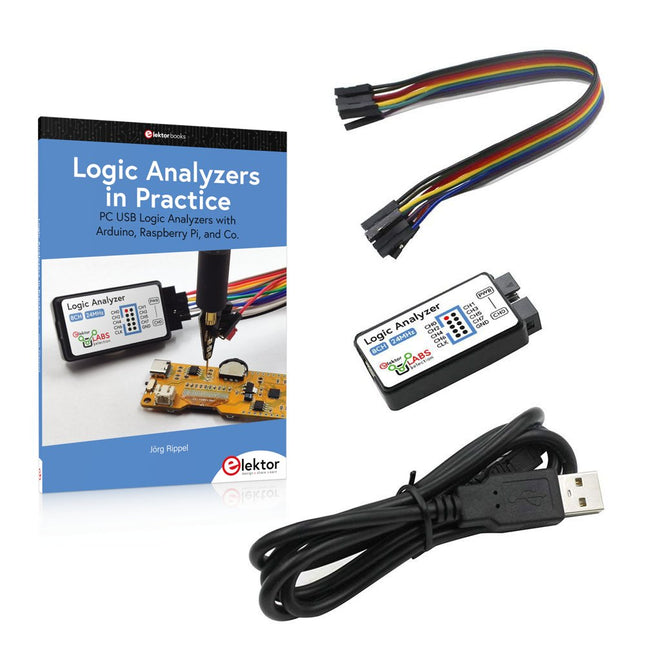
Elektor Bundles Logic Analyzers in Practice (Bundel)
Boek: Logic Analyzers in Practice Step-by-step instructions guide you through the analysis of modern protocols such as I²C, SPI, UART, RS-232, NeoPixel, WS28xx, HD44780 and 1-Wire. With the help of numerous experimental circuits based on the Raspberry Pi Pico, Arduino Uno and the Bus Pirate, you will learn the practical application of popular USB logic analyzers. All the experimental circuits presented in this book have been fully tested and are fully functional. The necessary program listings are included – no special programming or electronics knowledge is required for these circuits. The programming languages used are MicroPython and C along with the development environments Thonny and Arduino IDE. This book uses several models of flexible and widely available USB logic analyzers and shows the strengths and weaknesses of each price range. You will learn about the criteria that matter for your work and be able to find the right device for you. Whether Arduino, Raspberry Pi or Raspberry Pi Pico, the example circuits shown allow you to get started quickly with protocol analysis and can also serve as a basis for your own experiments. After reading this book, you will be familiar with all the important terms and contexts, conduct your own experiments, analyze protocols independently, culminating in a comprehensive knowledge set of digital signals and protocols. USB Logic Analyzer (8-ch, 24 MHz) Deze USB Logic Analyzer is een 8-kanaals logic analyzer met elke ingang bedoeld voor het op twee manieren opnemen van analoge data. Hij is perfect voor het debuggen en analyseren van signalen zoals I²C, UART, SPI, CAN en 1-Wire. De analyzer bemonstert een digitale ingang die is aangesloten op een te testen apparaat (DUT) met een hoge bemonsteringssnelheid. De aansluiting op de PC gaat via USB. Specificaties Kanalen 8 digitale kanalen Maximale bemonsteringssnelheid 24 MHz Maximale ingangsspanning 0 V ~ 5 V Bedrijfstemperatuur 0°C ~ 70°C Ingangsimpedantie 1 MΩ || 10 pF Ondersteunde protocollen I²C, SPI, UART, CAN, 1-wire, enz. PC-aansluiting USB Afmetingen 55 x 28 x 14 mm Downloads Software Deze bundel bevat: Boek "Logic Analyzers in Practice" (normale prijs: € 35) USB Logic Analyzer (8-kanaals, 24 MHz) (normale prijs: € 20) USB-kabel Jumper Draad Lintkabel
€ 54,95€ 39,95Beste prijs
-

Elektor Bundles Mikrocontroller-Praxiskurs für Arduino-Einsteiger (Bundle)
Mit dem Elektor Arduino Nano Trainingsboard (MCCAB) eigene Projekte realisieren Der Mikrocontroller ist das wohl faszinierendste Teilgebiet der Elektronik, denn aufgrund der Vielzahl von Funktionen, die er auf seinem Chip vereinigt, ist er für den Entwickler ein universelles Multi-Tool zur Realisierung seiner Projekte. Praktisch jedes Gerät des täglichen Gebrauchs wird heute von einem Mikrocontroller gesteuert. Für einen elektronischen Laien blieb es aufgrund der Komplexität bisher allerdings ein Wunschtraum, eigene Ideen mit einem Mikrocontroller zu realisieren. Das Arduino-Konzept hat den Einsatz von Mikrocontrollern weitgehend vereinfacht, sodass jetzt auch Laien eigene Elektronik-Ideen mit einem Mikrocontroller verwirklichen können. Buch & Hardware im Bundle: 'Learning by Doing' Dieses im Bundle mitgelieferte Buch (im großen A4-Format) zeigt, wie man auch ohne große Erfahrung in Elektronik und Programmiersprachen eigene Projekte mit einem Mikrocontroller realisieren kann. Es ist ein Mikrocontroller-Praxiskurs für Einsteiger, denn nach einem Überblick über die Interna des Mikrocontrollers und einer Einführung in die Programmiersprache C liegt der Schwerpunkt des Kurses auf den praktischen Übungen. Der Leser eignet sich die erforderlichen Kenntnisse durch 'Learning by Doing' an: in dem umfangreichen Praxisteil mit 12 Projekten und 46 Übungen wird das im vorderen Teil des Buches Gelernte mit vielen Beispielen unterlegt. Die Übungen sind dabei so aufgebaut, dass der Bearbeiter eine Aufgabenstellung erhält, die er mit seinem im Theorieteil des Buches aufgebauten Wissen löst. Für jede Übung gibt es anschließend eine ausführlich erklärte und kommentierte Musterlösung, die dem Bearbeiter bei Problemen weiterhilft und die er mit seiner eigenen Lösung vergleichen kann. Arduino IDE In der Arduino IDE, einer Software-Entwicklungsumgebung, die kostenlos auf den eigenen PC heruntergeladen werden kann und die das gesamte Softwarepaket enthält, das für ein eigenes Mikrocontroller-Projekt benötigt wird, schreibt der Bearbeiter mit dem Editor der IDE seine Programme („Apps“) in der Programmiersprache C. Der in die Arduino IDE integrierte Compiler übersetzt sie in die Bits und Bytes, die der Mikrocontroller versteht und die dann über ein USB-Kabel in den Speicher des Mikrocontrollers auf dem Elektor Arduino Nano Trainingsboard (MCCAB) geladen werden. Externe Sensoren, Motoren oder Baugruppen abfragen oder steuern Das Elektor Arduino Nano Trainingsboard (MCCAB) enthält neben einem Mikrocontrollermodul Arduino Nano alle für die Übungen benötigten Bauteile wie Leuchtdioden, Schalter, Taster, akustische Signalgeber usw. Auch externe Sensoren, Motoren oder Baugruppen können mit diesem Mikrocontroller-Übungssystem abgefragt oder gesteuert werden. Technische Daten (Arduino Nano Trainingsboard MCCAB) Stromversorgung Über die USB-Verbindung des zur Erstellung der Programme sowieso angeschlossenen PCs oder ein externes Netzteil (nicht im Lieferumfang enthalten) Betriebsspannung +5 Vcc Eingangsspannung Alle Eingänge 0 V bis +5 V VX1 und VX2 +8 V bis +12 V (nur bei Verwendung eines externen Netzteils) Mikrocontrollermodul Arduino Nano Hardwareperipherie LCD 2x16 Zeichen Potenziometer P1 & P2 JP3: Auswahl der Betriebsspannung von P1 & P2 Verteiler SV4: Verteiler für die BetriebsspannungenSV5, SV6: Verteiler für die Ein-/Ausgänge des Mikrocontrollers Schalter und Taster RESET-Taster auf dem Arduino Nano-Modul6x Tastschalter K1 … K66x Schiebeschalter S1 … S6JP2: Verbindung der Schalter mit den Eingängen des Mikrocontrollers Summer Piezo-Summer Buzzer1 mit Steckbrücke auf JP6 Leuchtanzeigen LED L auf dem Arduino Nano-Modul, verbunden mit GPIO D1311x LED: Zustandsanzeige für die Ein-/AusgängeJP6: Verbindung der LEDs LD10 … LD20 mit den GPIOs D2 … D12 Serielle SchnittstellenSPI & I²C JP4: Auswahl des Signals an Pin X der SPI-Steckerleiste SV12SV9 bis SV12: SPI-Interface (3,3 V/5 V) bzw. I²C-Interface Schaltausgang für externe Geräte SV1, SV7: Schaltausgang (maximal +24 V/160 mA, extern zugeführt)SV2: 2x13 Pins zum Anschluss externer Module 3x3 LED-Matrix (9 rote LEDs) SV3: Spalten der 3x3 LED-Matrix (Ausgänge D6 … D8)JP1: Verbindung der Reihen mit den GPIOs D3 … D5 Software Library MCCABLib Steuerung der Hardware-Komponenten (Schalter, Taster, Leuchtdioden, 3x3 LED-Matrix, Summer) auf dem MCCAB Trainingsboard Betriebstemperatur bis +40 °C Abmessungen 100 x 100 x 20 mm Technische Daten (Arduino Nano) Mikrocontroller ATmega328P Architektur AVR Betriebsspannung 5 V Flashspeicher 32 KB, davon 2 KB vom Bootloader belegt SRAM 2 KB Taktfrequenz 16 MHz Analoge IN-Pins 8 EEPROM 1 KB DC-Strom pro I/O-Pin 40 mA an einem I/O-Pin, insgesamt maximal 200 mA an allen Pins gemeinsam Eingangsspannung 7-12 V Digitale I/O-Pins 22 (6 davon sind PWM-fähig) PWM-Ausgänge 6 Stromverbrauch 19 mA Abmessungen 18 x 45 mm Gewicht 7 g Lieferumfang Elektor Arduino Nano MCCAB Trainingsboard Arduino Nano Buch: Mikrocontroller-Praxiskurs für Arduino-Einsteiger
€ 139,95€ 119,95Beste prijs
-
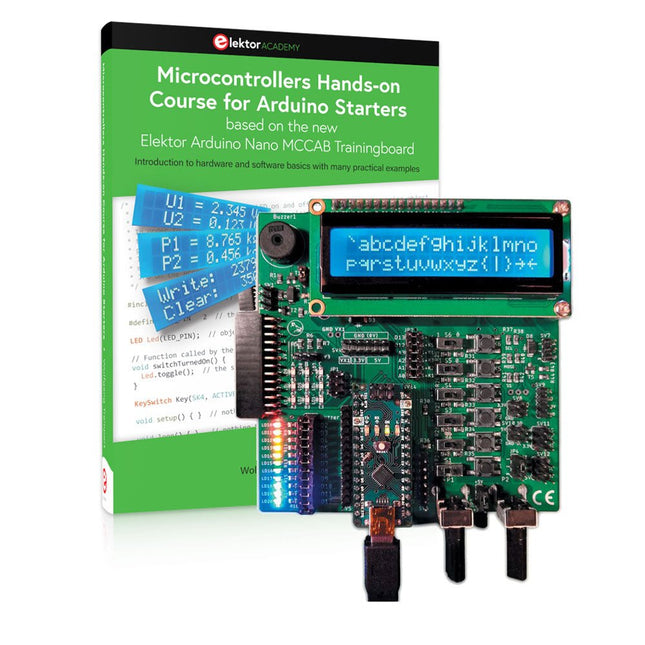
Elektor Bundles Microcontrollers Hands-on Course for Arduino Starters (Bundel)
Bouw uw eigen projecten met het Elektor Arduino Nano MCCAB Training Board De microcontroller is waarschijnlijk het meest fascinerende onderwerp van de moderne elektronica. Door de veelheid aan functies die hij op zijn chip combineert is het een universeel multi-tool voor ontwikkelaars om hun projecten mee te bouwen. Vrijwel elk dagelijks gebruikt apparaat wordt tegenwoordig bestuurd door een microcontroller. Voor een elektronica-leek is het realiseren van de eigen ideeën met een microcontroller echter tot nu toe een utopie gebleven vanwege de complexiteit ervan. Het Arduino-concept heeft het gebruik van microcontrollers sterk vereenvoudigd, zodat zelfs onervaren starters nu hun eigen elektronica ideeën kunnen realiseren met een microcontroller. Book & Hardware in de bundel: 'Leren door te doen' Het boek, dat ook in de bundel zit, leert ons hoe je zelfs zonder veel ervaring met elektronica en programmeertalen je eigen projecten met een microcontroller kunt bouwen. Het is een echte hands-on cursus microcontrollers voor starters. Want na een beschrijving van het inwendige van de microcontroller en een introductie in de programmeertaal C, ligt de focus van de cursus op praktische oefeningen. De lezer bouwt de nodige kennis op met 'leren door te doen': in het uitgebreide praktische gedeelte van het boek, met 12 projecten en 46 oefeningen, wordt het geleerde in het voorste deel van het boek met veel voorbeelden onderbouwd. Elke oefening wordt gevolgd door een uitgewerkt voorbeeld met uitleg en toelichting, wat de lezer helpt om de vraagstukken op te lossen en met de eigen oplossing te vergelijken. Arduino IDE De Arduino IDE is een software ontwikkelomgeving die gratis op de eigen pc kan worden gedownload, en die alle software bevat die nodig is voor uw eigen microcontroller-projecten. U schrijft de programma's ('apps') met de editor van de IDE in de programmeertaal C. En U vertaalt ze naar bits en bytes die de microcontroller begrijpt met behulp van de ingebouwde compiler van de Arduino IDE. En kunt ze vervolgens via een USB-kabel laden naar het geheugen van de microcontroller op het Elektor Arduino MCAB Nano Training Board. Externe sensoren, motoren of schakelingen checken of besturen Naast een Arduino Nano microcontroller module bevat het Elektor Arduino Nano MCCAB Training Board ook alle componenten die nodig zijn voor de oefeningen, zoals LED’s, schakelaars, drukknoppen, buzzer enz. Ook externe sensoren, motoren of modules kunnen worden gecheckt of bestuurd met dit microcontroller-trainingssysteem. Specificaties (Arduino Nano Training Board MCCAB) Voeding Via de USB-aansluiting van de aangesloten pc of een externe voeding (niet inbegrepen) Spanning +5 Vcc Ingangsspanning Alle ingangen 0 V tot +5 V VX1 en VX2 +8 V tot +12 V (alleen bij gebruik van een externe voeding) Hardware LCD 2x16 karakters Potentiometer P1 & P2 JP3: Selectie van de werkspanning van P1 & P2 Verdelers SV4: Verdeler voor de werkspanningenSV5, SV6: Verdelers voor de in-/uitgangen van de microcontroller Schakelaars en knoppen RESET knop op de Arduino Nano module; 6x drukknop schakelaars K1 ... K6; 6x Schuifschakelaars S1 ... S6; JP2: Jumper van de schakelaars met de ingangen van de microcontroller Buzzer Piezo buzzer ‘Buzzer1’ met jumper op JP6 Indicator LED’s 11 x LED: Status indicator voor de ingangen/uitgangen LED L op de Arduino Nano module, aangesloten op GPIO D13 JP6; Aansluiting van LED's LD10 ... LD20 met GPIO's D2 ... D12 Seriële interfacesSPI & I²C JP4: Selectie van het signaal op pin X van de SPI-connector SV12 SV9 naar SV12: SPI-interface (3,3 V/5 V) of I²C-interface Uitgangen voor externe apparaten SV1, SV7: Geschakelde uitgang (maximaal +24 V/160 mA, extern aangesloten) SV2: 2x13 pinnen voor aansluiting van externe modules 3x3 LED matrix(9 rode LED's) SV3: Kolommen van de 3x3 LED matrix (uitgangen D6 ... D8) JP1: Verbinding van de rijen met de GPIO's D3 ... D5 Software MCCABLib library Controle van hardware componenten (schakelaars, knoppen, LED's, 3x3 LED matrix, buzzer) op het MCCAB Training Board Werktemperatuur Tot +40 °C Afmetingen 100 x 100 x 20 mm Specificaties (Arduino Nano) Microcontroller ATmega328P Architectuur AVR Spanning 5 V Flash memory 32 KB, waarvan 2 KB gebruikt door de bootloader SRAM 2 KB Kloksnelheid 16 MHz Analoge IN Pinnen 8 EEPROM 1 KB DC stroom per I/O-pin 40 mA op één I/O-pin, totaal maximaal 200 mA op alle pinnen samen Ingangsspanning 7-12 V Digitale I/O-pinnen 22 (waarvan 6 PWM) PWM Uitgangen 6 Stroomverbruik 19 mA Afmetingen 18 x 45 mm Gewicht 7 g Inbegrepen Elektor Arduino Nano MCCAB Training Board Arduino Nano Boek: Microcontrollers Hands-on Course for Arduino Starters
€ 139,95€ 119,95Beste prijs
-
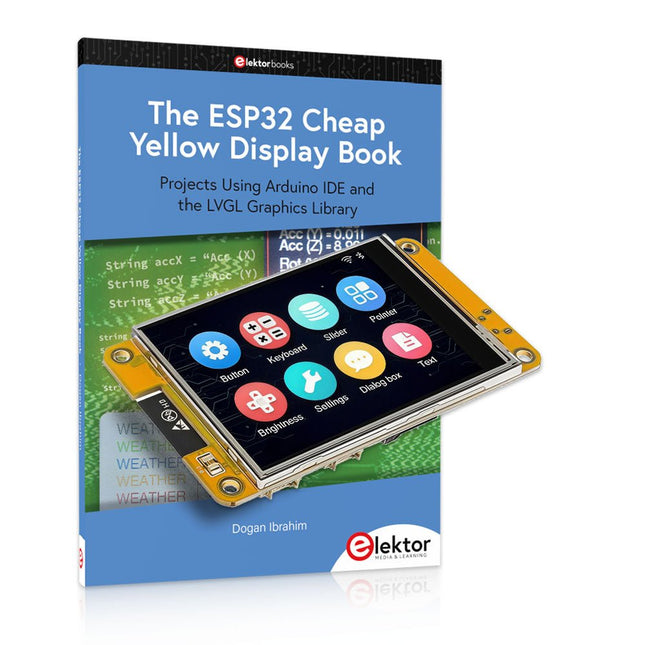
Elektor Bundles The ESP32 Cheap Yellow Display Bundel
Meer dan 40 volledig geteste ESP32-projecten met Arduino IDE en de LVGL grafische bibliotheek Deze bundel bevat de ESP32 Cheap Yellow Display (CYD) – een compact ontwikkelbord dat een standaard ESP32-microcontroller combineert met een TFT-kleurendisplay van 320 x 240 pixels. Het bord beschikt ook over meerdere aansluitingen voor GPIO, seriële communicatie (TX/RX), voeding en aarde. Het ingebouwde display is een groot voordeel, omdat gebruikers hiermee complexe, grafische projecten kunnen maken zonder dat er externe LCD's of displays nodig zijn. Het bijbehorende boek introduceert de hardware en de ingebouwde aansluitingen van het CYD-bord in detail. Het biedt een reeks projecten van beginners- tot gevorderdenniveau, ontwikkeld met de populaire Arduino IDE 2.0. Zowel basis grafische functies als de krachtige LVGL grafische bibliotheek worden behandeld, met praktische projecten die elke aanpak illustreren. Alle meegeleverde projecten zijn volledig getest en klaar voor gebruik. Het boek bevat blokdiagrammen, circuitschema's, complete codelijsten en stapsgewijze uitleg. Met de LVGL-bibliotheek kunnen lezers moderne, kleurrijke grafische interfaces maken met behulp van widgets zoals knoppen, labels, schuifregelaars, kalenders, toetsenborden, grafieken, tabellen, menu's, animaties en meer. ESP32 Cheap Yellow Display Board Dit ontwikkelbord (ook bekend als "Cheap Yellow Display") wordt aangedreven door de ESP-WROOM-32, een dual-core MCU met geïntegreerde Wi-Fi- en Bluetooth-mogelijkheden. Het werkt op een hoofdfrequentie tot 240 MHz, met 520 KB SRAM, 448 KBROM en 4 MB Flash-geheugen. Het bord is voorzien van een 2,8-inch scherm met een resolutie van 240 x 320 en resistieve aanraking. Bovendien bevat het bord een achtergrondverlichtingsbesturingscircuit, aanraakbesturingscircuit, luidsprekeraandrijfcircuit, lichtgevoelig circuit en RGB-LED-besturingscircuit. Het biedt ook een TF-kaartsleuf, seriële interface, DHT11 temperatuur- en vochtigheidssensorinterface en extra IO-poorten. De module ondersteunt ontwikkeling in Arduino IDE, ESP-IDE, MicroPython en Mixly. Toepassingen Beeldoverdracht voor Smart Home-apparaat Draadloze bewaking Slimme landbouw Draadloze QR-herkenning Signaal van draadloos positioneringssysteem En andere IoT-toepassingen Specificaties Microcontroller ESP-WROOM-32 (Dual-core MCU met geïntegreerde Wi-Fi en Bluetooth) Frequentie Tot 240 MHz (rekenkracht is maximaal 600 DMIPS) SRAM 520 KB ROM 448 KB Flash 4 MB Bedrijfsspanning 5 V Stroomverbruik ca. 115 mA Display 2,8" TFT-kleurenscherm (240 x 320) Touch Resistief Touch Driver chip ILI9341 Afmetingen 50 x 86 mm Gewicht 50 g Downloads GitHub Deze bundel bevat: The ESP32 Cheap Yellow Display Book (normale prijs: € 35) ESP32 Cheap Yellow Display Board (normale prijs: € 25) 1x ESP32 Dev Board met 2,8" display en acryl-behuizing 1x Touchpen 1x Aansluitkabel 1x USB-kabel
€ 59,95€ 49,95Beste prijs


-

, van Lobna Belarbi Elektor's Raspberry Pi-bundels: van geschikt voor beginners tot geavanceerde gebruikers
Find the Perfect Raspberry Pi Bundle for Your Skill Level Whether you're a beginner eager to explore the world of Raspberry Pi or an advanced...
-

, van Clemens Valens Werk nauwkeurig met de Andonstar digitale microscoop AD409
Andonstar digitale microscopen worden gewaardeerd om hun betaalbaarheid en goede prestaties. Laten we eens kijken naar de AD409 digitale microscoop.

