Deze bundel bevat:
Boek: Get Started with the NXP FRDM-MCXN947 Development Board (normale prijs: € 40)
NXP FRDM-MCXN947 Development Board (normale prijs: € 30)
Boek: Get Started with the NXP FRDM-MCXN947 Development Board
Projecten ontwikkelen op het gebied van connectiviteit, graphics, machine learning, motorbesturing en sensoren
Dit (Engelse) boek gaat over het gebruik van de FRDM-MCXN947 Development Board, ontwikkeld door NXP Semiconductors. Het integreert de duale Arm Cortex-M33, werkend op maximaal 150 MHz. Ideaal voor industriële, IoT- en machine learning-toepassingen. Het beschikt over Hi-Speed USB, CAN 2.0, I³C en 10/100 Ethernet. Het bord bevat een ingebouwde MCU-Link debugger, FlexI/O voor LCD-besturing en dual-bank flash voor lees-terwijl-schrijftaken, met ondersteuning voor grote externe seriële geheugens.
Een van de belangrijke kenmerken van het ontwikkelbord is de geïntegreerde eIQ Neutron Neural Processing Unit (NPU), wat gebruikers in staat stelt om AI-gebaseerde projecten te ontwikkelen. Het ontwikkelbord ondersteunt ook Arduino Uno header pins, waardoor het compatibel is met veel Arduino shields, een mikroBUS-connector voor MikroElektronika Click Boards en een Pmod-connector.
Een van de voordelen van de FRDM-MCXN947 development board is dat het verschillende ingebouwde debug probes bevat, waarmee programmeurs hun programma's kunnen debuggen door direct met de MCU te communiceren. Met behulp van de debugger kunnen programmeurs stap voor stap door een programma gaan, breakpoints invoegen, variabelen bekijken en wijzigen, enzovoort.
In het boek zijn veel werkende en geteste projecten ontwikkeld met behulp van de populaire MCUXpresso IDE en de SDK met verschillende sensoren en actuatoren. Het gebruik van de populaire CMSIS-DSP-bibliotheek wordt ook uitgelegd met verschillende veelgebruikte matrixbewerkingen.
De in het boek verstrekte projecten kunnen zonder enige aanpassingen in veel toepassingen worden gebruikt. Alternatief kunnen lezers hun projecten baseren op de projecten die in het boek worden gegeven tijdens de ontwikkeling van hun eigen projecten.
NXP FRDM-MCXN947 Development Board
De FRDM-MCXN947 is een compact en veelzijdig ontwikkelboard ontworpen voor snelle prototyping met MCX N94 en N54 microcontrollers. Het beschikt over industriestandaard headers voor eenvoudige toegang tot de I/O's van de MCU, geïntegreerde open-standaard seriële interfaces, extern flashgeheugen en een onboard MCU-Link debugger.
Specificaties
Microcontroller
MCX-N947 Dual Arm Cortex-M33-cores @ 150 MHz elk met geoptimaliseerde prestatie-efficiëntie, tot 2 MB dual-bank flitser met optioneel volledig ECC RAM, externe flitser
Versnellers: neurale verwerkingseenheid, PowerQuad, Smart DMA, enz.
Geheugenuitbreiding
*DNP MicroSD-kaartsleuf
Connectiviteit
Ethernet Phy en connector
HS USB-C-connectoren
SPI/I²C/UART-connector (PMOD/mikroBUS, DNP)
WiFi-connector (PMOD/mikroBUS, DNP)
CAN-FD-zendontvanger
Foutopsporing
Ingebouwde MCU-Link-foutopsporing met CMSIS-DAP
JTAG/SWD-connector
Sensor
P3T1755 I³C/I²C temperatuursensor, touchpad
Uitbreidingsopties
Arduino Header (met FRDM-uitbreidingsrijen)
FRDM-koptekst
FlexIO/LCD-header
SmartDMA/camerakop
Pmod *DNP
mikroBUS
Gebruikersinterface
RGB-gebruikers-LED, plus reset-, ISP- en wakeup-knoppen
Inbegrepen
1x FRDM-MCXN947 Development Board
1x USB-C kabel
1x Quick Start Guide
Downloads
Datasheet
Block diagram
Het Motorino bord is een uitbreidingsbord om tot 16 PWM-gestuurde 5V-Servo-motoren aan te sturen en te gebruiken. De bijgeleverde klokgenerator zorgt voor een zeer nauwkeurig PWM-signaal en een zeer nauwkeurige positionering. Het bord heeft 2 ingangen voor een spanning van 4,8 V tot 6 V die gebruikt kan worden voor maximaal 11 A. Met deze ingang is een perfecte stroomvoorziening altijd gegarandeerd en zijn zelfs grotere projecten geen probleem. De voeding loopt direct over de Motorino die zorgt voor een aansluiting voor spanning, massa en aansturing. Met de ingebouwde condensator wordt de spanning gebufferd wat een plotselinge spanningsval bij een hoge belasting voorkomt. Maar er is ook de mogelijkheid om een andere condensator aan te sluiten. De besturing en het programmeren kan, zoals gebruikelijk, met de Arduino. Handleidingen en code voorbeelden maken een snelle introductie voor beginners mogelijk. Speciale kenmerken 16 Kanalen, eigen klok generator Input 1 Coaxiale voedingsconnector 5,5 / 2,1 mm, 4,8-6 V / 5 A max Input 2 Schroef-terminal, 4,8-6 V / 6 A max Communicatie 16 x PWM Compatibel met Arduino Uno, Mega en wellicht meer microcontroller met Arduino-compatibele pinout Afmetingen 69 x 24 x 56 mm Werkingssfeer Bord, Handleiding, Winkelverpakking
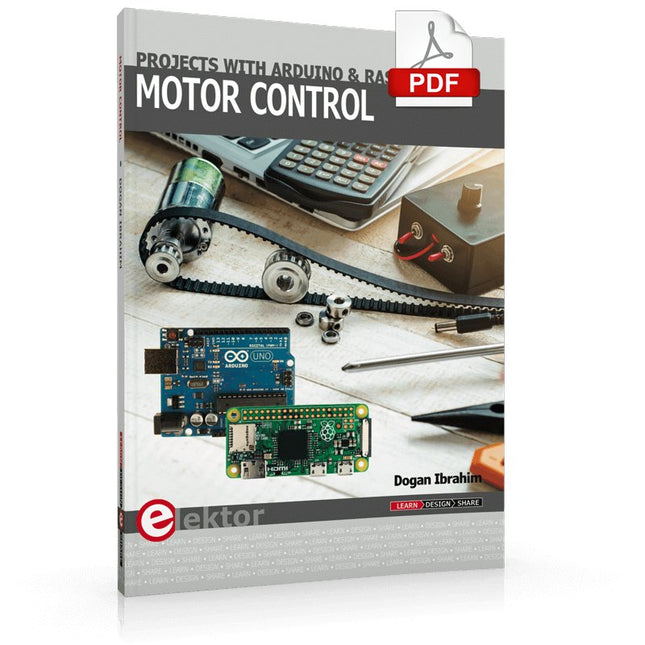
This book is about DC electric motors and their use in Arduino and Raspberry Pi Zero W based projects. The book includes many tested and working projects where each project has the following sub-headings:
Title of the project
Description of the project
Block diagram
Circuit diagram
Project assembly
Complete program listing of the project
Full description of the program
The projects in the book cover the standard DC motors, stepper motors, servo motors, and mobile robots. The book is aimed at students, hobbyists, and anyone else interested in developing microcontroller based projects using the Arduino Uno or the Raspberry Pi Zero W.
One of the nice features of this book is that it gives complete projects for remote control of a mobile robot from a mobile phone, using the Arduino Uno as well as the Raspberry Pi Zero W development boards. These projects are developed using Wi-Fi as well as the Bluetooth connectivity with the mobile phone. Readers should be able to move a robot forward, reverse, turn left, or turn right by sending simple commands from a mobile phone. Full program listings of all the projects as well as the detailed program descriptions are given in the book. Users should be able to use the projects as they are presented, or modify them to suit to their own needs.
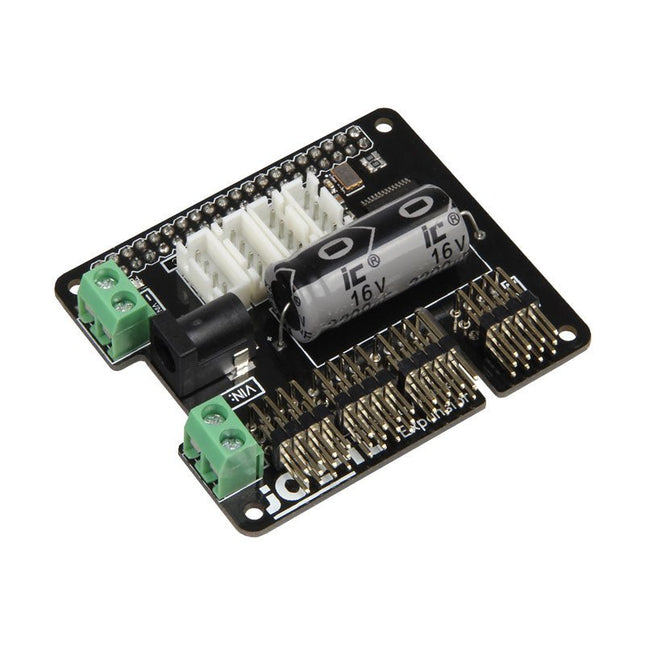
The MotoPi is an extension-board to control and use up to 16 PWM-controlled 5 V servo motors. The board can be additional powered by a voltage between 4.8 V and 6 V so a perfect supply is always guaranteed and even larger projects can be powered. With the additional power supply and the integrated Analog-Digital-Converter, new possibilities can be reached. An additional power supply per motor is not required anymore because all connections (Voltage, Ground, Control) are directly connected to the board. The control and the programing can be directly done, as usual, on the Raspberry Pi. Special features 16 Channels, own clock generator, Inkl. Analog Digital Converter Input 1 Coaxial power connector 5.5 / 2.1 mm, 5 V / 6 A max Input 2 Screw terminal, 4.8-6 V / 6 A max Compatible with Raspberry Pi A+, B+, 2B, 3B Dimensions 65 x 56 x 24 mm Scope of supply Board, manual, fixing material
De LuckFox Pico Ultra is een compacte single-board computer (SBC) die wordt aangestuurd door de Rockchip RV1106G3-chipset, ontworpen voor AI-verwerking, multimedia en low-power embedded-toepassingen.
Hij is uitgerust met een ingebouwde 1 TOPS NPU, waardoor hij ideaal is voor edge AI-werklasten. Met 256 MB RAM, 8 GB onboard eMMC-opslag, geïntegreerde wifi en ondersteuning voor de LuckFox PoE-module levert het bord zowel prestaties als veelzijdigheid in een breed scala aan use cases.
De LuckFox Pico Ultra draait op Linux en ondersteunt verschillende interfaces, waaronder MIPI CSI, RGB LCD, GPIO, UART, SPI, I²C en USB. Dit biedt een eenvoudig en efficiënt ontwikkelplatform voor toepassingen in smart home, industriële besturing en IoT.
Specificaties
Chip
Rockchip RV1106G3
Processor
Cortex A7 1,2 GHz
Neurale netwerkprocessor (NPU)
1 TOPS, ondersteunt int4, int8, int16
Beeldprocessor (ISP)
Max. invoer 5M @30fps
Geheugen
256 MB DDR3L
WiFi + Bluetooth
2,4GHz WiFi-6 Bluetooth 5.2/BLE
Camera-interface
MIPI CSI 2-lane
DPI-interface
RGB666
PoE-interface
IEEE 802.3af PoE
Luidsprekerinterface
MX1,25 mm
USB
USB 2.0-host/apparaat
GPIO
30 GPIO pinnen
Ethernet
10/100M Ethernet-controller en ingebedde PHY
Standaardopslagmedium
eMMC (8 GB)
Inbegrepen
1x LuckFox Pico Ultra W
1x LuckFox PoE module
1x IPX 2.4G 2 db-antenne
1x USB-A naar USB-C kabel
1x Schroevenpakket
Downloads
Wiki
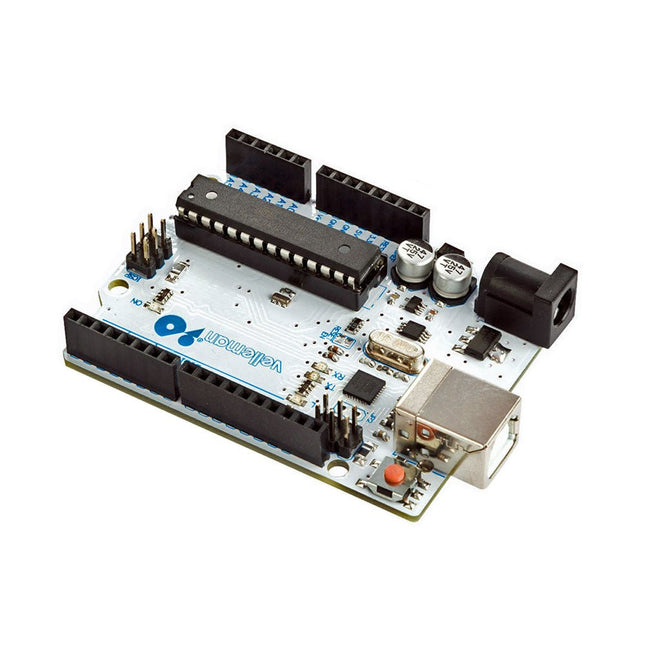
Het ATmega328 Uno Development Board (compatibel met Arduino Uno) is een microcontrollerbord gebaseerd op de ATmega328.
Hij heeft 14 digitale in-/uitgangspinnen (waarvan 6 kunnen worden gebruikt als PWM-uitgangen), 6 analoge ingangen, een 16 MHz keramische resonator, een USB-aansluiting, een stroomaansluiting, een ICSP-header en een resetknop.
Het bevat alles wat nodig is om de microcontroller te ondersteunen; sluit hem aan op een computer met een USB-kabel of voorzie hem van stroom met een AC-naar-DC-adapter of batterij om aan de slag te gaan.
Specificaties
Microcontroller
ATmega328
Bedrijfsspanning
5 V gelijkstroom
Ingangsspanning (aanbevolen)
7-12 V gelijkstroom
Ingangsspanning (limieten)
6-20 V gelijkstroom
Digitale I/O-pinnen
14 (waarvan 6 PWM-uitvoer leveren)
Analoge ingangspinnen
6
SRAM
2 kB (ATmega328)
EEPROM
1 kB (ATmega328)
Flash-geheugen
32 kB (ATmega328) waarvan 0,5 kB gebruikt door bootloader
Kloksnelheid
16 MHz
Downloads
Manual
The FRDM-MCXN947 is a compact and versatile development board designed for rapid prototyping with MCX N94 and N54 microcontrollers. It features industry-standard headers for easy access to the MCU's I/Os, integrated open-standard serial interfaces, external flash memory, and an onboard MCU-Link debugger.
Specificaties
Microcontroller
MCX-N947 Dual Arm Cortex-M33 cores @ 150 MHz each with optimized performance efficiency, up to 2 MB dual-bank flash with optional full ECC RAM, External flash
Accelerators: Neural Processing Unit, PowerQuad, Smart DMA, etc.
Memory Expansion
*DNP Micro SD card socket
Connectivity
Ethernet Phy and connector
HS USB-C connectors
SPI/I²C/UART connector (PMOD/mikroBUS, DNP)
WiFi connector (PMOD/mikroBUS, DNP)
CAN-FD transceiver
Debug
On-board MCU-Link debugger with CMSIS-DAP
JTAG/SWD connector
Sensor
P3T1755 I³C/I²C Temp Sensor, Touch Pad
Expansion Options
Arduino Header (with FRDM expansion rows)
FRDM Header
FlexIO/LCD Header
SmartDMA/Camera Header
Pmod *DNP
mikroBUS
User Interface
RGB user LED, plus Reset, ISP, Wakeup buttons
Inbegrepen
1x FRDM-MCXN947 Development Board
1x USB-C Cable
1x Quick Start Guide
Downloads
Datasheet
Block diagram
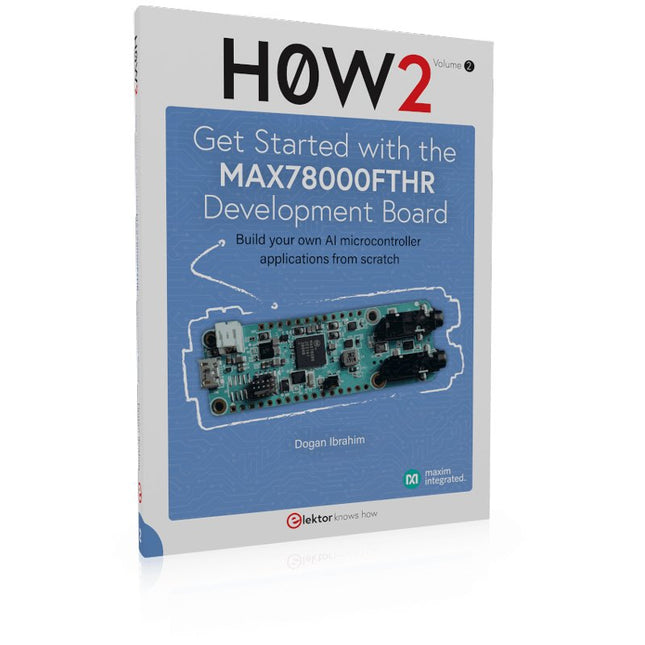
Build your own AI microcontroller applications from scratch
The MAX78000FTHR from Maxim Integrated is a small development board based on the MAX78000 MCU. The main usage of this board is in artificial intelligence applications (AI) which generally require large amounts of processing power and memory. It marries an Arm Cortex-M4 processor with a floating-point unit (FPU), convolutional neural network (CNN) accelerator, and RISC-V core into a single device. It is designed for ultra-low power consumption, making it ideal for many portable AI-based applications.
This book is project-based and aims to teach the basic features of the MAX78000FTHR. It demonstrates how it can be used in various classical and AI-based projects. Each project is described in detail and complete program listings are provided. Readers should be able to use the projects as they are, or modify them to suit their applications. This book covers the following features of the MAX78000FTHR microcontroller development board:
Onboard LEDs and buttons
External LEDs and buttons
Using analog-to-digital converters
I²C projects
SPI projects
UART projects
External interrupts and timer interrupts
Using the onboard microphone
Using the onboard camera
Convolutional Neural Network
The OKdo E1 is an ultra-low-cost Development Board based on the NXP LPC55S69JBD100 dual-core Arm Cortex-M33 microcontroller. The E1 board is perfect for Industrial IoT, building control and automation, consumer electronics, general embedded and secure applications. Features Processor with Arm TrustZone, Floating Point Unit (FPU) and Memory Protection Unit (MPU) CASPER Crypto co-processor to enable hardware acceleration for certain asymmetric cryptographic algorithms PowerQuad Hardware Accelerator for fixed and floating point DSP functions SRAM Physical Unclonable Function (PUF) for key generation, storage and reconstruction PRINCE module for real-time encryption and decryption of flash data AES-256 and SHA2 engines Up to Nine Flexcomm interfaces. Each Flexcomm interface can be selected by software to be a USART, SPI, I²C, and I²S interface USB 2.0 High-Speed Host/Device controller with on-chip PHY USB 2.0 Full-Speed Host/Device controller with on-chip PHY Up to 64 GPIOs Secure digital input/output (SD/MMC and SDIO) card interface Specifications LPC55S69JBD100 640kbyte flash microcontroller In-built CMSIS-DAP v1.0.7 debugger based on LPC11U35 Internal PLL support up to 100MHz operation, 16MHz can be mounted for full 150MHz operation. SRAM 320kB 32kHz crystal for real-time clock 4 user switches 3-colour LED User USB connector 2-off 16-way expansion connectors UART over USB virtual COM port
The EC200U-EU C4-P01 development board features the EC200U-EU LTE Cat 1 wireless communication module, offering a maximum data rate of up to 10 Mbps for downlink and 5 Mbps for uplink. It supports multi-mode and multi-band communication, making it a cost-effective solution.
The board is designed in a compact and unified form factor, compatible with the Quectel multi-mode LTE Standard EC20-CE. It includes an onboard USB-C port, allowing for easy development with just a USB-C cable.
Additionally, the board is equipped with a 40-pin GPIO header that is compatible with most Raspberry Pi HATs.
Kenmerken
Equipped with EC200U-EU LTE Cat 1 wireless communication module, multi-mode & multi-band support
Onboard 40-Pin GPIO header, compatible with most Raspberry Pi HATs
5 LEDs for indicating module operating status
Supports TCP, UDP, PPP, NITZ, PING, FILE, MQTT, NTP, HTTP, HTTPS, SSL, FTP, FTPS, CMUX, MMS protocols, etc.
Supports GNSS positioning (GPS, GLONASS, BDS, Galileo, QZSS)
Onboard Nano SIM card slot and eSIM card slot, dual card single standby
Onboard MIPI connector for connecting MIPI screen and is fully compatible with Raspberry Pi peripherals
Onboard camera connector, supports customized SPI cameras with a maximum of 300,000 pixels
Provides tools such as QPYcom, Thonny IDE plugin, and VSCode plugin, etc. for easy learning and development
Comes with online development resources and manual (example in QuecPython)
Specificaties
Applicable Regions
Europe, Middle East, Africa, Australia, New Zealand, Brazil
LTE-FDD
B1, B3, B5, B7, B8, B20, B28
LTE-TDD
B38, B40, B41
GSM / GPRS / EDGE
GSM: B2, B3, B5, B8
GNSS
GPS, GLONASS, BDS, Galileo, QZSS
Bluetooth
Bluetooth 4.2 (BR/EDR)
Wi-Fi Scan
2.4 GHz 11b (Rx)
CAT 1
LTE-FDD: DL 10 Mbps; UL 5 Mbps
LTE-TDD: DL 8.96 Mbps; UL 3.1 Mbps
GSM / GPRS / EDGE
GSM: DL 85.6 Kbps; UL 85.6 Kbps
USB-C Port
Supports AT commands testing, GNSS positioning, firmware upgrading, etc.
Communication Protocol
TCP, UDP, PPP, NITZ, PING, FILE, MQTT, NTP, HTTP, HTTPS, SSL, FTP, FTPS, CMUX, MMS
SIM Card
Nano SIM and eSIM, dual card single standby
Indicator
P01: Module Pin 1, default as EC200A-XX PWM0
P05: Module Pin 5, NET_MODE indicator
SCK1: SIM1 detection indicator, lights up when SIM1 card is inserted
SCK2: SIM2 detection indicator, lights up when SIM2 card is inserted
PWR: Power indicator
Buttons
PWK: Power ON/OFF
RST: Reset
BOOT: Forcing into firmware burning mode
USB ON/OFF: USB power consumption detection switch
Antenna Connectors
LTE main antenna + DIV / WiFi (scanning only) / Bluetooth antenna + GNSS antenna
Operating Temperature
−30~+75°C
Storage Temperature
−45~+90°C
Downloads
Wiki
Quectel Resources